







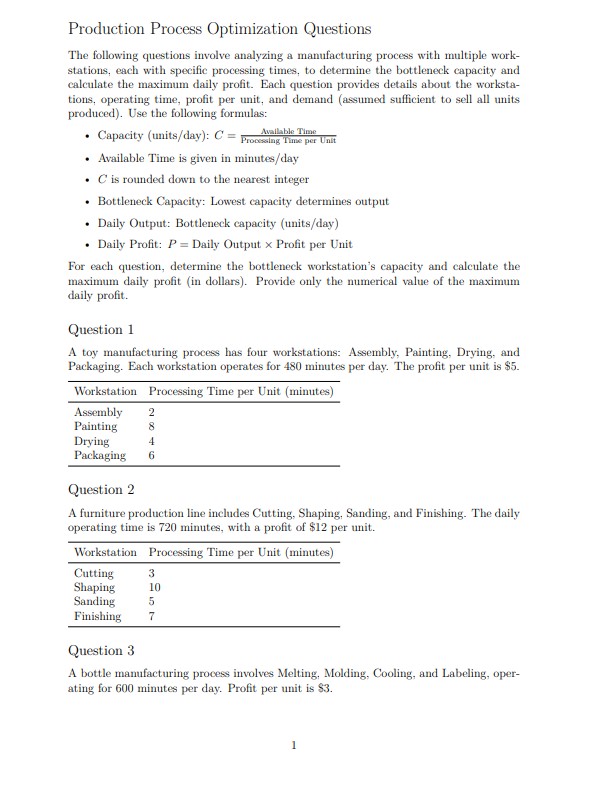
Question: 4 The following questions involve analyzing a manufacturing process with multiple work - stations, each with specific processing times, to determine the bottleneck capacity and
The following questions involve analyzing a manufacturing process with multiple work
stations, each with specific processing times, to determine the bottleneck capacity and
calculate the maximum daily profit. Each question provides details about the worksta
tions, operating time, profit per unit, and demand assumed sufficient to sell all units
produced Use the following formulas:
Capacity unitsday: C Avallable Time Procossing Time per Unit
Available Time is given in minutesday
C is rounded down to the nearest integer
Bottleneck Capacity: Lowest capacity determines output
Daily Output: Bottleneck capacity unitsday
Daily Profit: P Daily Output xx Profit per Unit
For each question, determine the bottleneck workstation's capacity and calculate the
maximum daily profit in dollars Provide only the numerical value of the maximum
daily profit.
Question
A toy manufacturing process has four workstations: Assembly, Painting, Drying, and
Packaging. Each workstation operates for minutes per day. The profit per unit is $
Question
A furniture production line includes Cutting, Shaping, Sanding, and Finishing. The daily
operating time is minutes, with a profit of $ per unit.
Question
A bottle manufacturing process involves Melting, Molding, Cooling, and Labeling, oper
ating for minutes per day. Profit per unit is $
Question
A circuit board production has Solder Paste Application, Component Placement, Reflow
Soldering, and Inspection. Operating time is minutes per day, with a profit of $
per unit.
Question
A textile process includes Spinning, Weaving, Dyeing, and Cutting, with minutes of
daily operation. Profit per unit is $
Question
A food packaging line has Mixing, Filling, Sealing, and Boxing, operating for minutes
per day. Profit per unit is $
Question
A metal fabrication process includes Cutting, Bending, Welding, and Polishing, with
minutes of operation daily. Profit per unit is $
Question
A glassware production line has Forming, Annealing, Inspecting, and Packing, operating
for minutes per day. Profit per unit is $
Question
A paper product process includes Pulping, Pressing, Drying, and Cutting, with
minutes of daily operation. Profit per unit is $
Question
A ceramic tile production has Mixing, Pressing, Glazing, and Firing, operating for
minutes per day. Profit per unit is $
Step by Step Solution
There are 3 Steps involved in it
1 Expert Approved Answer
Step: 1 Unlock

Question Has Been Solved by an Expert!
Get step-by-step solutions from verified subject matter experts
Step: 2 Unlock
Step: 3 Unlock
 Study Help