







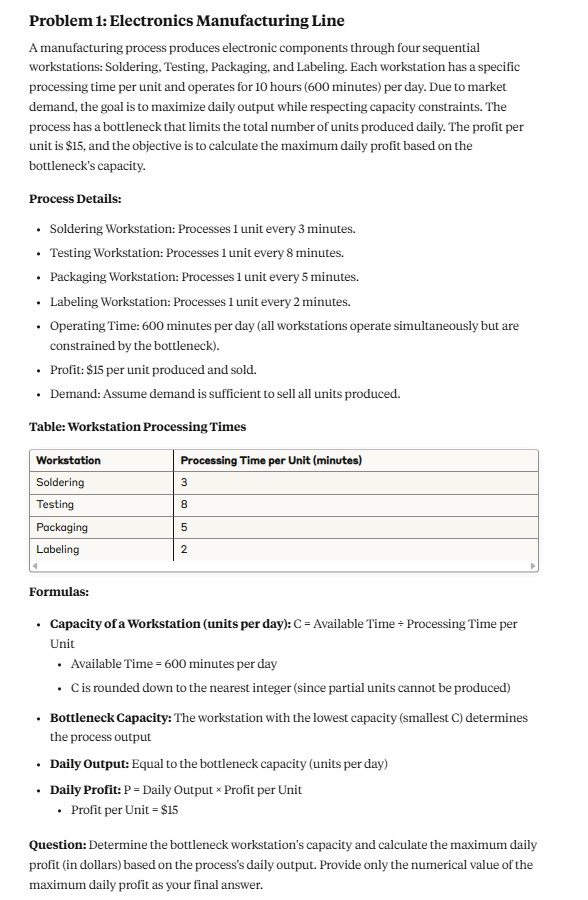
Question: Problem 1 : Electronics Manufacturing Line A manufacturing process produces electronic components through four sequential workstations: Soldering, Testing, Packaging, and Labeling. Each workstation has a
Problem
: Electronics Manufacturing Line
A manufacturing process produces electronic components through four sequential workstations: Soldering, Testing, Packaging, and Labeling. Each workstation has a specific processing time per unit and operates for
day. Due market demand, the goal maximize daily output while respecting capacity constraints. The process has a bottleneck that the total number units produced daily. The profit per unit
$
the objective calculate the maximum daily profit based the bottleneck's capacity.
Process Details:
Workstation: Processes
every
Workstation: Processes
every
Workstation: Processes
every
Workstation: Processes
every
Time:
per day
all workstations operate simultaneously but are constrained the bottleneck
:
$
unit produced and sold.
: Assume demand sufficient sell all units produced.
Table: Workstation Processing Times
Formulas:
a Workstation
units per day
:
mathrm
Time
div
Time per Unit
Time
per day
rounded down the nearest integer
since partial units cannot produced
Capacity: The workstation with the lowest capacity
smallest
the process output
Output: Equal the bottleneck capacity
units per day
Profit:
Output
times
per Unit
per Unit
$
Question: Determine the bottleneck workstation's capacity and calculate the maximum daily profit
dollars
the process's daily output. Provide only the numerical value the maximum daily profit your final answer.
Problem : Textile Production Process
A textile manufacturing process produces fabric through three sequential workstations:
Weaving, Dyeing, and Quality Control. Each workstation has a specific processing time per
unit and operates for hours minutes per day. Due market demand, the goal
maximize daily output while respecting capacity constraints. The process has a bottleneck
that the total number units produced daily. The profit per unit $ and the
objective calculate the maximum daily profit based the bottleneck's capacity.
Process Details:
Weaving Workstation: Processes unit every minutes.
Dyeing Workstation: Processes unit every minutes.
Quality Control Workstation: Processes unit every minutes.
Operating Time: minutes per day workstations operate simultaneously but are
constrained the bottleneck
Profit: $ per unit produced and sold.
Demand: Assume demand sufficient sell all units prod A food processing facility produces packaged meals throu
Step by Step Solution
There are 3 Steps involved in it
1 Expert Approved Answer
Step: 1 Unlock

Question Has Been Solved by an Expert!
Get step-by-step solutions from verified subject matter experts
Step: 2 Unlock
Step: 3 Unlock
 Study Help