







Question: 4 Trade Agreements (Chapter 11, will NOT be Graded) (a) Consider the world consisting of three countries: Canada, US and Japan. Producers in country i
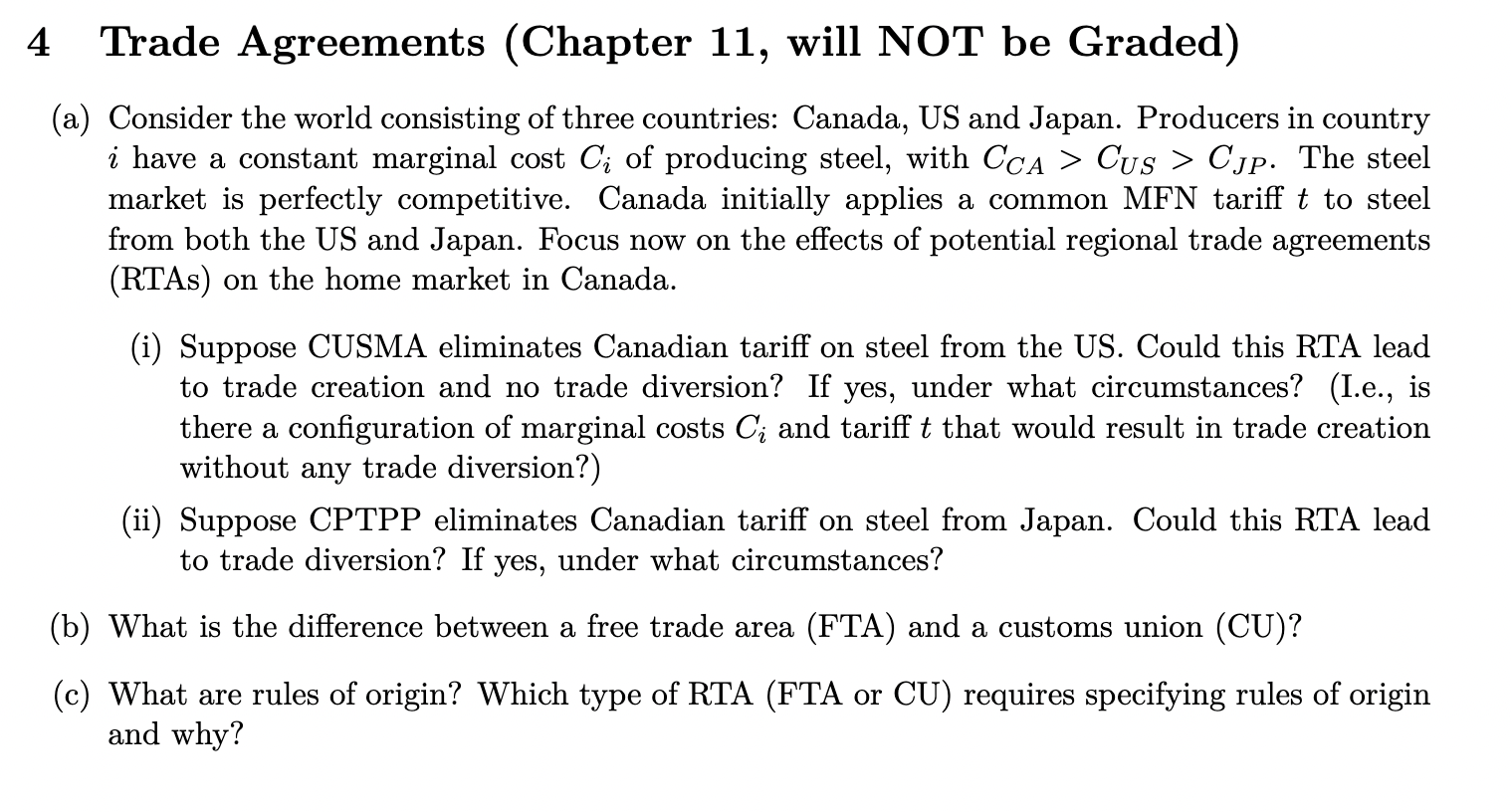
4 Trade Agreements (Chapter 11, will NOT be Graded) (a) Consider the world consisting of three countries: Canada, US and Japan. Producers in country i have a constant marginal cost Ci of producing steel, with CCA>CUS>CJP. The steel market is perfectly competitive. Canada initially applies a common MFN tariff t to steel from both the US and Japan. Focus now on the effects of potential regional trade agreements (RTAs) on the home market in Canada. (i) Suppose CUSMA eliminates Canadian tariff on steel from the US. Could this RTA lead to trade creation and no trade diversion? If yes, under what circumstances? (I.e., is there a configuration of marginal costs Ci and tariff t that would result in trade creation without any trade diversion?) (ii) Suppose CPTPP eliminates Canadian tariff on steel from Japan. Could this RTA lead to trade diversion? If yes, under what circumstances? (b) What is the difference between a free trade area (FTA) and a customs union (CU)? (c) What are rules of origin? Which type of RTA (FTA or CU) requires specifying rules of origin and why
Step by Step Solution
There are 3 Steps involved in it

Get step-by-step solutions from verified subject matter experts
 Study Help