







Question: 4. True or false? (+1 for each correct answer, -1 for each incorrect answer, 0 for each omitted answer) (a) f(N) = N(t(N)) entails t(N)
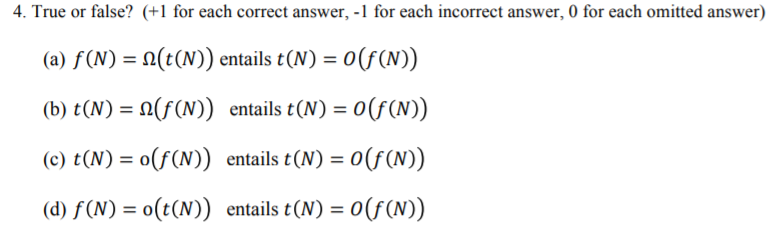
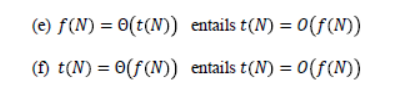

4. True or false? (+1 for each correct answer, -1 for each incorrect answer, 0 for each omitted answer) (a) f(N) = N(t(N)) entails t(N) = 0(f(n)) (b) t(N) = 2(f(n)) entails t(N) = 0 (f(n)) (c) t(N) = o(f(n)) entails t(N) = 0(f(n)) (d) f(N) = o(t(N)) entails t(N) = 0 (f(n)) @) f(N) = O(t(N)) entails t(N) = 0(f(n)) (f) t(N) = o(f(n)) entails t(N) = 0(f(n)) 6. Prove that if I(N) = o(fiN) + g(N)) and g(N) = off (N)) then I(N) = O(fN)). Hint: review how I proved another algebraic big-O property in class (4 points)
Step by Step Solution
There are 3 Steps involved in it
1 Expert Approved Answer
Step: 1 Unlock

Question Has Been Solved by an Expert!
Get step-by-step solutions from verified subject matter experts
Step: 2 Unlock
Step: 3 Unlock
 Study Help