







Question: (4) We consider a single-period model with three securities: the bank account whose price process is A(0) = A(1) = 1, and two stocks with
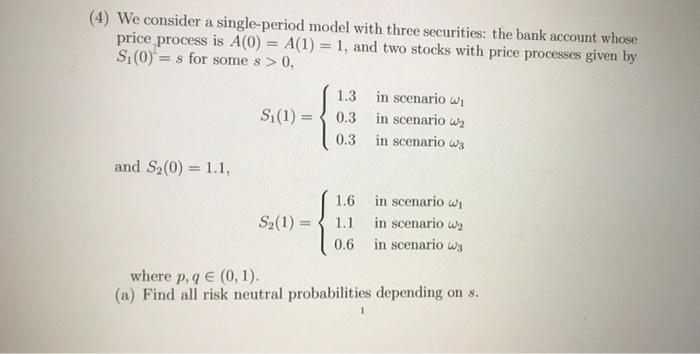
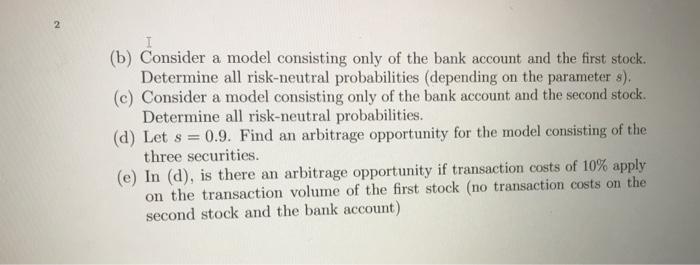
(4) We consider a single-period model with three securities: the bank account whose price process is A(0) = A(1) = 1, and two stocks with price processes given by S (0)s for some s > 0, 1.3 in scenario w S (1) = 0.3 in scenario 0.3 in scenario w3 and S(0) = 1.1, 1.6 in scenario W S2(1) 1.1 in scenario w 0.6 in scenario wa where p, q (0, 1). (a) Find all risk neutral probabilities depending on s. (b) Consider a model consisting only of the bank account and the first stock. Determine all risk-neutral probabilities (depending on the parameters). (c) Consider a model consisting only of the bank account and the second stock. Determine all risk-neutral probabilities. (d) Let s 0.9. Find an arbitrage opportunity for the model consisting of the three securities. (e) In (d), is there an arbitrage opportunity if transaction costs of 10% apply on the transaction volume of the first stock (no transaction costs on the second stock and the bank account) (4) We consider a single-period model with three securities: the bank account whose price process is A(0) = A(1) = 1, and two stocks with price processes given by S (0)s for some s > 0, 1.3 in scenario w S (1) = 0.3 in scenario 0.3 in scenario w3 and S(0) = 1.1, 1.6 in scenario W S2(1) 1.1 in scenario w 0.6 in scenario wa where p, q (0, 1). (a) Find all risk neutral probabilities depending on s. (b) Consider a model consisting only of the bank account and the first stock. Determine all risk-neutral probabilities (depending on the parameters). (c) Consider a model consisting only of the bank account and the second stock. Determine all risk-neutral probabilities. (d) Let s 0.9. Find an arbitrage opportunity for the model consisting of the three securities. (e) In (d), is there an arbitrage opportunity if transaction costs of 10% apply on the transaction volume of the first stock (no transaction costs on the second stock and the bank account)
Step by Step Solution
There are 3 Steps involved in it

Get step-by-step solutions from verified subject matter experts
 Study Help