Question: 4. What to do Complete the table after carefully reading the article. If you think that any of the fifteen issues show both similarities and
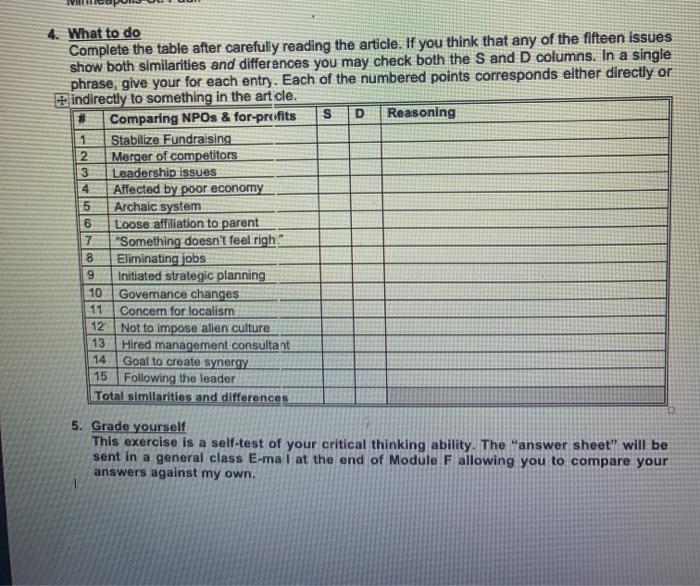
4. What to do Complete the table after carefully reading the article. If you think that any of the fifteen issues show both similarities and differences you may check both the S and D columns. In a single phrase, give your for each entry. Each of the numbered points corresponds either directly or + indirectly to something in the art icle. Comparing NPOS & for-proifits Stabilize Fundraising Merger of competitors 3 Reasoning 1 2 Leadership issues Affected by poor economy Archaic system Loose affiliation to parent "Something doesn't feel righ Eliminating jobs Initiated strategic planning 10 Govenance changes 11 Concern for localism 12 Not to impose alien culture Hired management consulta nt 14 Goal to create synergy Following the leader Total similarities and differences 4 5 6. 7 8 9 13 15
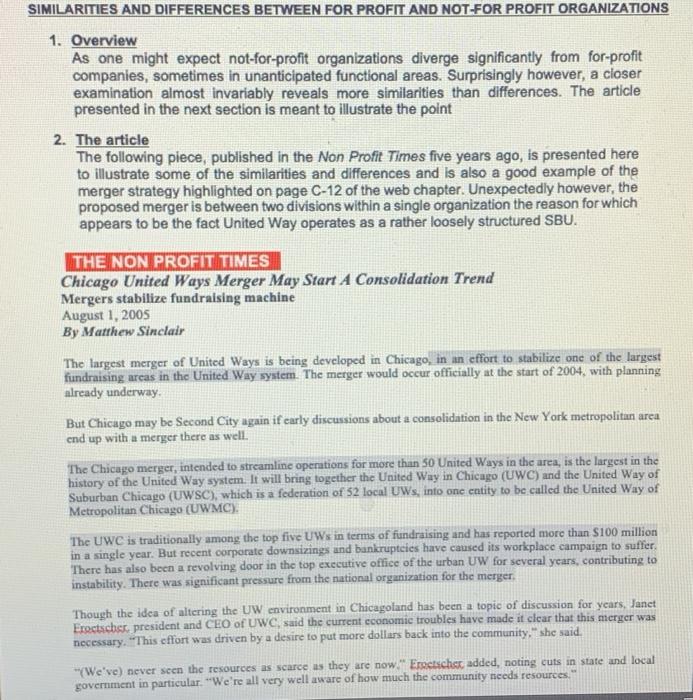
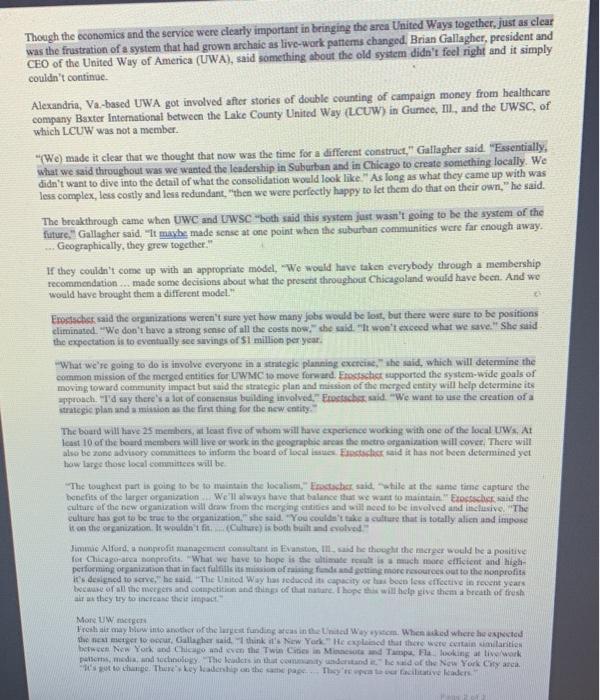
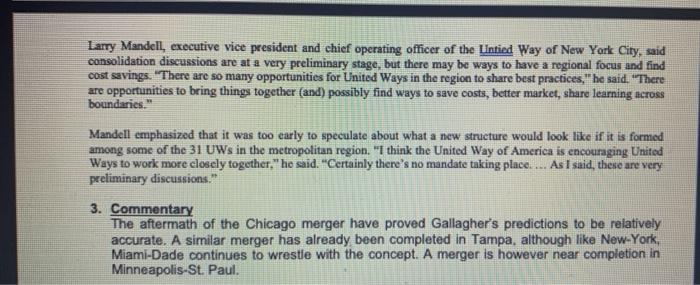
IN 4. What to do Complete the table after carefully reading the article. If you think that any of the fifteen issues show both similarities and differences you may check both the S and D columns. In a single phrase, give your for each entry. Each of the numbered points corresponds either directly or indirectly to something in the art cle. S Comparing NPOs & for-profits D Reasoning 1 Stabilize Fundraising 2 Merger of competitors 3 Leadership issues 4 Affected by poor economy 5 Archaic system 6 Loose affiliation to parent 7 "Something doesn't feel righ 8 Eliminating jobs 9 Initiated strategic planning 10 Governance changes 11 Concern for localism 12 Not to impose alien culture 13 Hired management consultant 14 Goal to create synergy 15 Following the leader Total similarities and differences 5. Grade yourself This exercise is a self-test of your critical thinking ability. The "answer sheet" will be sent in a general class E-ma i at the end of Module F allowing you to compare your answers against my own. SIMILARITIES AND DIFFERENCES BETWEEN FOR PROFIT AND NOT-FOR PROFIT ORGANIZATIONS 1. Overview As one might expect not-for-profit organizations diverge significantly from for-profit companies, sometimes in unanticipated functional areas. Surprisingly however, a closer examination almost invariably reveals more similarities than differences. The article presented in the next section is meant to illustrate the point 2. The article The following piece, published in the Non Profit Times five years ago, is presented here to illustrate some of the similarities and differences and is also a good example of the merger strategy highlighted on page C-12 of the web chapter. Unexpectedly however, the proposed merger is between two divisions within a single organization the reason for which appears to be the fact United Way operates as a rather loosely structured SBU. THE NON PROFIT TIMES Chicago United Ways Merger May Start A Consolidation Trend Mergers stabilize fundraising machine August 1, 2005 By Matthew Sinclair The largest merger of United Ways is being developed in Chicago, in an effort to stabilize one of the largest fundraising areas in the United Way system. The merger would occur officially at the start of 2004, with planning already underway But Chicago may be Second City again if carly discussions about a consolidation in the New York metropolitan area end up with a merger there as well. The Chicago merger, intended to streamline operations for more than 50 United Ways in the area, is the largest in the history of the United Way system. It will bring together the United Way in Chicago (UWC) and the United Way of Suburban Chicago (UWSC), which is a federation of 52 local UWs, into one entity to be called the United Way of Metropolitan Chicago (UWMC) The UWC is traditionally among the top five UWs in terms of fundraising and has reported more than $100 million in a single year. But recent corporate downsizings and bankruptcies have caused its workplace campaign to suffer. There has also been a revolving door in the top executive office of the urban UW for several years, contributing to instability. There was significant pressure from the national organization for the merger Though the idea of altering the UW environment in Chicagoland has been a topic of discussion for years, Janet Erotschs, president and CEO of UWC, said the current economic troubles have made it clear that this merger was necessary. "This effort was driven by a desire to put more dollars back into the community," she said. (We've never seen the resources as scarce as they are now.Eretschst, added, noting cuts in state and local government in particular. "We're all very well aware of how much the community needs resources." Though the economics and the service were clearly important in bringing the area United Ways together, just as clear was the frustration of a system that had grown archaic as live-work patterns changed. Brian Gallagher, president and CEO of the United Way of America (UWA), said something about the old system didn't feel right and it simply couldn't continue Alexandria, Va-based UWA got involved after stories of double counting of campaign money from healthcare company Baxter International between the Lake County United Way (LCUW) in Gurnee, II., and the UWSC, of which LOUW was not a member. "We made it clear that we thought that now was the time for a different construct." Gallagher said. "Essentially what we said throughout was we wanted the leadership in Suburban and in Chicago to create something locally. We didn't want to dive into the detail of what the consolidation would look like " As long as what they came up with was less complex, less costly and less redundant, then we were perfectly happy to let them do that on their own," he said. The breakthrough came when UWC and UWSC "both said this system just wasn't going to be the system of the future. Gallagher said. "It maybe made sense at one point when the suburban communities were far enough away. Geographically, they grew together." If they couldn't come up with an appropriate model, "We would have taken everybody through a membership recommendation.. made some decisions about what the present throughout Chicagoland would have been. And we would have brought them a different model." Erostaches, said the organizations weren't sure yet how many jobs would be lost, but there were stare to be positions eliminated. "We don't have a strong sense of all the costs now." she said. "It won't exceed what we save." She said the expectation is to eventually see savings of $1 million per year. "What we're going to do is involve everyone in a strategic planning exercise," she said, which will determine the common mission of the merged entities for UWMC to move forward. Erostscht supported the systems-wide goals of moving toward community impact but said the strategic plan and mission of the merged entity will help determine its approach. Td say there's a lot of consensus building involved." Frostache said. "We want to use the creation of a strategic plan and a mission as the first thing for the new entity The board will have 25 members, at least five of whom will have experience working with one of the local UWs. At least 10 of the board members will live or work in the cooraphic areas the metro organization will cover. There will also be one advisory Committees to inform the board of local lases Escach said it has not been determined yet how large those local committees will be "The toughest part is going to be to maintain the localism," Estacher said tile at the same time capture the benefits of the larger organization We'll always have that balance that we want to maintain." Etosha sant the culture at the new organization will draw from the merging entities and will need to be involved and inclusive. The culture has got to be true to the organization." she said. You couldn't take a culture that is totally alien and impose it on the organization. It wouldn't fit (Culture) is both band solved Jimmie Alford, comprofit management consultant in Evanston II. said he thought the merger would be a positive for Chicaporta nonprofits What we have to hope is the ultimate wat is a much more efficient and high performing organization that in fact fulfill its mission of training funde and getting more resources out to the nonprofit it's designed to save," he said. "The United Way educati capacity or has been less effective in cent years w of all the mergers and competition and things of that stare. I hope this will help give them a breath of trash at they try to increase their impact More UW mcg Fresh it may Now into another of the largest funding areas in the way system. Whenked where to the tour, Gallagher said think it's New York. He explained that there were certain similarities between New York and Chicago and even the Twin Citiei Mesta Tuna Fialooking a livework pams, media, wodochnology. The des interad head of the New York Cwy area 'ching. They leadership on the pape. They're attive des Larry Mandell, executive vice president and chief operating officer of the Untied Way of New York City, said consolidation discussions are at a very preliminary stage, but there may be ways to have a regional focus and find cost savings. "There are so many opportunities for United Ways in the region to share best practices," he said. "There are opportunities to bring things together (and) possibly find ways to save costs, better market, share learning across boundaries." Mandell emphasized that it was too early to speculate about what a new structure would look like if it is formed among some of the 31 UWs in the metropolitan region. "I think the United Way of America is encouraging United Ways to work more closely together," he said. "Certainly there's no mandate taking place.... As I said, these are very preliminary discussions." 3. Commentary The aftermath of the Chicago merger have proved Gallagher's predictions to be relatively accurate. A similar merger has already been completed in Tampa, although like New-York, Miami-Dade continues to wrestle with the concept. A merger is however near completion in Minneapolis-St. Paul









 Study Help