







Question: Please read the question Question : In the article Learning to Think, Thinking to Learn the author recommends using incorrect answers to deepen students'
Please read the question
Question: In the article "Learning to Think, Thinking to Learn" the author recommends using incorrect answers to deepen students' thinking. Why does she suggest this and what do you think about that strategy?
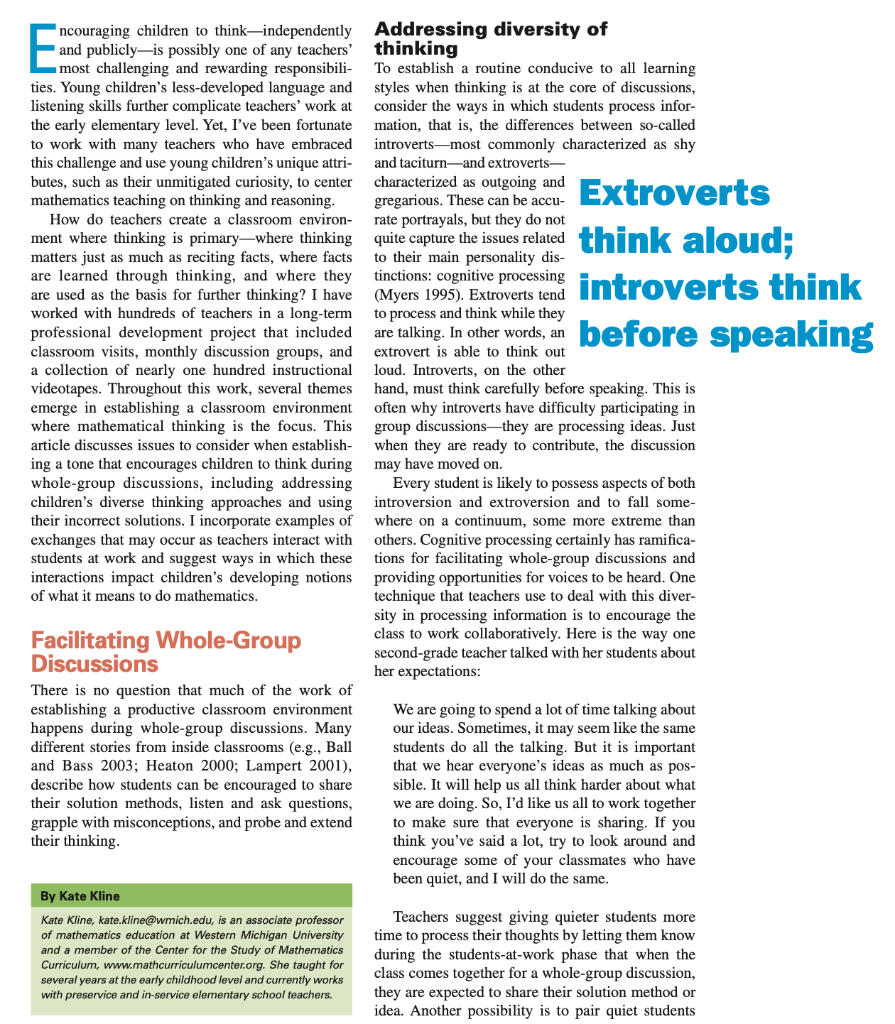
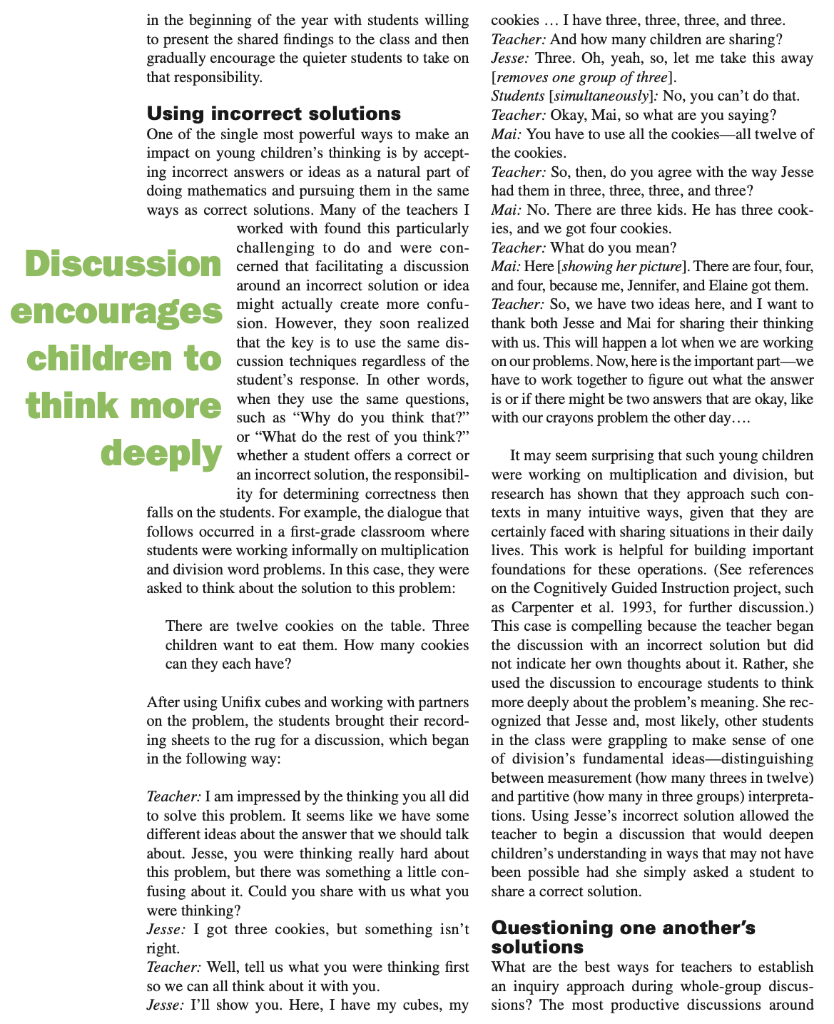
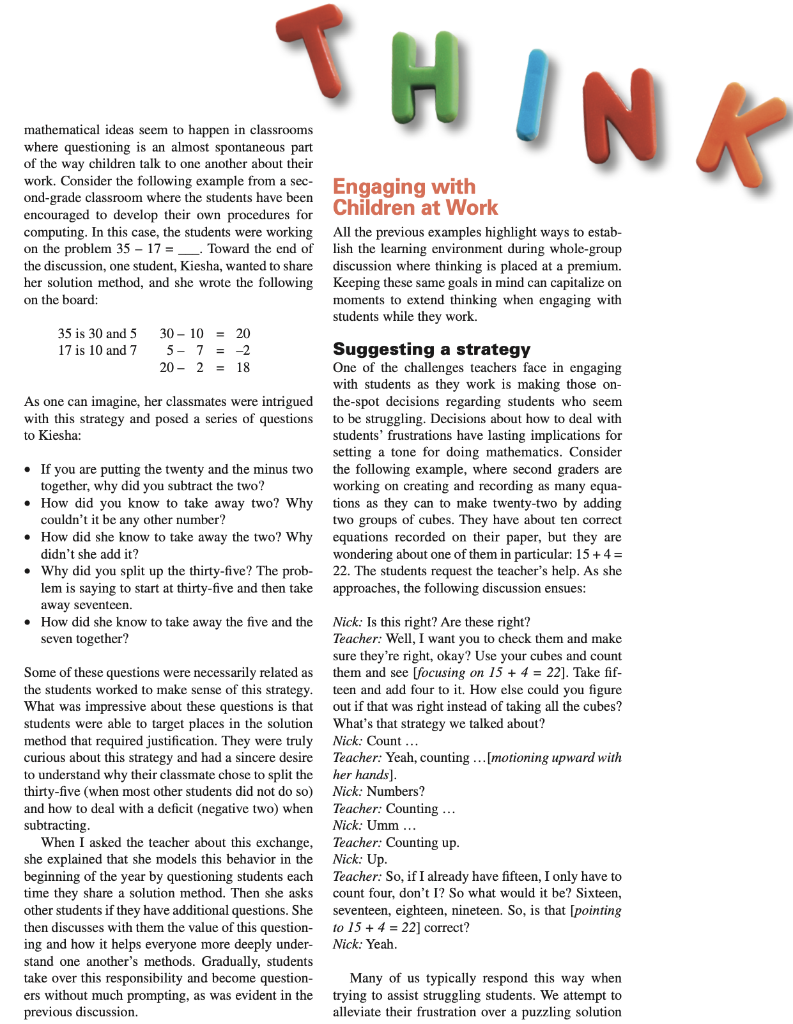
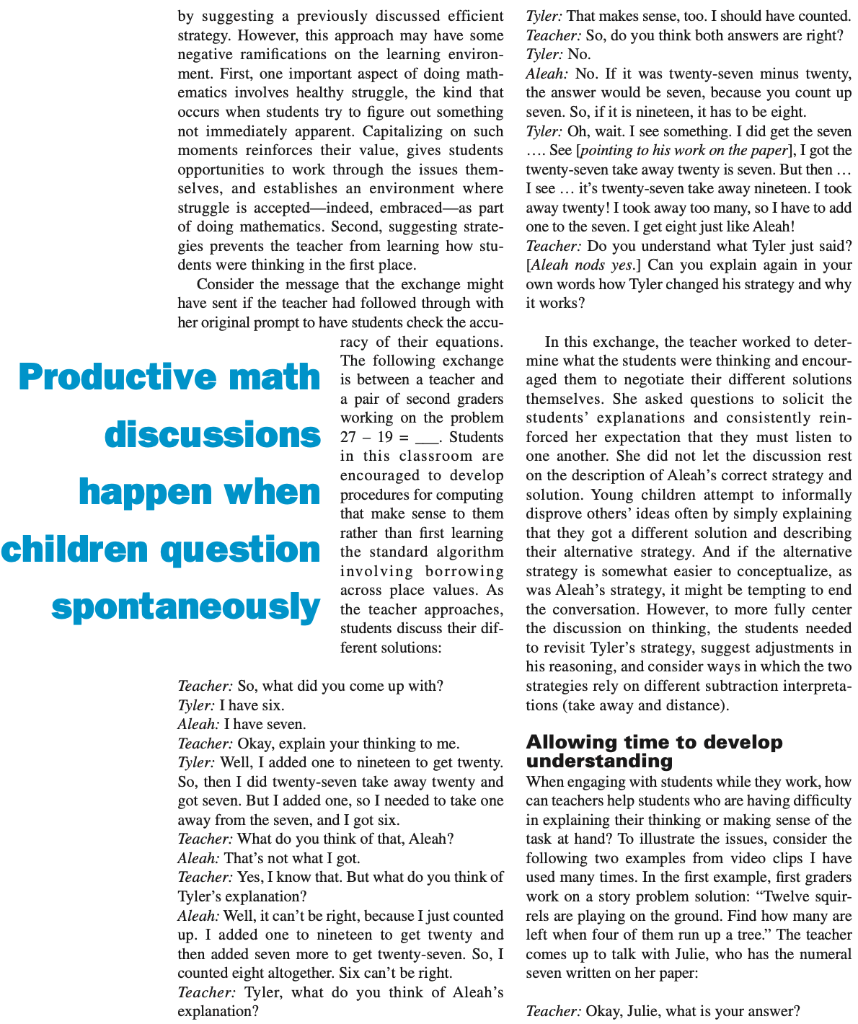
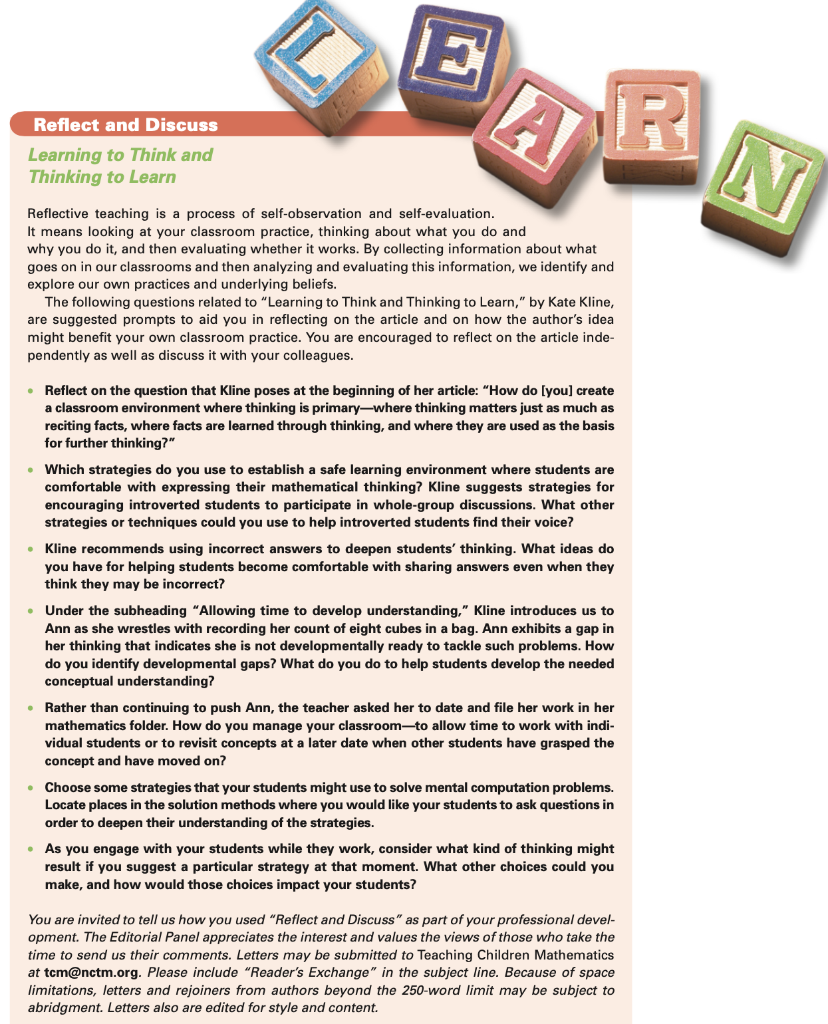
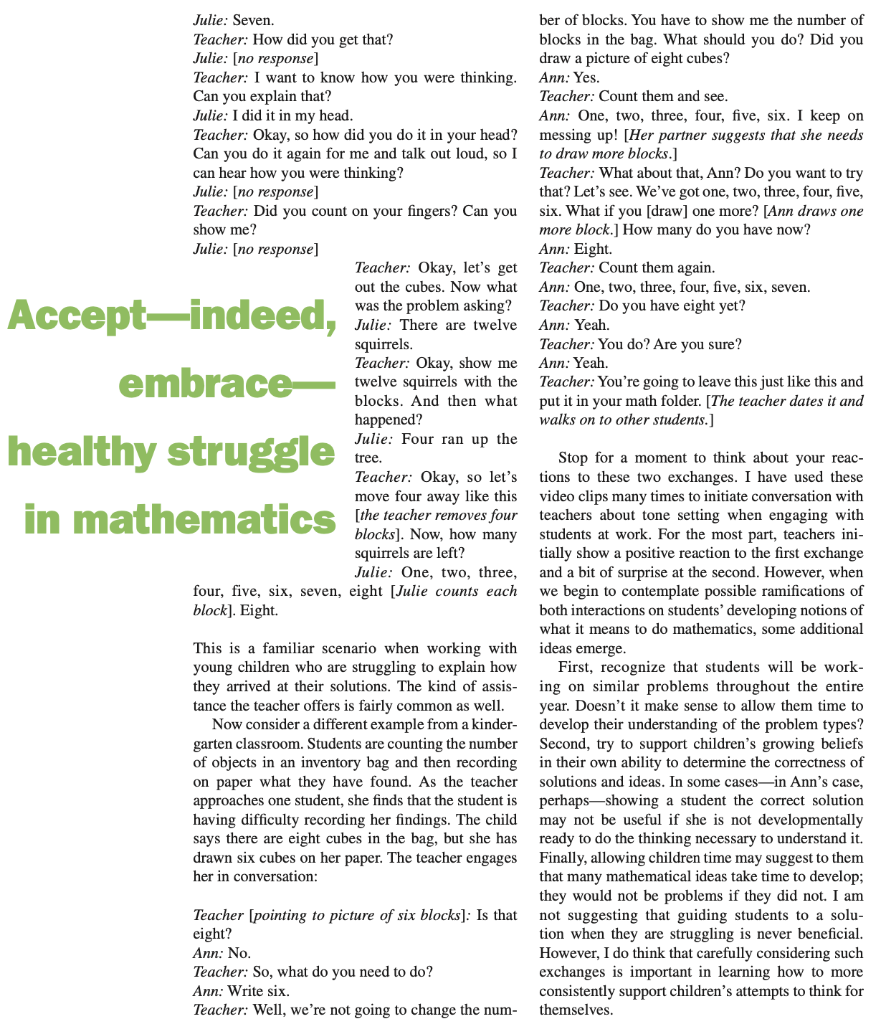
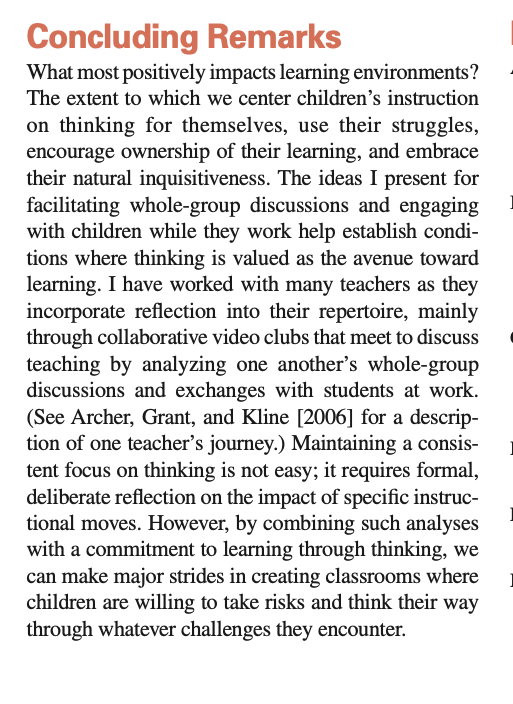
Extroverts quite capture the issues related think aloud; tinctions: cognitive processing introverts think before speaking encouraging children to thinkindependently Addressing diversity of and publiclyis possibly one of any teachers' thinking most challenging and rewarding responsibili- To establish a routine conducive to all learning ties. Young children's less-developed language and styles when thinking is at the core of discussions, listening skills further complicate teachers' work at consider the ways in which students process infor- the early elementary level. Yet, I've been fortunate mation, that is, the differences between so-called to work with many teachers who have embraced introvertsmost commonly characterized as shy this challenge and use young children's unique attri- and taciturnand extroverts- butes, such as their unmitigated curiosity, to center characterized as outgoing and mathematics teaching on thinking and reasoning. gregarious. These can be accu- How do teachers create a classroom environ- rate portrayals, but they do not ment where thinking is primary-where thinking matters just as much as reciting facts, where facts to their main personality dis- are learned through thinking, and where they are used as the basis for further thinking? I have ). tend worked with hundreds of teachers in a long-term to process and think while they professional development project that included are talking. In other words, an classroom visits, monthly discussion groups, and extrovert is able to think out a collection of nearly one hundred instructional loud. Introverts, on the other videotapes. Throughout this work, several themes hand, must think carefully before speaking. This is emerge in establishing a classroom environment often why introverts have difficulty participating in where mathematical thinking is the focus. This group discussionsthey are processing ideas. Just article discusses issues to consider when establish- when they are ready to contribute, the discussion ing a tone that encourages children to think during may have moved on. whole-group discussions, including addressing Every student is likely to possess aspects of both children's diverse thinking approaches and using introversion and extroversion and to fall some- their incorrect solutions. I incorporate examples of where on a continuum, some more extreme than exchanges that may occur as teachers interact with others. Cognitive processing certainly has ramifica- students at work and suggest ways in which these tions for facilitating whole-group discussions and interactions impact children's developing notions providing opportunities for voices to be heard. One of what it means to do mathematics. technique that teachers use to deal with this diver- sity in processing information is to encourage the class to work collaboratively. Here is the way one Facilitating Whole-Group second-grade teacher talked with her students about Discussions her expectations: There is no question that much of the work of establishing a productive classroom environment We are going to spend a lot of time talking about happens during whole-group discussions. Many our ideas. Sometimes, it may seem like the same different stories from inside classrooms (e.g., Ball students do all the talking. But it is important and Bass 2003; Heaton 2000; Lampert 2001), that we hear everyone's ideas as much as pos- describe how students can be encouraged to share sible. It will help us all think harder about what their solution methods, listen and ask questions, we are doing. So, I'd like us all to work together grapple with misconceptions, and probe and extend to make sure that everyone is sharing. If you their thinking. think you've said a lot, try to look around and encourage some of your classmates who have been quiet, and I will do the same. By Kate Kline Kate Kline, kate.kline@wmich.edu, is an associate professor Teachers suggest giving quieter students more of mathematics education at Western Michigan University time to process their thoughts by letting them know and a member of the Center for the Study of Mathematics during the students-at-work phase that when the Curriculum, www.mathcurriculumcenter.org. She taught for several years at the early childhood level and currently works class comes together for a whole-group discussion, with preservice and in-service elementary school teachers. they are expected to share their solution method or idea. Another possibility is to pair quiet students in the beginning of the year with students willing to present the shared findings to the class and then gradually encourage the quieter students to take on that responsibility. Using incorrect solutions One of the single most powerful ways to make an impact on young children's thinking is by accept- ing incorrect answers or ideas as a natural part of doing mathematics and pursuing them in the same ways as correct solutions. Many of the teachers I worked with found this particularly challenging to do and were con- cerned that facilitating a discussion around an incorrect solution or idea cookies ... I have three, three, three, and three. Teacher: And how many children are sharing? Jesse: Three. Oh, yeah, so, let me take this away [removes one group of three). Students [simultaneously]: No, you can't do that. Teacher: Okay, Mai, so what are you saying? Mai: You have to use all the cookiesall twelve of the cookies. Teacher: So, then, do you agree with the way Jesse had them in three, three, three, and three? Mai: No. There are three kids. He has three cook- ies, and we got four cookies. Teacher: What do you mean? Mai: Here (showing her picture). There are four, four, and four, because me, Jennifer, and Elaine got them. Teacher: So, we have two ideas here, and I want to thank both Jesse and Mai for sharing their thinking with us. This will happen a lot when we are working on our problems. Now, here is the important partwe have to work together to figure out what the answer is or if there might be two answers that are okay, like with our crayons problem the other day.... , that the key is to use the same dis- Discussion encourages might actually create more confu- children to cussion techniques regardless of the think more deeply student's response. In other words, when they use the same questions, such as "Why do you think that?" or "What do the rest of you think?" whether a student offers a correct an incorrect solution, the responsibil- ity for determining correctness then falls on the students. For example, the dialogue that follows occurred in a first-grade classroom where students were working informally on multiplication and division word problems. In this case, they were asked to think about the solution to this problem: There are twelve cookies on the table. Three children want to eat them. How many cookies can they each have? It may seem surprising that such young children were working on multiplication and division, but research has shown that they approach such con- texts in many intuitive ways, given that they are certainly faced with sharing situations in their daily lives. This work is helpful for building important foundations for these operations. (See references on the Cognitively Guided Instruction project, such as Carpenter et al. 1993, for further discussion.) This case is compelling because the teacher began the discussion with an incorrect solution but did not indicate her own thoughts about it. Rather, she used the discussion to encourage students to think more deeply about the problem's meaning. She rec- ognized that Jesse and, most likely, other students in the class were grappling to make sense of one of division's fundamental ideasdistinguishing between measurement (how many threes in twelve) and partitive (how many in three groups) interpreta- tions. Using Jesse's incorrect solution allowed the teacher to begin a discussion that would deepen children's understanding in ways that may not have been possible had she simply asked a student to share a correct solution. After using Unifix cubes and working with partners on the problem, the students brought their record- ing sheets to the rug for a discussion, which began in the following way: Teacher: I am impressed by the thinking you all did to solve this problem. It seems like we have some different ideas about the answer that we should talk about. Jesse, you were thinking really hard about this problem, but there was something a little con- fusing about it. Could you share with us what you were thinking? Jesse: I got three cookies, but something isn't right. Teacher: Well, tell us what you were thinking first so we can all think about it with you. Jesse: I'll show you. Here, I have my cubes, my Questioning one another's solutions What are the best ways for teachers to establish an inquiry approach during whole-group discus- sions? The most productive discussions around THINK = mathematical ideas seem to happen in classrooms where questioning is an almost spontaneous part of the way children talk to one another about their work. Consider the following example from a sec- Engaging with ond-grade classroom where the students have been encouraged to develop their own procedures for Children at Work computing. In this case, the students were working All the previous examples highlight ways to estab- on the problem 35 - 17 = _. Toward the end of lish the learning environment during whole-group the discussion, one student, Kiesha, wanted to share discussion where thinking is placed at a premium. her solution method, and she wrote the following Keeping these same goals in mind can capitalize on on the board: moments to extend thinking when engaging with students while they work. 35 is 30 and 5 30 - 10 = 20 17 is 10 and 7 5 - 7 -2 Suggesting a strategy 20 - 2 = 18 One of the challenges teachers face in engaging with students as they work is making those on- As one can imagine, her classmates were intrigued the-spot decisions regarding students who seem with this strategy and posed a series of questions to be struggling. Decisions about how to deal with to Kiesha: students' frustrations have lasting implications for setting a tone for doing mathematics. Consider If you are putting the twenty and the minus two the following example, where second graders are together, why did you subtract the two? working on creating and recording as many equa- How did you know to take away two? Why tions as they can to make twenty-two by adding couldn't it be any other number? two groups of cubes. They have about ten correct How did she know to take away the two? Why equations recorded on their paper, but they are didn't she add it? wondering about one of them in particular: 15+4 = Why did you split up the thirty-five? The prob- 22. The students request the teacher's help. As she lem is saying to start at thirty-five and then take approaches, the following discussion ensues: away seventeen How did she know to take away the five and the Nick: Is this right? Are these right? seven together? Teacher: Well, I want you to check them and make sure they're right, okay? Use your cubes and count Some of these questions were necessarily related as them and see [focusing on 15 + 4 = 22]. Take fif- the students worked to make sense of this strategy. teen and add four to it. How else could you figure What was impressive about these questions is that out if that was right instead of taking all the cubes? students were able to target places in the solution What's that strategy we talked about? method that required justification. They were truly Nick: Count... curious about this strategy and had a sincere desire Teacher: Yeah, counting ... [motioning upward with to understand why their classmate chose to split the her hands) thirty-five (when most other students did not do so) Nick: Numbers? and how to deal with a deficit (negative two) when Teacher: Counting ... subtracting. Nick: Umm... When I asked the teacher about this exchange, Teacher: Counting up. she explained that she models this behavior in the Nick: Up beginning of the year by questioning students each Teacher: So, if I already have fifteen, I only have to time they share a solution method. Then she asks count four, don't I? So what would it be? Sixteen, other students if they have additional questions. She seventeen, eighteen, nineteen. So, is that (pointing then discusses with them the value of this question- to 15 + 4 = 22] correct? ing and how it helps everyone more deeply under- Nick: Yeah. stand one another's methods. Gradually, students take over this responsibility and become question- Many of us typically respond this way when ers without much prompting, as was evident in the trying to assist struggling students. We attempt to previous discussion. alleviate their frustration over a puzzling solution Productive math discussions 27 19 = happen when procedures for computing children question spontaneously by suggesting a previously discussed efficient Tyler: That makes sense, too. I should have counted. strategy. However, this approach may have some Teacher: So, do you think both answers are right? negative ramifications on the learning environ- Tyler: No. ment. First, one important aspect of doing math- Aleah: No. If it was twenty-seven minus twenty, ematics involves healthy struggle, the kind that the answer would be seven, because you count up occurs when students try to figure out something seven. So, if it is nineteen, it has to be eight. not immediately apparent. Capitalizing on such Tyler: Oh, wait. I see something. I did get the seven moments reinforces their value, gives students .... See [pointing to his work on the paper], I got the opportunities to work through the issues them- twenty-seven take away twenty is seven. But then ... selves, and establishes an environment where I see ... it's twenty-seven take away nineteen. I took struggle is accepted-indeed, embracedas part away twenty! I took away too many, so I have to add of doing mathematics. Second, suggesting strate- one to the seven. I get eight just like Aleah! gies prevents the teacher from learning how stu- Teacher: Do you understand what Tyler just said? dents were thinking in the first place. [Aleah nods yes.] Can you explain again in your Consider the message that the exchange might own words how Tyler changed his strategy and why have sent if the teacher had followed through with it works? her original prompt to have students check the accu- racy of their equations. In this exchange, the teacher worked to deter- The following exchange mine what the students were thinking and encour- is between a teacher and aged them to negotiate their different solutions a pair of second graders themselves. She asked questions to solicit the working on the problem students' explanations and consistently rein- Students forced her expectation that they must listen to in this classroom are one another. She did not let the discussion rest encouraged to develop on the description of Aleah's correct strategy and solution. Young children attempt to informally disprove others' ideas often by simply explaining rather than first learning that they got a different solution and describing the standard algorithm their alternative strategy. And if the alternative involving borrowing strategy is somewhat easier to conceptualize, as across place values. As was Aleah's strategy, it might be tempting to end the teacher approaches, the conversation. However, to more fully center students discuss their dif- the discussion on thinking, the students needed ferent solutions: to revisit Tyler's strategy, suggest adjustments in his reasoning, and consider ways in which the two Teacher: So, what did you come up with? strategies rely on different subtraction interpreta- Tyler: I have six. tions (take away and distance). Aleah: I have seven. Teacher: Okay, explain your thinking to me. Allowing time to develop Tyler: Well, I added one to nineteen to get twenty. understanding So, then I did twenty-seven take away twenty and When engaging with students while they work, how got seven. But I added one, so I needed to take one can teachers help students who are having difficulty away from the seven, and I got six. in explaining their thinking or making sense of the Teacher: What do you think of that, Aleah? task at hand? To illustrate the issues, consider the Aleah: That's not what I got. following two examples from video clips I have Teacher: Yes, I know that. But what do you think of used many times. In the first example, first graders Tyler's explanation? work on a story problem solution: "Twelve squir- Aleah: Well, it can't be right, because I just counted rels are playing on the ground. Find how many are up. I added one to nineteen to get twenty and left when four of them run up a tree. The teacher then added seven more to get twenty-seven. So, I comes up to talk with Julie, who has the numeral counted eight altogether. Six can't be right. seven written on her paper: Teacher: Tyler, what do you think of Aleah's explanation? Teacher: Okay, Julie, what is your answer? E Reflect and Discuss Learning to Think and Thinking to Learn A R N Reflective teaching is a process of self-observation and self-evaluation. It means looking at your classroom practice, thinking about what you do and why you do it, and then evaluating whether it works. By collecting information about what goes on in our classrooms and then analyzing and evaluating this information, we identify and explore our own practices and underlying beliefs. The following questions related to "Learning to think and Thinking to Learn," by Kate Kline, are suggested prompts to aid you in reflecting on the article and on how the author's idea might benefit your own classroom practice. You are encouraged to reflect on the article inde- pendently as well as discuss it with your colleagues. . Reflect on the question that Kline poses at the beginning of her article: "How do (you) create a classroom environment where thinking is primarywhere thinking matters just as much as reciting facts, where facts are learned through thinking, and where they are used as the basis for further thinking?" Which strategies do you use to establish a safe learning environment where students are comfortable with expressing their mathematical thinking? Kline suggests strategies for encouraging introverted students to participate in whole-group discussions. What other strategies or techniques could you use to help introverted students find their voice? Kline recommends using incorrect answers to deepen students' thinking. What ideas do you have for helping students become comfortable with sharing answers even when they think they may be incorrect? Under the subheading "Allowing time to develop understanding," Kline introduces us to Ann as she wrestles with recording her count of eight cubes in a bag. Ann exhibits a gap in her thinking that indicates she is not developmentally ready to tackle such problems. How do you identify developmental gaps? What do you do to help students develop the needed conceptual understanding? Rather than continuing to push Ann, the teacher asked her to date and file her work in her mathematics folder. How do you manage your classroom-to allow time to work with indi- vidual students or to revisit concepts at a later date when other students have grasped the concept and have moved on? Choose some strategies that your students might use to solve mental computation problems. Locate places in the solution methods where you would like your students to ask questions in order to deepen their understanding of the strategies. As you engage with your students while they work, consider what kind of thinking might result if you suggest a particular strategy at that moment. What other choices could you make, and how would those choices impact your students? You are invited to tell us how you used "Reflect and Discuss" as part of your professional devel- opment. The Editorial Panel appreciates the interest and values the views of those who take the time to send us their comments. Letters may be submitted to Teaching Children Mathematics at tcm@nctm.org. Please include "Reader's Exchange" in the subject line. Because of space limitations, letters and rejoiners from authors beyond the 250-word limit may be subject to abridgment. Letters also are edited for style and content Julie: Seven Teacher: How did you get that? Julie: (no response] Teacher: I want to know how you were thinking. Can you explain that? Julie: I did it in my head. Teacher: Okay, so how did you do it in your head? Can you do it again for me and talk out loud, so I can hear how you were thinking? Julie: (no response] Teacher: Did you count on your fingers? Can you show me? Julie: (no response] Teacher: Okay, let's get out the cubes. Now what was the problem asking? Julie: There are twelve squirrels. Teacher: Okay, show me ber of blocks. You have to show me the number of blocks in the bag. What should you do? Did you draw a picture of eight cubes? Ann: Yes. Teacher: Count them and see. Ann: One, two, three, four, five, six. I keep on messing up! (Her partner suggests that she needs to draw more blocks.] Teacher: What about that, Ann? Do you want to try that? Let's see. We've got one, two, three, four, five, six. What if you (draw] one more? [Ann draws one more block.] How many do you have now? Ann: Eight. Teacher: Count them again. Ann: One, two, three, four, five, six, seven. Teacher: Do you have eight yet? Ann: Yeah. Teacher: You do? Are you sure? Ann: Yeah. Teacher: You're going to leave this just like this and put it in your math folder. [The teacher dates it and walks on to other students.] Accept-indeed, embrace twelve squirrels with the healthy struggle in mathematics blocks. And then what happened? Julie: Four ran up the tree Teacher: Okay, so let's move four away like this [the teacher removes four blocks). Now, how many squirrels are left? Julie: One, two, three, four, five, six, seven, eight (Julie counts each block]. Eight. Stop for a moment to think about your reac- tions to these two exchanges. I have used these video clips many times to initiate conversation with teachers about tone setting when engaging with students at work. For the most part, teachers ini- tially show a positive reaction to the first exchange and a bit of surprise at the second. However, when we begin to contemplate possible ramifications of both interactions on students' developing notions of what it means to do mathematics, some additional ideas emerge. This is a familiar scenario when working with young children who are struggling to explain how they arrived at their solutions. The kind of assis- tance the teacher offers is fairly common as well. Now consider a different example from a kinder- garten classroom. Students are counting the number of objects in an inventory bag and then recording on paper what they have found. As the teacher approaches one student, she finds that the student is having difficulty recording her findings. The child says there are eight cubes in the bag, but she has drawn six cubes on her paper. The teacher engages her in conversation: First, recognize that students will be work- ing on similar problems throughout the entire year. Doesn't it make sense to allow them time to develop their understanding of the problem types? Second, try to support children's growing beliefs in their own ability to determine the correctness of solutions and ideas. In some cases-in Ann's case, perhapsshowing a student the correct solution may not be useful if she is not developmentally ready to do the thinking necessary to understand it. Finally, allowing children time may suggest to them that many mathematical ideas take time to develop; they would not be problems if they did not. I am not suggesting that guiding students to a solu- tion when they are struggling is never beneficial. However, I do think that carefully considering such exchanges is important in learning how to more consistently support children's attempts to think for themselves. Teacher (pointing to picture of six blocks]: Is that eight? Ann: No. Teacher: So, what do you need to do? Ann: Write six. Teacher: Well, we're not going to change the num- Concluding Remarks What most positively impacts learning environments? The extent to which we center children's instruction on thinking for themselves, use their struggles, encourage ownership of their learning, and embrace their natural inquisitiveness. The ideas I present for facilitating whole-group discussions and engaging with children while they work help establish condi- tions where thinking is valued as the avenue toward learning. I have worked with many teachers as they incorporate reflection into their repertoire, mainly through collaborative video clubs that meet to discuss teaching by analyzing one another's whole-group discussions and exchanges with students at work. (See Archer, Grant, and Kline [2006] for a descrip- tion of one teacher's journey.) Maintaining a consis- tent focus on thinking is not easy; it requires formal, deliberate reflection on the impact of specific instruc- tional moves. However, by combining such analyses with a commitment to learning through thinking, we can make major strides in creating classrooms where children are willing to take risks and think their way through whatever challenges they encounter
Step by Step Solution
There are 3 Steps involved in it
1 Expert Approved Answer
Step: 1 Unlock

Question Has Been Solved by an Expert!
Get step-by-step solutions from verified subject matter experts
Step: 2 Unlock
Step: 3 Unlock
 Study Help