







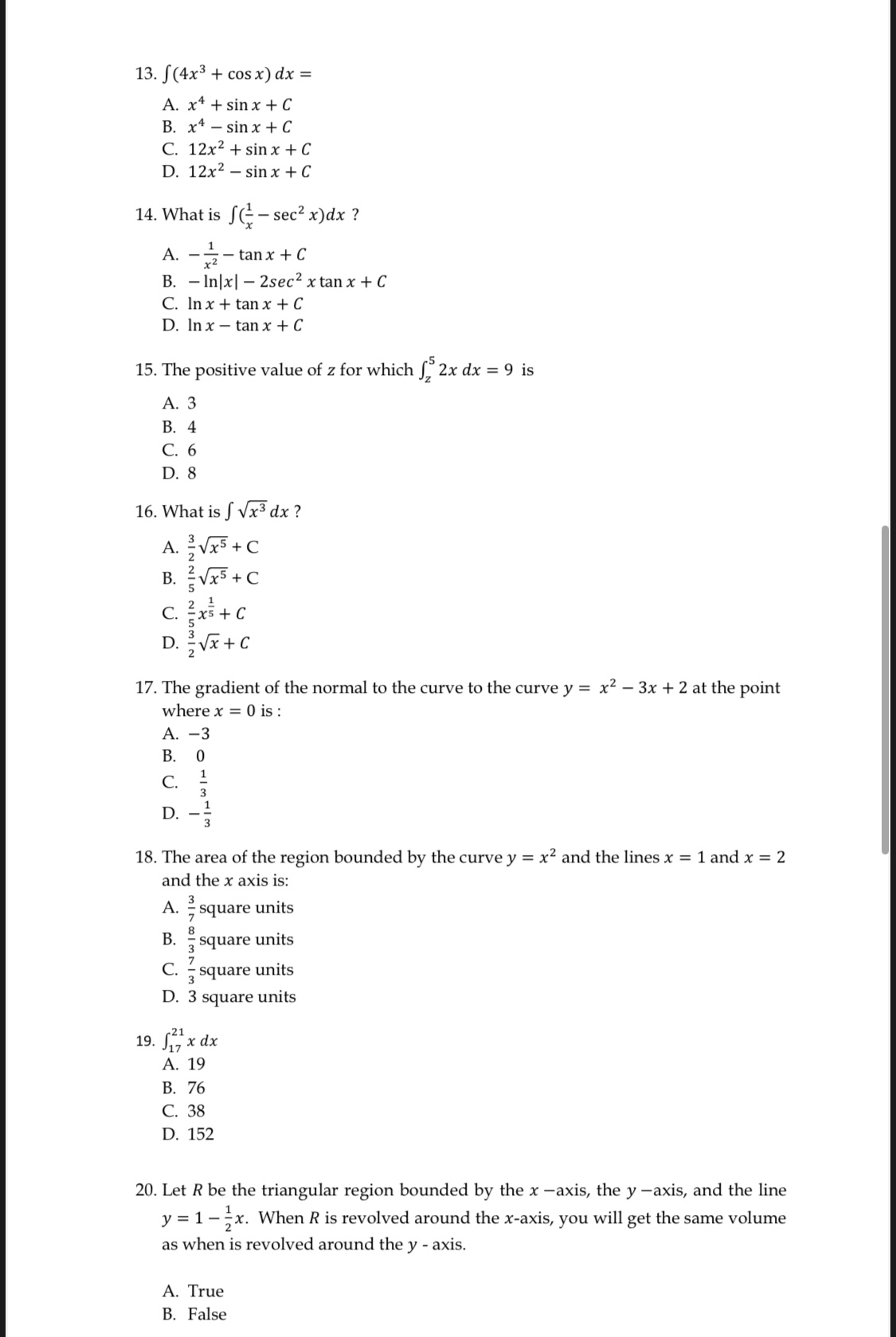
Question: ( 4 x 3 + c o s x ) d x = A . x 4 + s i n x + C B
A
B
C
D
What is
A
B
C
D
The positive value of for which is
A
B
C
D
What is
A
B
C
D
The gradient of the normal to the curve to the curve at the point where is :
A
B
C
D
The area of the region bounded by the curve and the lines and and the axis is:
A square units
B square units
C square units
D square units
A
B
C
D
Let be the triangular region bounded by the axis, the axis, and the line When is revolved around the axis, you will get the same volume as when is revolved around the axis.
A True
B False
Step by Step Solution
There are 3 Steps involved in it
1 Expert Approved Answer
Step: 1 Unlock

Question Has Been Solved by an Expert!
Get step-by-step solutions from verified subject matter experts
Step: 2 Unlock
Step: 3 Unlock
 Study Help