







Question: [40 MARKS SECTION A Answer ALL questions in this section. Read the case study below and answer ALL the questions that follow. Lenovo Computer Corporation
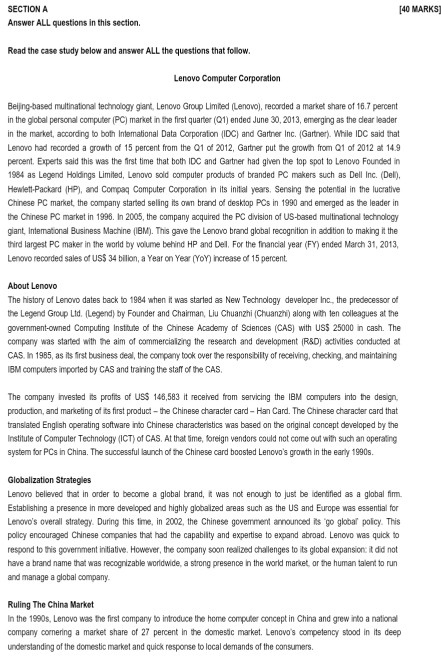
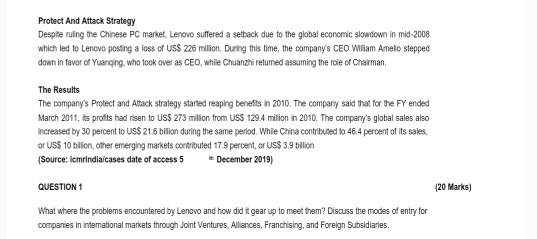
[40 MARKS SECTION A Answer ALL questions in this section. Read the case study below and answer ALL the questions that follow. Lenovo Computer Corporation Beijng-based multinational technology giant, Lenovo Group Limited (Lenovo), recorded a market share of 16.7 percent in the global personal computer (PC) market in the first quarter (Q1) ended June 30, 2013, emerging as the clear leader in the market, according to both International Data Corporation (IDC) and Gartner Inc. (Gartner). While IDC said that Lenovo had recorded a growth of 15 percent from the 01 of 2012, Gartner put the growth from Q1 of 2012 at 14.9 percent. Experts said this was the first time that both IDC and Gartner had given the top spot to Lenovo Founded in 1984 as Legend Holdings Limited, Lenovo sold computer products of branded PC makers such as Dell Inc. (Del), Hewlett-Packard (HP), and Compaq Computer Corporation in its initial years. Sensing the potential in the lucrative Chinese PC market, the company started selling its own brand of desktop PCs in 1990 and emerged as the leader in the Chinese PC market in 1996. In 2005, the company acquired the PC division of US-based multinational technology giant, Interational Business Machine (IBM). This gave the Lenovo brand global recognition in addition to making it the third largest PC maker in the world by volume behind HP and Dell. For the financial year (FY) ended March 31, 2013, Lenovo recorded sales of US$ 34 bilion, a Year on Year (YoY) increase of 15 percent. About Lenovo The history of Lenovo dates back to 1984 when it was started as New Technology developer Inc., the predecessor of the Legend Group Ltd. (Legend) by Founder and Chairman, Liu Chuanzhi Chuanzhi) along with ten colleagues at the government-owned Computing Institute of the Chinese Academy of Sciences (CAS) with US$ 25000 in cash. The company was started with the aim of commercializing the research and development (R&D) activities conducted at CAS. In 1985, as its first business deal, the company took over the responsibility of receiving checking and maintaining IBM computers imported by CAS and training the staff of the CAS, The company invested its profits of US$ 148,583 it received from servicing the IBM computers into the design, production, and marketing of its first product the Chinese character card - Han Card. The Chinese character card that translated English operating software into Chinese characteristics was based on the original concept developed by the Institute of Computer Technology (ICT) of CAS. At that time, foreign vendors could not come out with such an operating system for PCs in China. The successful launch of the Chinese card boosted Lenovo's growth in the early 1990s. Globalization Strategies Lenovo believed that in order to become a global brand, was not enough to just be identified as a global fim. Establishing a presence in more developed and highly globalized areas such as the US and Europe was essential for Lenovo's overall strategy. During this time, in 2002, the Chinese government announced its "go global policy. This policy encouraged Chinese companies that had the capability and expertise to expand abroad. Lenovo was quick to respond to this government initiative. However, the company soon realized challenges to its global expansion it did not have a brand name that was recognizable worldwide, a strong presence in the world market or the human talent to run and manage a global company Ruling The China Market In the 1990s, Lenovo was the first company to introduce the home computer concept in China and grew into a national company cornering a market share of 27 percent in the domestic market. Lenovo's competency stood in its deep understanding of the domestic market and quick response to local demands of the consumers. Protect And Attack Strategy Despite ruling the Chinese PC market, Lenovo suffered a setback due to the global economic slowdown in mid-2008 which led to Lenovo posting a loss of US$ 226 milion. During this time, the company's CEO Wiliam Amelo stepped down in favor of Yuanging, who took over as CEO while Chuanzhi retumed assuming the role of Chairman The Results The company's Protect and Attack strategy started reaping benefits in 2010. The company said that for the FY ended March 2011, is profits had risen to US$ 273 milion from USS 129.4 milion in 2010. The company's global sales also increased by 30 percent to US$ 21.6 billion during the same period. While China contributed to 46.4 percent of its sales, or US$ 10 billion, other emerging markets contributed 17.9 percent, or US$ 3.9 bilion (Source: iemrindialcases date of access 5 December 2019) QUESTION 1 (20 Marks) What where the problems encountered by Lenovo and how did it gear up to meet them? Discuss the modes of entry for companies in interational markets through Joint Ventures, Alliances, Franchising, and Foreign Subsidiaries
Step by Step Solution
There are 3 Steps involved in it
1 Expert Approved Answer
Step: 1 Unlock

Question Has Been Solved by an Expert!
Get step-by-step solutions from verified subject matter experts
Step: 2 Unlock
Step: 3 Unlock
 Study Help