







Question: (4.17.) Calculating scattering length density. In class we noted that the contrast for scattering can be described using various terms including electron density, refractive index,
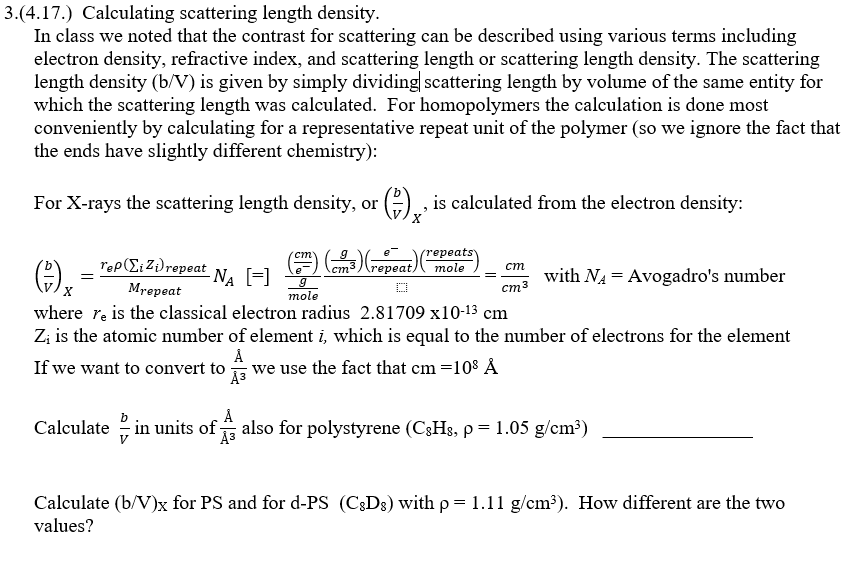
(4.17.) Calculating scattering length density. In class we noted that the contrast for scattering can be described using various terms including electron density, refractive index, and scattering length or scattering length density. The scattering length density (b/V) is given by simply dividing/ scattering length by volume of the same entity for which the scattering length was calculated. For homopolymers the calculation is done most conveniently by calculating for a representative repeat unit of the polymer (so we ignore the fact that the ends have slightly different chemistry): For X-rays the scattering length density, or (Vb)X, is calculated from the electron density: (Vb)X=Mrepeatre(iZi)repeatNA[=]moleg(ecm)E(cm3g)(repeate)(molerepeats)=cm3cm with NA= Avogadro's number where re is the classical electron radius 2.817091013cm Zi is the atomic number of element i, which is equal to the number of electrons for the element If we want to convert to A3A we use the fact that cm=108A Calculate Vb in units of A3A also for polystyrene (C8H8,=1.05g/cm3) Calculate (b/V)x for PS and for d-PS (C8D8) with =1.11g/cm3). How different are the two
Step by Step Solution
There are 3 Steps involved in it

Get step-by-step solutions from verified subject matter experts
 Study Help