Question: 4.27 Problems in this exercise refer to the following sequence of instructions, and assume that it is executed on a five-stage pipelined datapath: ADD X5,
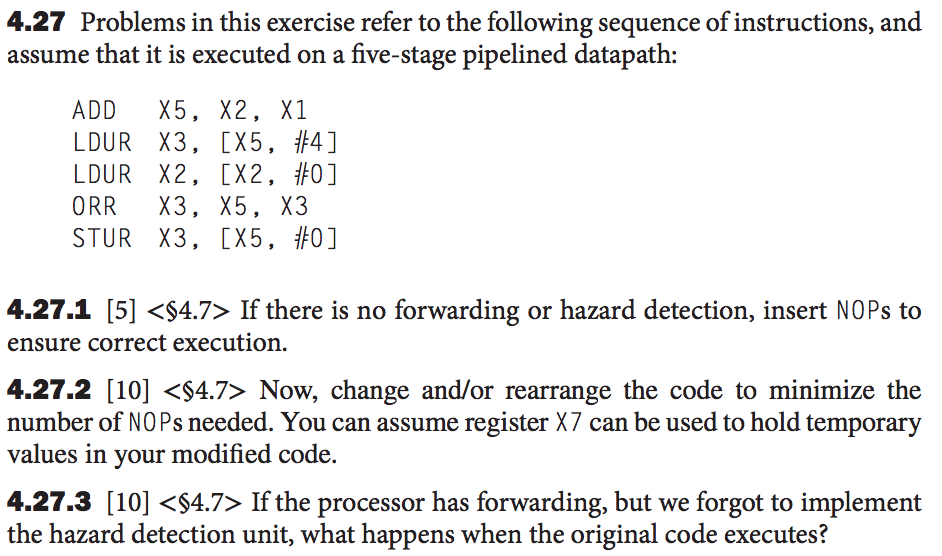
4.27 Problems in this exercise refer to the following sequence of instructions, and assume that it is executed on a five-stage pipelined datapath: ADD X5, X2, X1 LDUR X3, [X5, #41 LDUR X2, [X2, #0 ] ORR X3, X5, X3 STUR X3, [X5, #0 ] 4.27.1 [5] If there is no forwarding or hazard detection, insert NOPs to ensure correct execution. 4.27.2 [10] Now, change and/or rearrange the code to minimize the number of NOPs needed. You can assume register X7 can be used to hold temporary values in your modified code. 4.27.3 [10] If the processor has forwarding, but we forgot to implement the hazard detection unit, what happens when the original code executes? 4.27 Problems in this exercise refer to the following sequence of instructions, and assume that it is executed on a five-stage pipelined datapath: ADD X5, X2, X1 LDUR X3, [X5, #41 LDUR X2, [X2, #0 ] ORR X3, X5, X3 STUR X3, [X5, #0 ] 4.27.1 [5] If there is no forwarding or hazard detection, insert NOPs to ensure correct execution. 4.27.2 [10] Now, change and/or rearrange the code to minimize the number of NOPs needed. You can assume register X7 can be used to hold temporary values in your modified code. 4.27.3 [10] If the processor has forwarding, but we forgot to implement the hazard detection unit, what happens when the original code executes









 Study Help