


Question: 44. Ways in which buying habits and preferences may differ from earlier generations include: a. Desire by consumers for more choices b. Better educated and
44. Ways in which buying habits and preferences

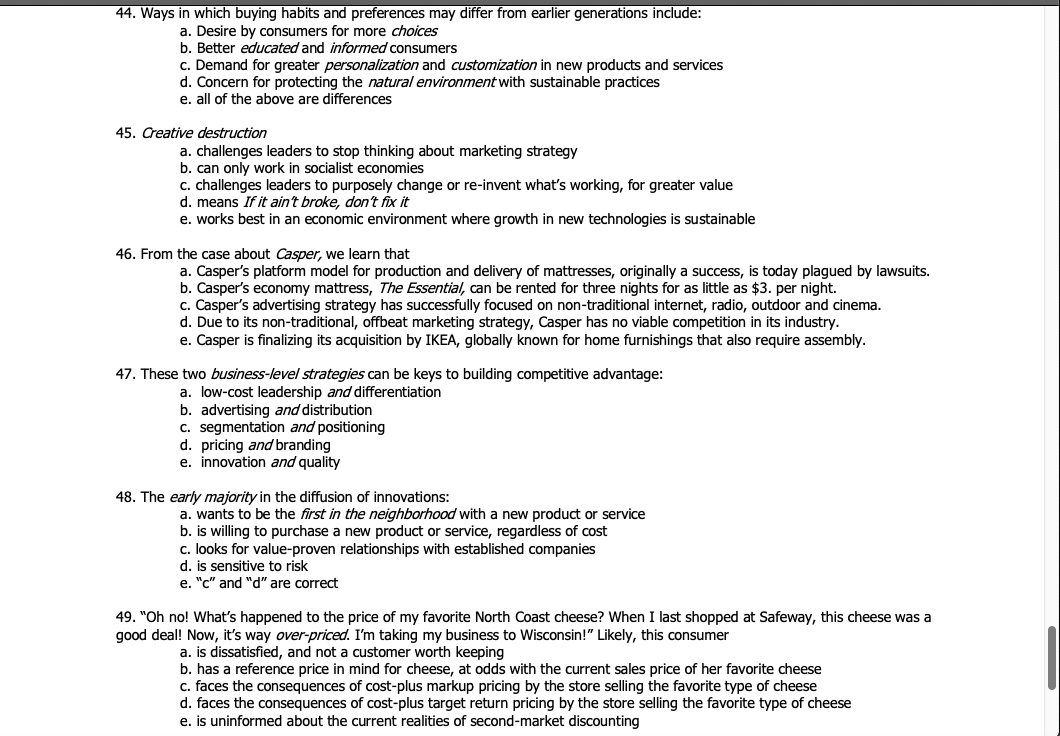
44. Ways in which buying habits and preferences may differ from earlier generations include: a. Desire by consumers for more choices b. Better educated and informed consumers c. Demand for greater personalization and customization in new products and services d. Concern for protecting the natural environment with sustainable practices e. all of the above are differences 45. Creative destruction a. challenges leaders to stop thinking about marketing strategy b. can only work in socialist economies C. challenges leaders to purposely change or re-invent what's working, for greater value d. means If it ain't broke, don't fix it e. works best in an economic environment where growth in new technologies is sustainable 46. From the case about Casper, we learn that a. Casper's platform model for production and delivery of mattresses, originally a success, is today plagued by lawsuits. b. Casper's economy mattress, The Essential, can be rented for three nights for as little as $3. per night. c. Casper's advertising strategy has successfully focused on non-traditional internet, radio, outdoor and cinema. d. Due to its non-traditional, offbeat marketing strategy, Casper has no viable competition in its industry. e. Casper is finalizing its acquisition by IKEA, globally known for home furnishings that also require assembly. 47. These two business-level strategies can be keys to building competitive advantage: a. low-cost leadership and differentiation b. advertising and distribution C. segmentation and positioning d. pricing and branding e. innovation and quality 48. The early majority in the diffusion of innovations: a. wants to be the first in the neighborhood with a new product or service b. is willing to purchase a new product or service, regardless of cost c. looks for value-proven relationships with established companies d. is sensitive to risk e. "c" and "d" are correct 49. "Oh no! What's happened to the price of my favorite North Coast cheese? When I last shopped at Safeway, this cheese was a good deal! Now, it's way over-priced. I'm taking my business to Wisconsin!" Likely, this consumer a. is dissatisfied, and not a customer worth keeping b. has a reference price in mind for cheese, at odds with the current sales price of her favorite cheese c. faces the consequences of cost-plus markup pricing by the store selling the favorite type of cheese d. faces the consequences of cost-plus target return pricing by the store selling the favorite type of cheese e. is uninformed about the current realities of second-market discounting

Step by Step Solution

There are 3 Steps involved in it

1 Expert Approved Answer
Step: 1 Unlock blur-text-image

Question Has Been Solved by an Expert!

Get step-by-step solutions from verified subject matter experts

Step: 2 Unlock
Step: 3 Unlock

Students Have Also Explored These Related General Management Questions!