







Question: 45. What Do Organizations Do to Manage Diversity? Examining Corporate Leadership, Training, Mentoring, Employee Resource Groups, and Social Responsibility Programs 1Well-managed diversity programs can benefit
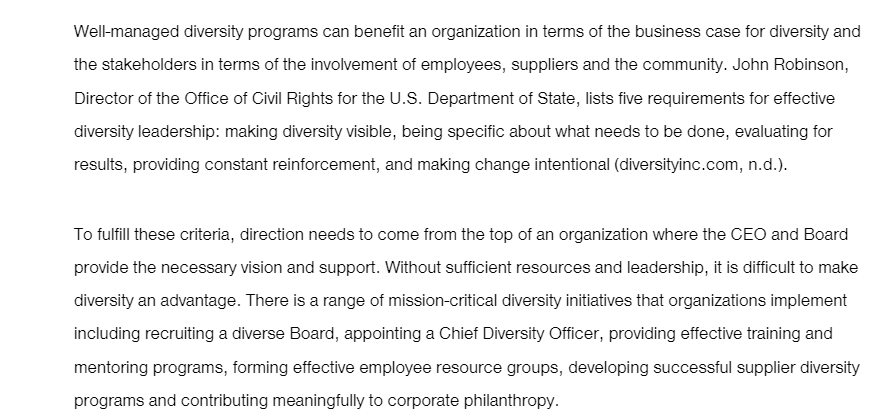
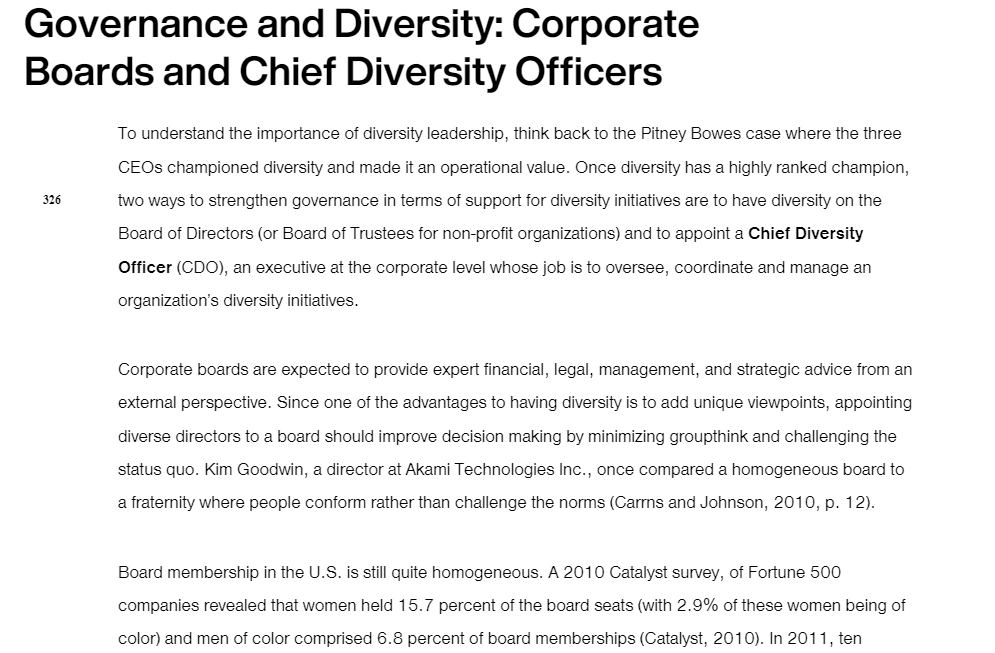
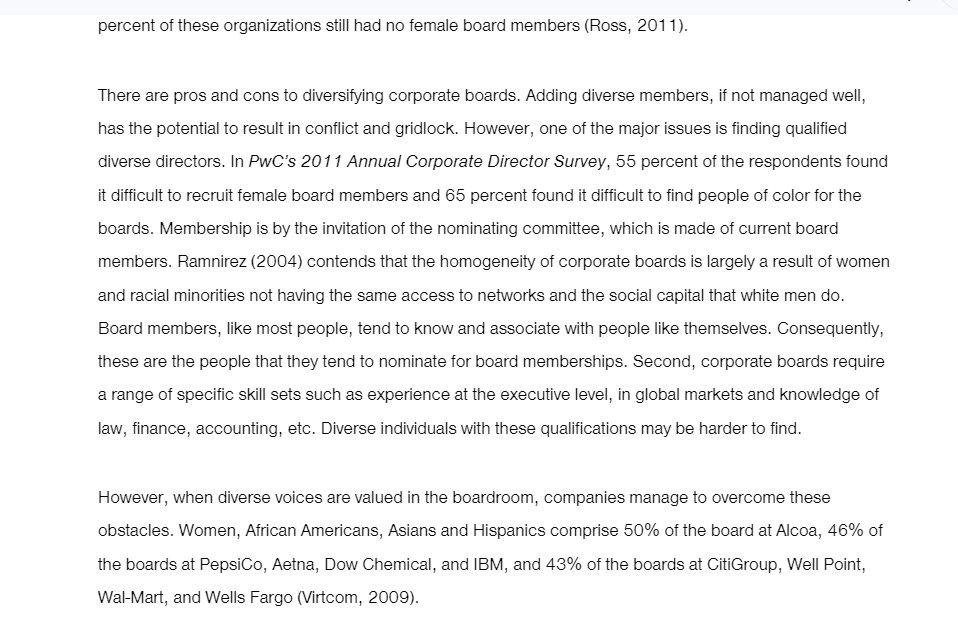
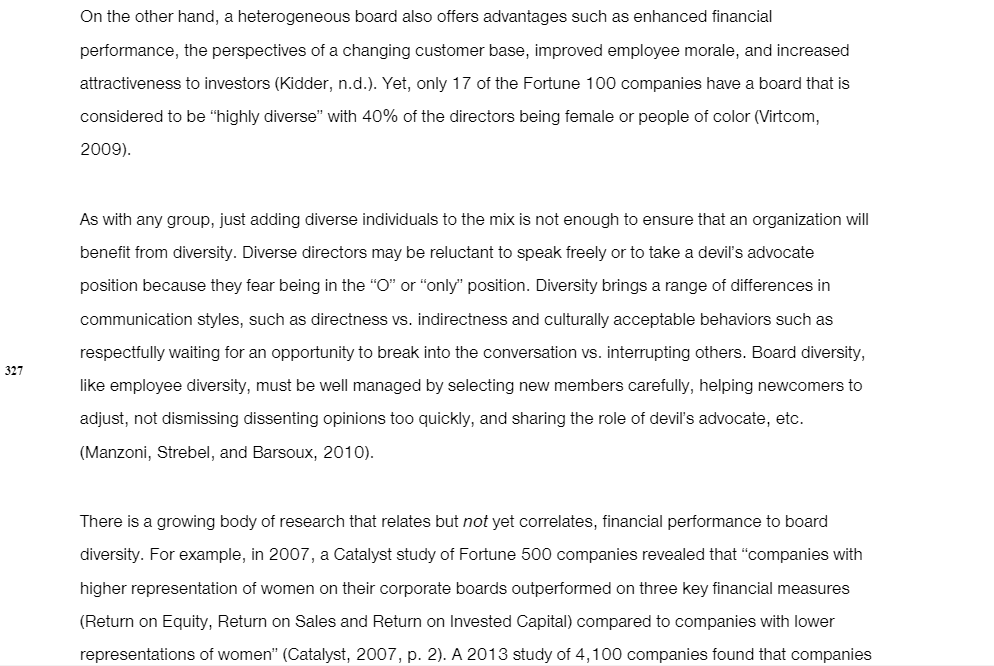
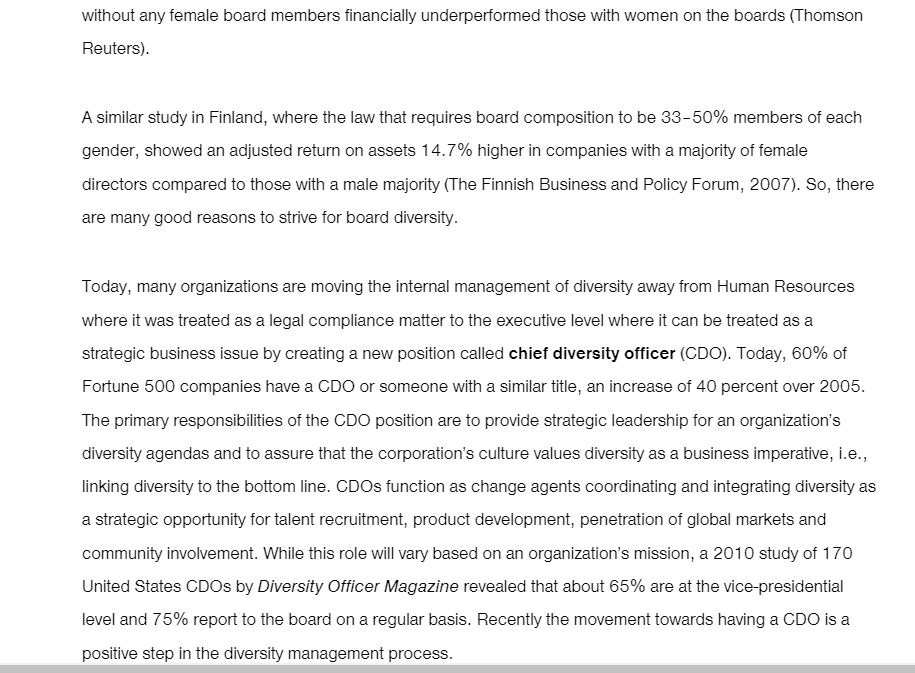
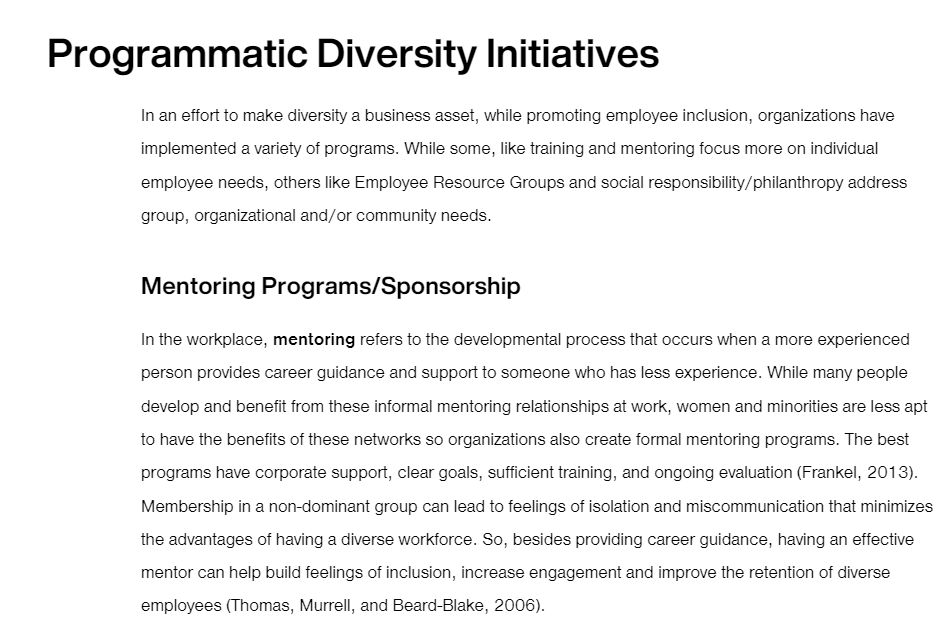
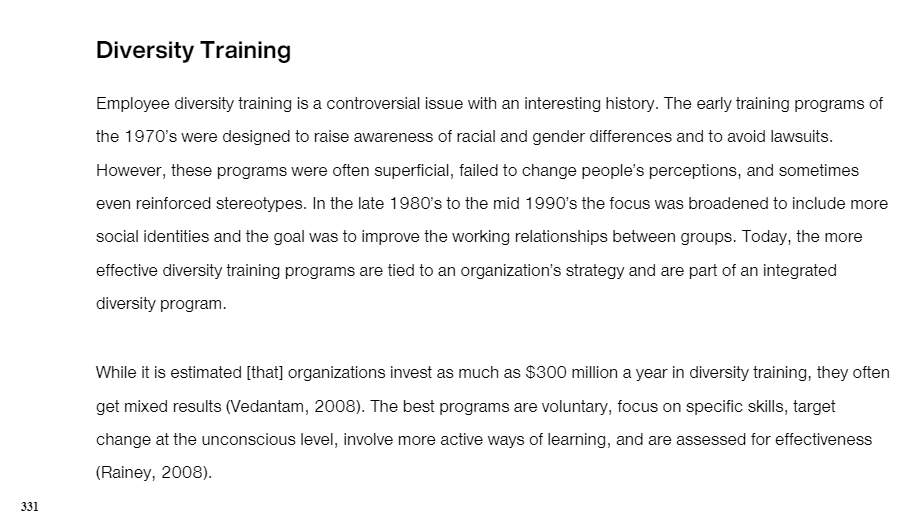
45. What Do Organizations Do to Manage Diversity? Examining Corporate Leadership, Training, Mentoring, Employee Resource Groups, and Social Responsibility Programs 1Well-managed diversity programs can benefit an organization in terms of the business case for diversity and the stakeholders in terms of the involvement of employees, suppliers and the community. John Robinson, Director of the Oflice of Civil Rights for the U.S. Department of State, lists five requirements for effective diversity leadership: making diversity visible, being specific about what needs to be done, evaluating for results, providing constant reinforcement, and making change intentional idiversityinccom, n.d.l. To fulfill these criteria, direction needs to come from the top of an organization where the CEO and Board provide the necessary vision and support. Without sufficient resources and leadership, it is difficult to make diversity an advantage. There is a range of missioncritical diversity initiatives that organizations implement including recruiting a diverse Board, appointing a Chief Diversity Officer, providing effective training and mentoring programs, forming effective employee resource groups, developing successful supplier diversity programs and contributing meaningfully to corporate philanthropy. Governance and Diversity: Corporate Boards and Chief Diversity Officers To understand the importance ot diversity leadership, think back to the Pitne},r Bowes case where the three CEOs championed diversity and made it an operational value. Once diversity has a highly ranked champion, 326 two ways to strengthen governance in terms of support tor diversity initiatives are to have diversity on the Board of Directors (or Board of Trustees for nonprofit organizations} and to appoint a Chief Diversity Officer ((300), an executive at the corporate level whose job is to oversee, coordinate and manage an organ ization's diversity initiatives. Corporate boards are expected to provide expert financial, legal, management, and strategic advice from an external perspective. Since one ot the advantages to having diversity is to add unique viewpoints, appointing diverse directors to a board should improve decision making by minimizing groupthink and challenging the status quo. Kim Goodwin, a director at Akami Technologies Inc., once compared a homogeneous board to a fraternity where people conform rather than challenge the norms (Carms and Johnson, 2010, p. 12}. Board membership in the U.S. is still quite homogeneous. A 2010 Catalyst survey, of Fortune 500 companies revealed that women held 15.? percent of the board seats (with 2.9% of these women being 01 color} and men 01 color comprised 6.8 percent of board memberships (Catalyst, 2010}. In 201 1, ten percent of these organizations still had no female board members (Floss, 2011). There are pros and cons to diversifying corporate boards. Adding diverse members, if not managed well, has the potential to result in conflict and gridlock. However, one of the major issues is nding qualified diverse directors. In PwC's 201 1 Annual Corporate Director Survey, 55 percent of the respondents found it difficult to recruit female board members and 65 percent found it difficult to find people of color for the boards. Membership is by the invitation of the nominating committee, which is made of current board members. Flamnirez (2004} contends that the homogeneity of corporate boards is largely a result ofwomen and racial minorities not having the same access to networks and the social capital that white men do. Board members, like most people, tend to know and associate with people like themselves. Consequently. these are the people that they tend to nominate for board memberships. Second, corporate boards require a range of specific skill sets such as experience at the executive level, in global markets and knowledge of law, finance, accountingI etc. Diverse individuals with these qualifications may be harder to find. However, when diverse voices are valued in the boardroom, companies manage to overcome these obstacles. Women, African Americans, Asians and Hispanics comprise 50% of the board at Alcoa, 46% of the boards at PepsiCo, Aetna, Dow Chemical, and IBM, and 43% of the boards at CitiGroup, Well Point, WalMari, and Wells Fargo Wiricom, 2009}. On the other hand, a heterogeneous board also offers advantages such as enhanced financial performance, the perspectives of a changing customer base, improved employee morale, and increased attractiveness to investors (Kidder, n.d.}. Yet, only 17' of the Fortune 100 companies have a board that is considered to be "highly diverse" with 40% of the directors being female or people of color (Virtcom, 2009}. As with any group, just adding diverse individuals to the mix is not enough to ensure that an organization will benet from diversity. Diverse directors may be reluctant to speakfreely or to take a devil's advocate position because they fear being in the \"\"0 or "only" position. Diversity brings a range of differences in communication styles, such as directness vs. indirectness and culturally acceptable behaviors such as respectfully waiting for an opportunity to break into the conversation vs. interrupting others. Board diversity, like employee diversity, must be well managed by selecting new members carefully, helping newcomers to adjust, not dismissing dissenting opinions too quickly, and sharing the role of devil's advocate, etc. (Manzoni, Strebel, and Barsoux, 2010}. There is a growing body of research that relates but not yet correlates, financial performance to board diversity. For example, in 200?, a Catalyst study of Fortune 500 companies revealed that \"companies with higher representation of women on their corporate boards outperformed on three key financial measures (Return on Equity, Return on Sales and Return on Invested Capital} compared to companies with lower representations of women" (Catalyst, 2007', p. 2}. A 2018 study of 4,100 companies found that companies without any female board members financially underperformed those with women on the boards (Thomson Reuters} . A similar study in Finland, where the law that requires board composition to be 8350% members of each gender, showed an adjusted return on assets 14.7% higher in companies with a majority of female directors compared to those with a male majority {The Finnish Business and Policy Forum, 200?}. So, there are many good reasons to strive for board diversity. Today, many organizations are moving the internal management of diversity awayirom Human Resources where it was treated as a legal compliance matter to the executive level where it can be treated as a strategic business issue by creating a new position called chief diversity officer {000). Today, 60% of Fortune 500 companies have a 000 or someone with a similar title, an increase of 40 percent over 2005. The primary responsibilities of the CDC) position are to provide strategic leadership for an organization's diversity agendas and to assure that the corporation's culture values diversity as a business imperative, i.e., linking diversity to the bottom line. CDOs function as change agents coordinating and integrating diversity as a strategic opportunity for talent recruitment, product development, penetration of global markets and community involvement. While this role will vary based on an organization's mission, a 2010 study of 1T0 United States CDOs by Diversity Officer Magazine revealed that about 65% are at the vicepresidential level and 75% report to the board on a regular basis. Recently the movement towards having a (300 is a positive step in the diversity management process. Programmatic Diversity Initiatives In an effort to make diversity a business asset, while promoting employee inclusion, organizations have implemented a variety of programs. While some, like training and mentoring focus more on individual employee needs, others like Employee Resource Groups and social responsibility/philanthropy address group, organizational and/or community needs. Mentoring Programs/Sponsorship In the workplace, mentoring refers to the developmental process that occurs when a more experienced person provides career guidance and support to someone who has less experience. While many people develop and benefit from these informal mentoring relationships at work, women and minorities are less apt to have the benefits of these networks so organizations also create formal mentoring programs. The best programs have corporate support, clear goals, sufficient training, and ongoing evaluation (Frankel, 2013). Membership in a non-dominant group can lead to feelings of isolation and miscommunication that minimizes the advantages of having a diverse workforce. So, besides providing career guidance, having an effective mentor can help build feelings of inclusion, increase engagement and improve the retention of diverse employees (Thomas, Murrell, and Beard-Blake, 2006).33] Diversity Training Employee diversity training is a controversial issue with an interesting history. The earlytraining programs of the 1970s were designed to raise awareness of racial and gender differences and to avoid lawsuits. However, these programs were often superficial, failed to change people's perceptions, and sometimes even reinforced stereotypes. In the late 1980's to the mid 1990's the focus was broadened to include more social identities and the goal was to improve the working relationships between groups. Today, the more effective diversity training programs are tied to an organization's strategy and are part of an integrated diversity program. While it is estimated [that] organizations invest as much as $300 million a year in diversity training, they often get mixed results Wedsntam, 2008}. The best programs are voluntary, focus on specific skills, target change at the unconscious level, involve more active ways of learning, and are assessed for effectiveness (Rainey, 2008}
Step by Step Solution
There are 3 Steps involved in it

Get step-by-step solutions from verified subject matter experts
 Study Help