







Question: Read the above and answer question below: Describe the differing contexts in which the two concepts (Employment-Related Equal Opportunity and Workplace Diversity Initiatives) arise, and
Read the above and answer question below:
Describe the differing contexts in which the two concepts (Employment-Related Equal Opportunity and Workplace Diversity Initiatives) arise, and address how those differences affect managerial responsibilities for each as well as the companys development of differing social responsibility programs for each?
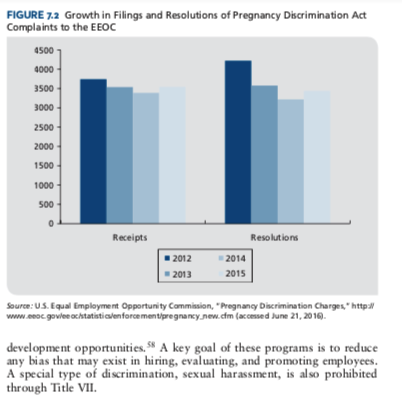
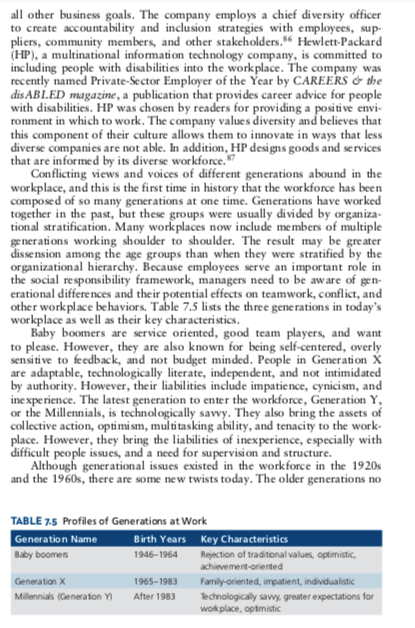
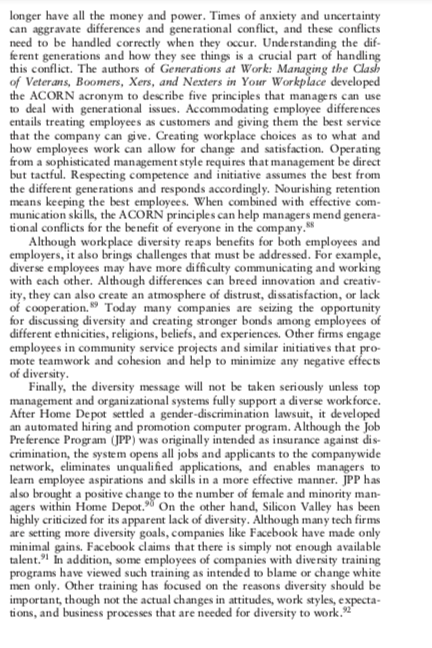
Equal Opportunity Title VII of the Civil Rights Act of 1964 prohibits employment discrimination on the basis of race, national origin, color, religion, and gender. This law is fundamental to employees' rights to join and advance in an organization according to merit rather than one of the characteristics just mentioned. For example, employers are not permitted to categorize jobs as only for men or women unless there is a reason gender is fundamental to the tasks and responsibilities. Addi- tional laws passed in the 1970s, 1980s, and 1990s were also designed to prohibit discrimination related to pregnancy, disabilities, age, and other factors. The Americans with Disabilities Act prohibits companies from discriminating on the basis of physical or mental disability in all employ- ment practices and requires them to make facilities accessible to and usable by persons with disabilities. The Pregnancy Discrimination Act, now 30 years old, was created to help protect the rights of mothers and mothers-to-be in the workplace. The act has been modified many times since its inception. As a result, the number of pregnancy discrimination complaints filed with the Equal Employment Opportunity Commission (EEOC) has continually decreased over the years. Figure 7.2 depicts the number of complaints and resolutions on pregnancy discrimination cases from 2012 through 2015. These legal imperatives require that companies formalize employment practices to ensure that no discrimination is occurring. Thus, managers must be fully aware of the types of practices that constitute discrimination and work to ensure that hiring, promotion, annual evaluation, and other procedures are fair and based on merit. The spread of HIV and AIDS has prompted multinational firms with operations in Africa to distribute educational literature and launch prevention programs. Some companies work with internal and external stakeholders and even fund medical facili- ties that help prevent the disease and treat HIV/AIDS patients. Another component to their initiatives involves education on fair treatment of employees with the disease. Multinational companies in Mexico produced a written commitment to eliminate the stigma and discrimination often surrounding HIV/AIDS in the workplace. 57 To ensure that they build balanced workforces, many companies have initiated affirmative action programs, which involve efforts to recruit, hire, train, and promote qualified individuals from groups that have traditionally been discriminated against on the basis of race, sex, or other characteristics. Coca-Cola established a program to create a level foundation for all employees to have access to the same information and FIGURE 7.2 Growth in Filings and Resolutions of Pregnancy Discrimination Act Complaints to the EEOC 4500 4000 3500 3000 2500 2000 1500 1000 500 Receipts 2012 2013 Resolutions 2014 2015 Source: U.S. Equal Employment Opportunity Commission, "Pregnancy Discrimination Charges," http:// www.coc.govle och statistics/enforcement/pregnancy new.cfm (accessed June 21, 2019 development opportunities. A key goal of these programs is to reduce any bias that may exist in hiring, evaluating, and promoting employees. A special type of discrimination, sexual harassment, is also prohibited through Title VII. Diversity Whereas Title VII of the Civil Rights Act grants legal protection to different types of employees, initiatives in workplace diversity focus on recruiting and retaining a diverse workforce as a business imperative. With diversity programs, companies assume an ethical obligation to employ and empower individuals regardless of age, gender, ethnicity, physical or mental ability, or other characteristics. These firms go beyond compliance with government guidelines to develop cultures that respect and embrace the unique skills, backgrounds, and contributions of all types of people. Thus, legal statutes focus on removing discrimination whereas diversity represents a leadership approach for cultivating and appreciating employee talent. Firms with an effective diversity effort link their diversity mis- sion statement with the corporate strategic plan, implement plans to recruit and retain a diverse talent pool, support community programs of diverse groups, hold management accountable for various types of diversity per- formance, and have tangible outcomes of the diversity strategy. Each firm must tailor its diversity initiative to meet unique employee, market, and industry conditions. Many firms embrace employee diversity to deal with supplier and customer diversity. Their assumption is that to effectively design, market, and support products for different target groups, a company must employ individuals who reflect its customers' characteristics. Organizations and industries with a population-wide customer base may use national demo- graphics for assessing their diversity effort. Kaiser Permanente uses a dash- board to assess the links between its senior-executive compensation and diversity. It is mandatory for company recruiters to have diversity slates that are viewed by human resources. Kaiser Permanente's strong empha- sis on diversity began in 1989 after the company developed the Minority Recruitment and Development Task Force to address racial inequalities. As demographics in the United States continue to shift, companies are faced with reconsidering their marketing and hiring strategies, including the link between employee and customer characteristics. The sharp growth in the Hispanic population is one of the most important shifts recorded. This has prompted firms to hire Hispanic employees and consultants and tailor their offerings to this demographic. Clorox and General Mills, for instance, are appealing to Hispanics with bilingual advertisements via mobile applications. As we discussed in Chapter 1, there are opportunities to link social responsibility objectives with business performance, and many firms are learning the benefits of employing individuals with different backgrounds and perspectives. For example, at New York Life, diversity is treated like all other business goals. The company employs a chief diversity officer to create accountability and inclusion strategies with employees, sup- pliers, community members, and other stakeholders.86 Hewlett-Packard (HP), a multinational information technology company, is committed to including people with disabilities into the workplace. The company was recently named Private Sector Employer of the Year by CAREERS the disABLED magazine, a publication that provides career advice for people with disabilities. HP was chosen by readers for providing a positive envi- ronment in which to work. The company values diversity and believes that this component of their culture allows them to innovate in ways that less diverse companies are not able. In addition, HP designs goods and services that are informed by its diverse workforce. Conflicting views and voices of different generations abound in the workplace, and this is the first time in history that the workforce has been composed of so many generations at one time. Generations have worked together in the past, but these groups were usually divided by organiza- tional stratification. Many workplaces now include members of multiple generations working shoulder to shoulder. The result may be greater dissension among the age groups than when they were stratified by the organizational hierarchy. Because employees serve an important role in the social responsibility framework, managers need to be aware of gen- erational differences and their potential effects on teamwork, conflict, and other workplace behaviors. Table 7.5 lists the three generations in today's workplace as well as their key characteristics. Baby boomers are service oriented, good team players, and want to please. However, they are also known for being self-centered, overly sensitive to feedback, and not budget minded. People in Generation X are adaptable, technologically literate, independent, and not intimidated by authority. However, their liabilities include impatience, cynicism, and inexperience. The latest generation to enter the workforce, Generation Y, or the Millennials, is technologically sawy. They also bring the assets of collective action, optimism, multitasking ability, and tenacity to the work- place. However, they bring the liabilities of inexperience, especially with difficult people issues, and a need for supervision and structure. Although generational issues existed in the workforce in the 1920s and the 1960s, there are some new twists today. The older generations no TABLE 7.5 Profiles of Generations at Work Generation Name Birth Years Key Characteristics Baby boomes 19461964 Rejection of traditional values, optimistic, achievement-oriented Generation X 1965-1983 Family-oriented, impatient, individualistic Millennials (Generation After 1983 Technologically sawy, greater expectations for workplace, optimistic longer have all the money and power. Times of anxiety and uncertainty can aggravate differences and generational conflict, and these conflicts need to be handled correctly when they occur. Understanding the dif- ferent generations and how they see things is a crucial part of handling this conflict. The authors of Generations at Work: Managing the Clash of Veterans, Boomers, Xers, and Nexters in Your Workplace developed the ACORN acronym to describe five principles that managers can use to deal with generational issues. Accommodating employee differences entails treating employees as customers and giving them the best service that the company can give. Creating workplace choices as to what and how employees work can allow for change and satisfaction. Operating from a sophisticated management style requires that management be direct but tactful. Respecting competence and initiative assumes the best from the different generations and responds accordingly. Nourishing retention means keeping the best employees. When combined with effective com- munication skills, the ACORN principles can help managers mend genera- tional conflicts for the benefit of everyone in the company. Although workplace diversity reaps benefits for both employees and employers, it also brings challenges that must be addressed. For example, diverse employees may have more difficulty communicating and working with each other. Although differences can breed innovation and creativ- ity, they can also create an atmosphere of distrust, dissatisfaction, or lack of cooperation. Today many companies are seizing the opportunity for discussing diversity and creating stronger bonds among employees of different ethnicities, religions, beliefs, and experiences. Other firms engage employees in community service projects and similar initiatives that pro- mote teamwork and cohesion and help to minimize any negative effects of diversity. Finally, the diversity message will not be taken seriously unless top management and organizational systems fully support a diverse workforce. After Home Depot settled a gender-discrimination lawsuit, it developed an automated hiring and promotion computer program. Although the Job Preference Program (JPP) was originally intended as insurance against dis- crimination, the system opens all jobs and applicants to the company wide network, eliminates unqualified applications, and enables managers to learn employee aspirations and skills in a more effective manner. JPP has also brought a positive change to the number of female and minority man- agers within Home Depot. On the other hand, Silicon Valley has been highly criticized for its apparent lack of diversity. Although many tech firms are setting more diversity goals, companies like Facebook have made only minimal gains. Facebook claims that there is simply not enough available talent." In addition, some employees of companies with diversity training programs have viewed such training as intended to blame or change white men only. Other training has focused on the reasons diversity should be important, though not the actual changes in attitudes, work styles, expecta- tions, and business processes that are needed for diversity to work. "2Step by Step Solution
There are 3 Steps involved in it
1 Expert Approved Answer
Step: 1 Unlock

Question Has Been Solved by an Expert!
Get step-by-step solutions from verified subject matter experts
Step: 2 Unlock
Step: 3 Unlock
 Study Help