Question: 480 CHAPTER 12 Project Auditing Despite these changes, the reliability of the remaining Alight-test interceptres remained a concern because most com ponents were produced when
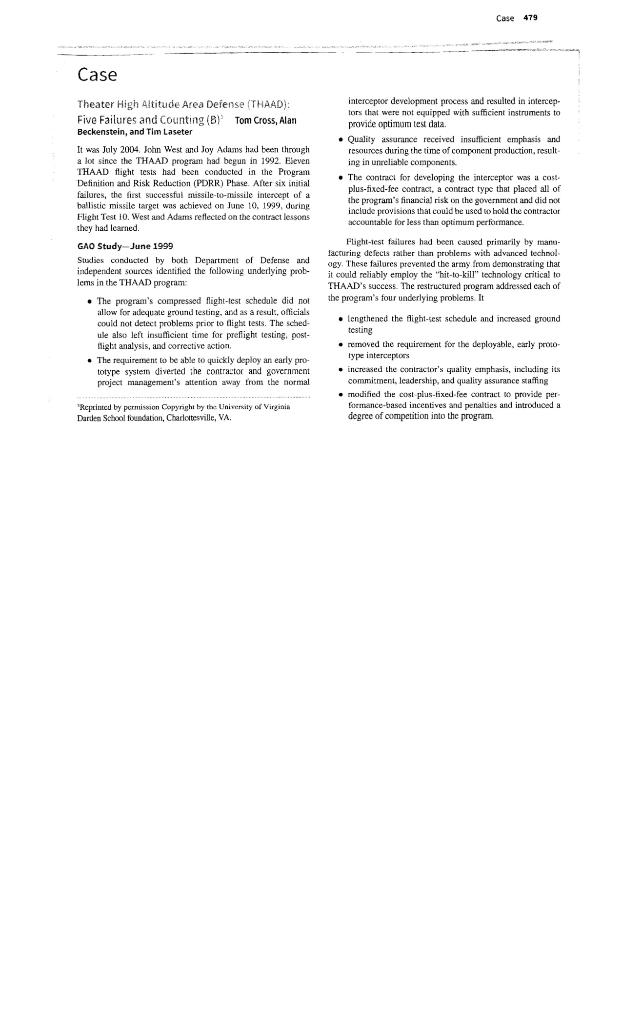
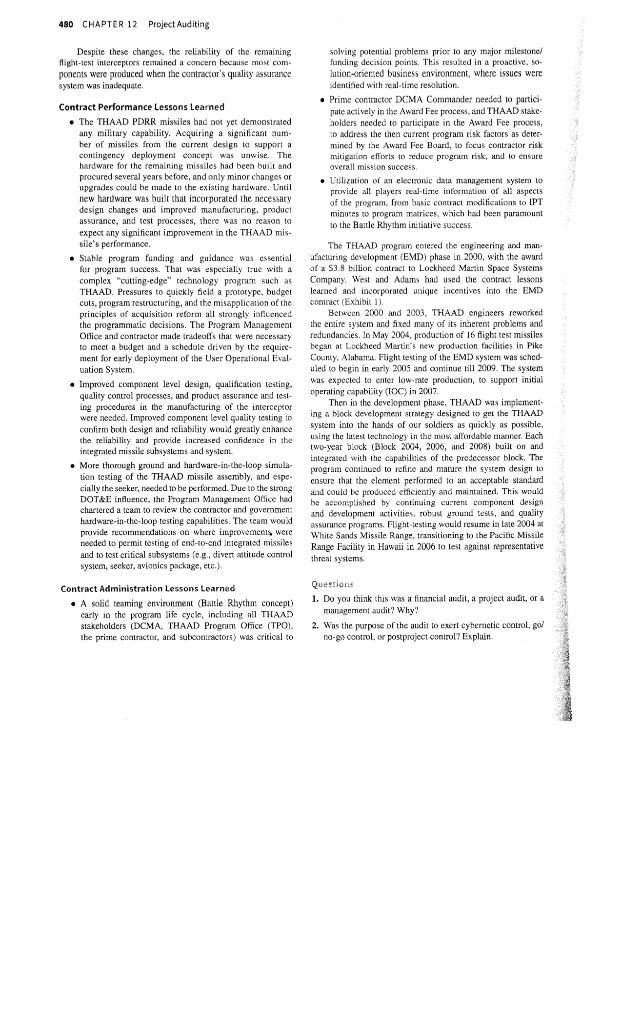
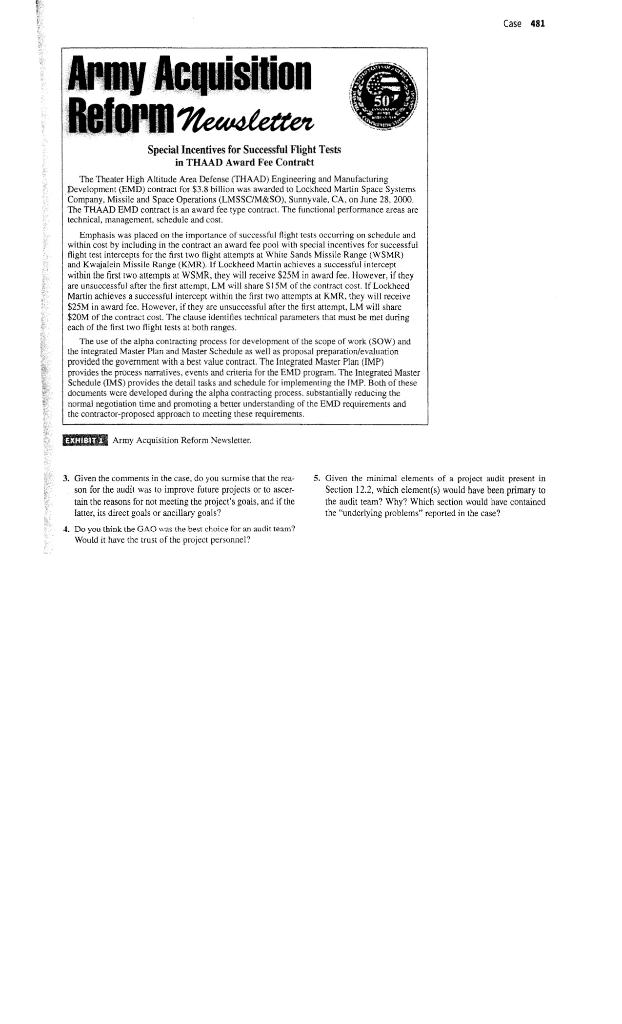
480 CHAPTER 12 Project Auditing Despite these changes, the reliability of the remaining Alight-test interceptres remained a concern because most com ponents were produced when the contractor's quality assurance system was inadequate Contract Performance Lessons Learned The THAAD PDRR missiles bad not yet demonstrated any military capability. Acquiring a significant num- ber of missiles from the current design to support a contingency deployment concept was unwise. The hardware for the remaining missiles had been built and procured several years before, and only minor changes or upgrades could be made to the existing hardware. Lintil new hardware was built that incorporated the necessary design changes and improved manufacturing, product assurance, and test processes, there was no reason to expect any significant improvement in the THAAD mis. sile's performance Siable program funding and guidance was essential for program success. That was especially true with a complex "cutting-edge technology program such as THAAD. Pressures to quickly field a prototype, budget cuts, program restructuring, and the misapplication of the principles of acquisition reform all strongly influenced the programmatic decisions. The Program Management Otlice and contractor made tradeals that were necessary to meet a bexiget and a schedule driven by the require- ment for early deployment of the User Operational Eval uation System Improved component level design, qualification testing, quality control processes, and product assurance and test- ing procedures in the manufacturing of the interceptor were needed. Improved component level quality testing to confirm both design and reliability would greatly enhance the reliability and provide increased confidence in the integrated missile subsystems and systent . More thorough ground and hardware-in-the-loop simula tion testing of the THAAD missile assembly, and espe- cially the seeker, needed to be performed. Due to the strong DOT&C influence, the Program Management Office had chartered a team to review the contractor and government hardware-in-the-loop testing capabilities. The team would provide recommendations on where improvements were needed to permit testing of end-to-end Integrated missiles and to test critical subsystems (eg, divert attitude control system, seeker, avionics package, etc.) solving potential problems prior to any major milestone/ funding decision points. This resulted in a proactive, so- lution-oriented business environment, where issues were dentified with real-time resolution. Prime contractor DCMA Commander needed to partici- pate actively in the Award Fee process, and THAAD stake holders needed to participate in the Award Fee process, o address the then current program risk factors as deter- mined by the Award Fee Board, to focus contractor risk mitigation efforts to reduce program risk, and to ensure Overall mission success Utilization of an electronic data management system to provide all players real-time information of all aspects of the program, from basic contract modifications to IPT minutes to program ratrices, which had been paramount to the Battle Rhythm initiative success. The THAAD program entered the engineering and man ufacturing development (EMD) phase in 2000, with the award of a $3.8 billion contract to Lockheed Martin Space Systems Company, West and Adams had used the contract lessons learned and incorporated unique incentives into the contact (Exhibit 1). Between 2000 and 2003, THAAD cngineers reworked the entire system and fixed many of its inherent problems and redundancies. In May 2004, production of 16 flight test missiles began at Lockheed Martin's new production facilities in Pike County, Alabama Flight testing of the EMD system was sched- uled to begin in early 2005 and continue till 2009. The system was expected to enter low-rate production, to support initial operating capability (TOC) in 2007 Then in the development phase, THAAD was implement- ing a block development strategy designed to get the THAAD system into the hands of our soldiers as quickly as possible, using the latest technology in the most allordable manner. Each two-year block (Block 2004, 2006, and 2008) built on and integrated with the capabilities of the predecessor block. The program continued to retire and mature the system design to cosure that the element performed to an acceptable standard and could be produced etficiently and maintained. This would be accomplished by continuing current component design and development activities. robust ground tests, and quality assurance programs. Flight-lesting would resume in late 2004 M White Sands Missile Range, transitioning to the Pacific Missile Range Facility in Hawaii ic 2006 lo lest against representative threat systems Contract Administration Lessons Learned A solid teaming environment (Haitle Rhythm concept) carly in the program life cycle, including all THAAD stakeholders (DCMA. THAAD Program Ofice (TPO). the prime contractor, and subcontractors) was critical to Questions 1. Do you think this was a financial audit, a project audit, or a management audit? Why! 2. Was the purpose of the audit to exert cybernetic control, go no-go control or postproject control? Explain Case 481 Army Acquisition Reform Newsletter The THAAD EMD contract is an award fee type contract Tyvale, CA on June 28, 2000. 50" Special Incentives for Successful Flight Tests in THAAD Award Fee Contratt The Theater High Altitude Area Defense (THAAD) Engineering and Manufacturing Development (EMD) contract for $3.8 billion was awarded to Lockheed Martin Space Systems areas are technical, management schedule and cost Emphasis was placed on the importance of successful flight tests occurring on schedule and within cost by including in the contract an award fee pool with special incentives for successful flight test intercepts for the first two flight attempts at White Sands Missile Range (WSMR) and Kwajalein Missile Range (KMR) If Lockheed Martin achieves a successful intercept within the first iwo alteenpls at WSMR, they will receive $25M in award fee. However, if they are unaccessful after the first attempt, LM will share SISM of the contract cost. If Lockheed Martin achieves a successful intercept within the first two attempts at KMR. they will receive S25M in award fee. However, if they are unsuccessful after the first attempt, LM will share $20M of the contract cast. The clause identifies technical parameters that must be inel during cach of the first two flight tests at both ranges The use of the alpha contracting process for development of the scope of work (SOW) and the integrated Master Plan and Master Schedule as well as proposal preparation evaluation a provides the process narratives, events and criteria for the EMD program. The Integrated Master Schedule (IMS) provides the detail tasks and schedule for implementing the IMP. Both of these documents were developed during the alpha contracting process. substantially reducing the normal negotiation time and promoting a better understanding of the EMD requirements and the contractor-proposed approach to meeting these requirements. EXHIBITI Army Acquisition Reform Newsletter 3. Given the comments in the case, do you surmise that the rea son for the audit was to improve future projects or to ascer tain the reasons for not meeting the project's goals, and if the latter, its direct goals or ancillary goals? 4. Do you think the GAO the best choice for an audit team? Would it have the trust of the project personnel! 5. Given the minimal elements of project audit present in Section 12.2, which element(s) would have been primary to the audit team? Why? Which section would have contained the underlying problems reported in the case? 480 CHAPTER 12 Project Auditing Despite these changes, the reliability of the remaining Alight-test interceptres remained a concern because most com ponents were produced when the contractor's quality assurance system was inadequate Contract Performance Lessons Learned The THAAD PDRR missiles bad not yet demonstrated any military capability. Acquiring a significant num- ber of missiles from the current design to support a contingency deployment concept was unwise. The hardware for the remaining missiles had been built and procured several years before, and only minor changes or upgrades could be made to the existing hardware. Lintil new hardware was built that incorporated the necessary design changes and improved manufacturing, product assurance, and test processes, there was no reason to expect any significant improvement in the THAAD mis. sile's performance Siable program funding and guidance was essential for program success. That was especially true with a complex "cutting-edge technology program such as THAAD. Pressures to quickly field a prototype, budget cuts, program restructuring, and the misapplication of the principles of acquisition reform all strongly influenced the programmatic decisions. The Program Management Otlice and contractor made tradeals that were necessary to meet a bexiget and a schedule driven by the require- ment for early deployment of the User Operational Eval uation System Improved component level design, qualification testing, quality control processes, and product assurance and test- ing procedures in the manufacturing of the interceptor were needed. Improved component level quality testing to confirm both design and reliability would greatly enhance the reliability and provide increased confidence in the integrated missile subsystems and systent . More thorough ground and hardware-in-the-loop simula tion testing of the THAAD missile assembly, and espe- cially the seeker, needed to be performed. Due to the strong DOT&C influence, the Program Management Office had chartered a team to review the contractor and government hardware-in-the-loop testing capabilities. The team would provide recommendations on where improvements were needed to permit testing of end-to-end Integrated missiles and to test critical subsystems (eg, divert attitude control system, seeker, avionics package, etc.) solving potential problems prior to any major milestone/ funding decision points. This resulted in a proactive, so- lution-oriented business environment, where issues were dentified with real-time resolution. Prime contractor DCMA Commander needed to partici- pate actively in the Award Fee process, and THAAD stake holders needed to participate in the Award Fee process, o address the then current program risk factors as deter- mined by the Award Fee Board, to focus contractor risk mitigation efforts to reduce program risk, and to ensure Overall mission success Utilization of an electronic data management system to provide all players real-time information of all aspects of the program, from basic contract modifications to IPT minutes to program ratrices, which had been paramount to the Battle Rhythm initiative success. The THAAD program entered the engineering and man ufacturing development (EMD) phase in 2000, with the award of a $3.8 billion contract to Lockheed Martin Space Systems Company, West and Adams had used the contract lessons learned and incorporated unique incentives into the contact (Exhibit 1). Between 2000 and 2003, THAAD cngineers reworked the entire system and fixed many of its inherent problems and redundancies. In May 2004, production of 16 flight test missiles began at Lockheed Martin's new production facilities in Pike County, Alabama Flight testing of the EMD system was sched- uled to begin in early 2005 and continue till 2009. The system was expected to enter low-rate production, to support initial operating capability (TOC) in 2007 Then in the development phase, THAAD was implement- ing a block development strategy designed to get the THAAD system into the hands of our soldiers as quickly as possible, using the latest technology in the most allordable manner. Each two-year block (Block 2004, 2006, and 2008) built on and integrated with the capabilities of the predecessor block. The program continued to retire and mature the system design to cosure that the element performed to an acceptable standard and could be produced etficiently and maintained. This would be accomplished by continuing current component design and development activities. robust ground tests, and quality assurance programs. Flight-lesting would resume in late 2004 M White Sands Missile Range, transitioning to the Pacific Missile Range Facility in Hawaii ic 2006 lo lest against representative threat systems Contract Administration Lessons Learned A solid teaming environment (Haitle Rhythm concept) carly in the program life cycle, including all THAAD stakeholders (DCMA. THAAD Program Ofice (TPO). the prime contractor, and subcontractors) was critical to Questions 1. Do you think this was a financial audit, a project audit, or a management audit? Why! 2. Was the purpose of the audit to exert cybernetic control, go no-go control or postproject control? Explain Case 481 Army Acquisition Reform Newsletter The THAAD EMD contract is an award fee type contract Tyvale, CA on June 28, 2000. 50" Special Incentives for Successful Flight Tests in THAAD Award Fee Contratt The Theater High Altitude Area Defense (THAAD) Engineering and Manufacturing Development (EMD) contract for $3.8 billion was awarded to Lockheed Martin Space Systems areas are technical, management schedule and cost Emphasis was placed on the importance of successful flight tests occurring on schedule and within cost by including in the contract an award fee pool with special incentives for successful flight test intercepts for the first two flight attempts at White Sands Missile Range (WSMR) and Kwajalein Missile Range (KMR) If Lockheed Martin achieves a successful intercept within the first iwo alteenpls at WSMR, they will receive $25M in award fee. However, if they are unaccessful after the first attempt, LM will share SISM of the contract cost. If Lockheed Martin achieves a successful intercept within the first two attempts at KMR. they will receive S25M in award fee. However, if they are unsuccessful after the first attempt, LM will share $20M of the contract cast. The clause identifies technical parameters that must be inel during cach of the first two flight tests at both ranges The use of the alpha contracting process for development of the scope of work (SOW) and the integrated Master Plan and Master Schedule as well as proposal preparation evaluation a provides the process narratives, events and criteria for the EMD program. The Integrated Master Schedule (IMS) provides the detail tasks and schedule for implementing the IMP. Both of these documents were developed during the alpha contracting process. substantially reducing the normal negotiation time and promoting a better understanding of the EMD requirements and the contractor-proposed approach to meeting these requirements. EXHIBITI Army Acquisition Reform Newsletter 3. Given the comments in the case, do you surmise that the rea son for the audit was to improve future projects or to ascer tain the reasons for not meeting the project's goals, and if the latter, its direct goals or ancillary goals? 4. Do you think the GAO the best choice for an audit team? Would it have the trust of the project personnel! 5. Given the minimal elements of project audit present in Section 12.2, which element(s) would have been primary to the audit team? Why? Which section would have contained the underlying problems reported in the case









 Study Help