





Question: 4-Behavioral case studies and questionnaire (1).pdf 58 - 168% + Leadership Instrument Rescarchers and practitioners alike have used many different instruments to assess the behaviors
4-Behavioral case studies and questionnaire4-Behavioral case studies and questionnaire4-Behavioral case studies and questionnaire

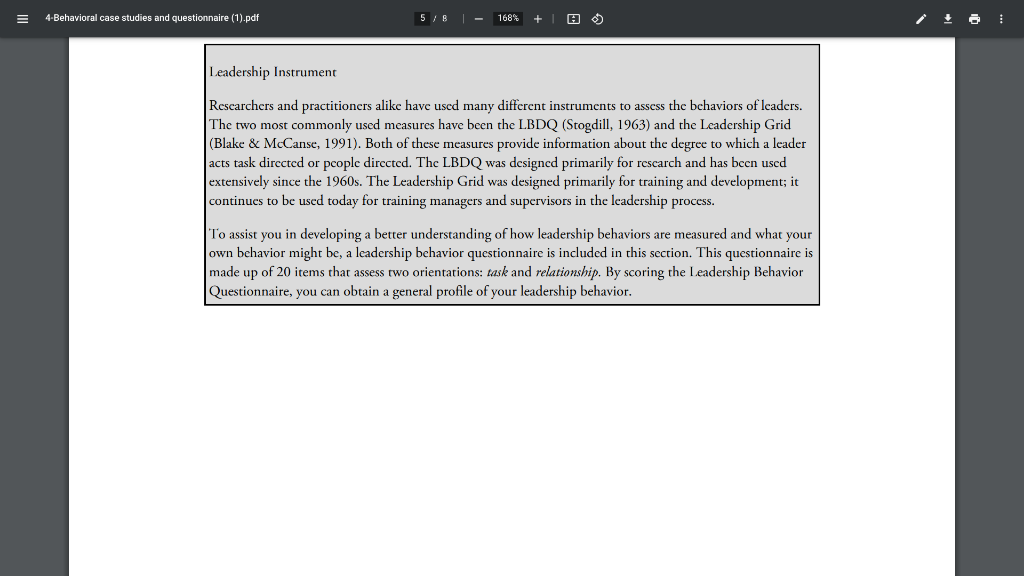
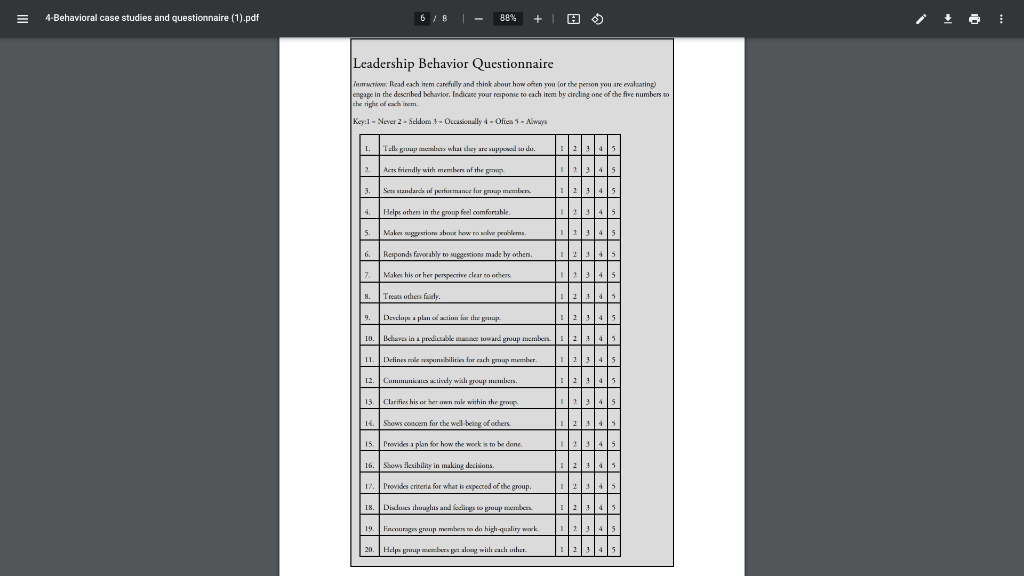
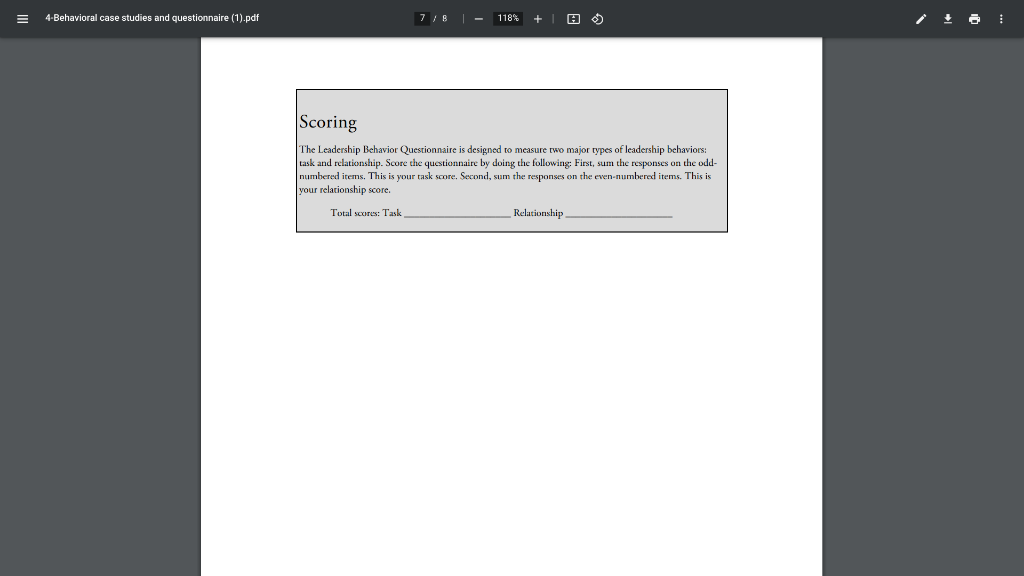
4-Behavioral case studies and questionnaire (1).pdf 58 - 168% + Leadership Instrument Rescarchers and practitioners alike have used many different instruments to assess the behaviors of leaders. The two most commonly used measures have been the LBDQ (Stogdill, 1963) and the Leadership Grid (Blake & McCanse, 1991). Both of these measures provide information about the degree to which a leader acts task directed or people directed. The LBDQ was designed primarily for rescarch and has been used extensively since the 1960s. The Leadership Grid was designed primarily for training and development; it continues to be used today for training managers and supervisors in the leadership process. To assist you in developing a better understanding of how leadership behaviors are measured and what your own behavior might be, a leadership behavior questionnaire is included in this section. This questionnaire is made up of 20 items that assess two orientations: task and relationship. By scoring the Leadership Behavior Questionnaire, you can obtain a general profile of your leadership behavior. 4-Behavioral case studies and questionnaire (1).pdf 6/B - 88% Leadership Behavior Questionnaire two: Read each item carefully and think about how often you for the person you are evaluating) engage in the described behavior. Indicare your response to each item by circling one of the five numbers to the right of each item Key:1 - Never 2 - Seldom 3 - Occasionally d - Often 5 - Always Toll group incl. what they are suppose sordu Acts friendly with members of the group Sets standards of perturence for poup members. Helps others in the group feel comfortable 5. Makertion about how to solve problems Responds favocably to suggestions made by others. Makes his or her perspective clear to others 8. Treats others faily. 9. Develu apland in for her up. 10. Believes in a predictabkoward group members 11. Detines role in ble for each group member 12. Cummi vedy with group members 13 Clarifies his or her wwn role within the group 14. Shows concern for the well-being of others 15. Provides a plan for how the work is to be done. 16. Shows flexibility in making decisions. 17. Provides criteria for what is expected of the group 18. Dulu houses and feelings to group member 19. Encourages group members to do high-quality work 20. Heps group members get along with ach ther. 4-Behavioral case studies and questionnaire (1).pdf 7/8 | - 118% + Scoring The Leadership Behavior Questionnaire is designed measure two major types of leadership behaviors: task and relationship. Score the questionnaire by doing the following: First, sum the responses on the odd- numbered items. This is your task score. Second, sum the responses on the even-numbered items. This is your relationship score. Total scores: Task Relationship 4-Behavioral case studies and questionnaire (1).pdf 58 - 168% + Leadership Instrument Rescarchers and practitioners alike have used many different instruments to assess the behaviors of leaders. The two most commonly used measures have been the LBDQ (Stogdill, 1963) and the Leadership Grid (Blake & McCanse, 1991). Both of these measures provide information about the degree to which a leader acts task directed or people directed. The LBDQ was designed primarily for rescarch and has been used extensively since the 1960s. The Leadership Grid was designed primarily for training and development; it continues to be used today for training managers and supervisors in the leadership process. To assist you in developing a better understanding of how leadership behaviors are measured and what your own behavior might be, a leadership behavior questionnaire is included in this section. This questionnaire is made up of 20 items that assess two orientations: task and relationship. By scoring the Leadership Behavior Questionnaire, you can obtain a general profile of your leadership behavior. 4-Behavioral case studies and questionnaire (1).pdf 6/B - 88% Leadership Behavior Questionnaire two: Read each item carefully and think about how often you for the person you are evaluating) engage in the described behavior. Indicare your response to each item by circling one of the five numbers to the right of each item Key:1 - Never 2 - Seldom 3 - Occasionally d - Often 5 - Always Toll group incl. what they are suppose sordu Acts friendly with members of the group Sets standards of perturence for poup members. Helps others in the group feel comfortable 5. Makertion about how to solve problems Responds favocably to suggestions made by others. Makes his or her perspective clear to others 8. Treats others faily. 9. Develu apland in for her up. 10. Believes in a predictabkoward group members 11. Detines role in ble for each group member 12. Cummi vedy with group members 13 Clarifies his or her wwn role within the group 14. Shows concern for the well-being of others 15. Provides a plan for how the work is to be done. 16. Shows flexibility in making decisions. 17. Provides criteria for what is expected of the group 18. Dulu houses and feelings to group member 19. Encourages group members to do high-quality work 20. Heps group members get along with ach ther. 4-Behavioral case studies and questionnaire (1).pdf 7/8 | - 118% + Scoring The Leadership Behavior Questionnaire is designed measure two major types of leadership behaviors: task and relationship. Score the questionnaire by doing the following: First, sum the responses on the odd- numbered items. This is your task score. Second, sum the responses on the even-numbered items. This is your relationship score. Total scores: Task Relationship
Step by Step Solution

There are 3 Steps involved in it

1 Expert Approved Answer
Step: 1 Unlock blur-text-image

Question Has Been Solved by an Expert!

Get step-by-step solutions from verified subject matter experts

Step: 2 Unlock
Step: 3 Unlock

Students Have Also Explored These Related General Management Questions!