







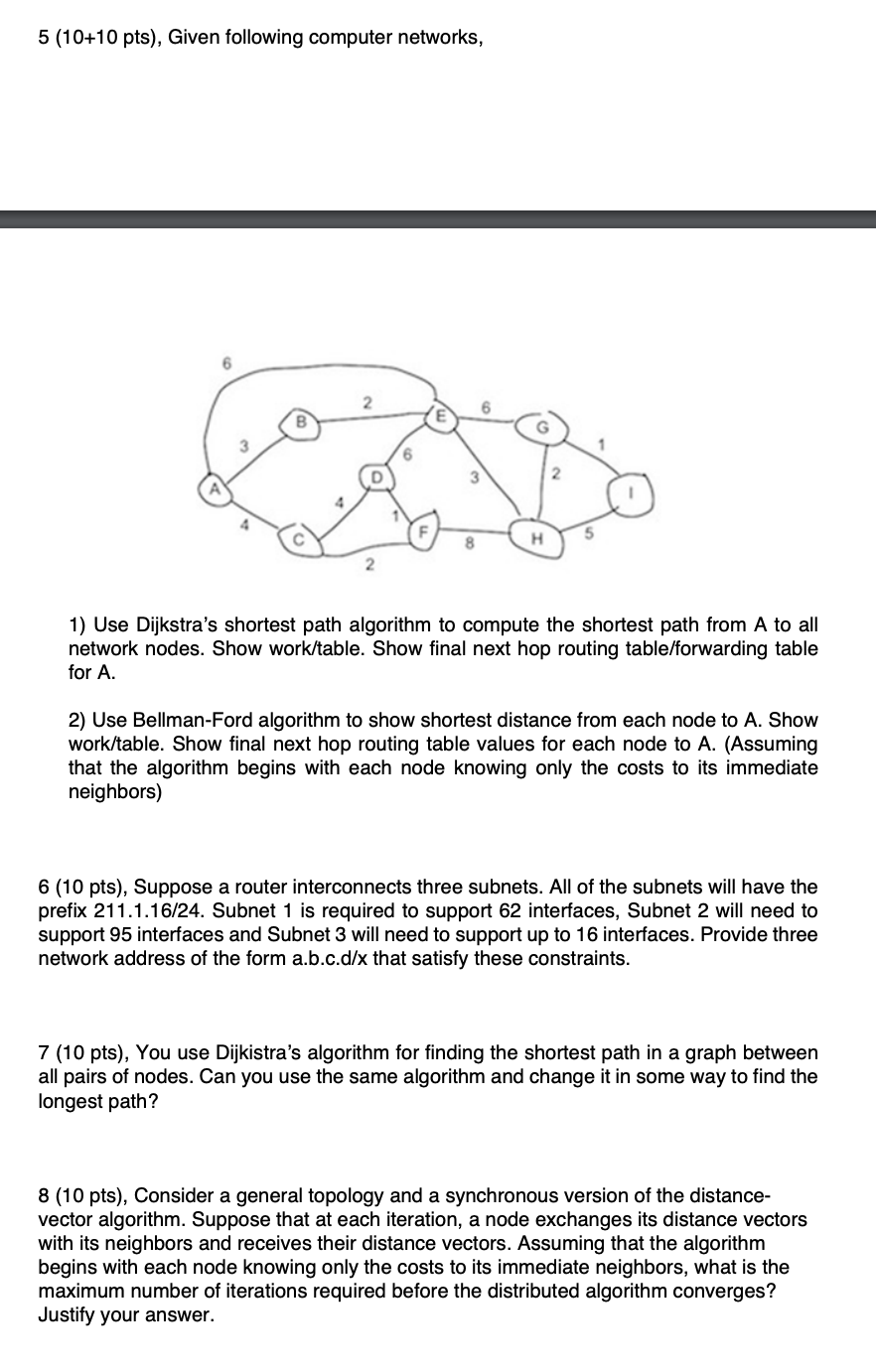
Question: 5 ( 1 0 + 1 0 pts ) , Given following computer networks, 1 ) Use Dijkstra's shortest path algorithm to compute the shortest
pts Given following computer networks,
Use Dijkstra's shortest path algorithm to compute the shortest path from A to all network nodes. Show worktable Show final next hop routing tableforwarding table for A
Use BellmanFord algorithm to show shortest distance from each node to A Show worktable Show final next hop routing table values for each node to AAssuming that the algorithm begins with each node knowing only the costs to its immediate neighbors
pts Suppose a router interconnects three subnets. All of the subnets will have the prefix Subnet is required to support interfaces, Subnet will need to support interfaces and Subnet will need to support up to interfaces. Provide three network address of the form abcdx that satisfy these constraints.
pts You use Dijkistra's algorithm for finding the shortest path in a graph between all pairs of nodes. Can you use the same algorithm and change it in some way to find the longest path?
pts Consider a general topology and a synchronous version of the distancevector algorithm. Suppose that at each iteration, a node exchanges its distance vectors with its neighbors and receives their distance vectors. Assuming that the algorithm begins with each node knowing only the costs to its immediate neighbors, what is the maximum number of iterations required before the distributed algorithm converges? Justify your answer.
Step by Step Solution
There are 3 Steps involved in it
1 Expert Approved Answer
Step: 1 Unlock

Question Has Been Solved by an Expert!
Get step-by-step solutions from verified subject matter experts
Step: 2 Unlock
Step: 3 Unlock
 Study Help