







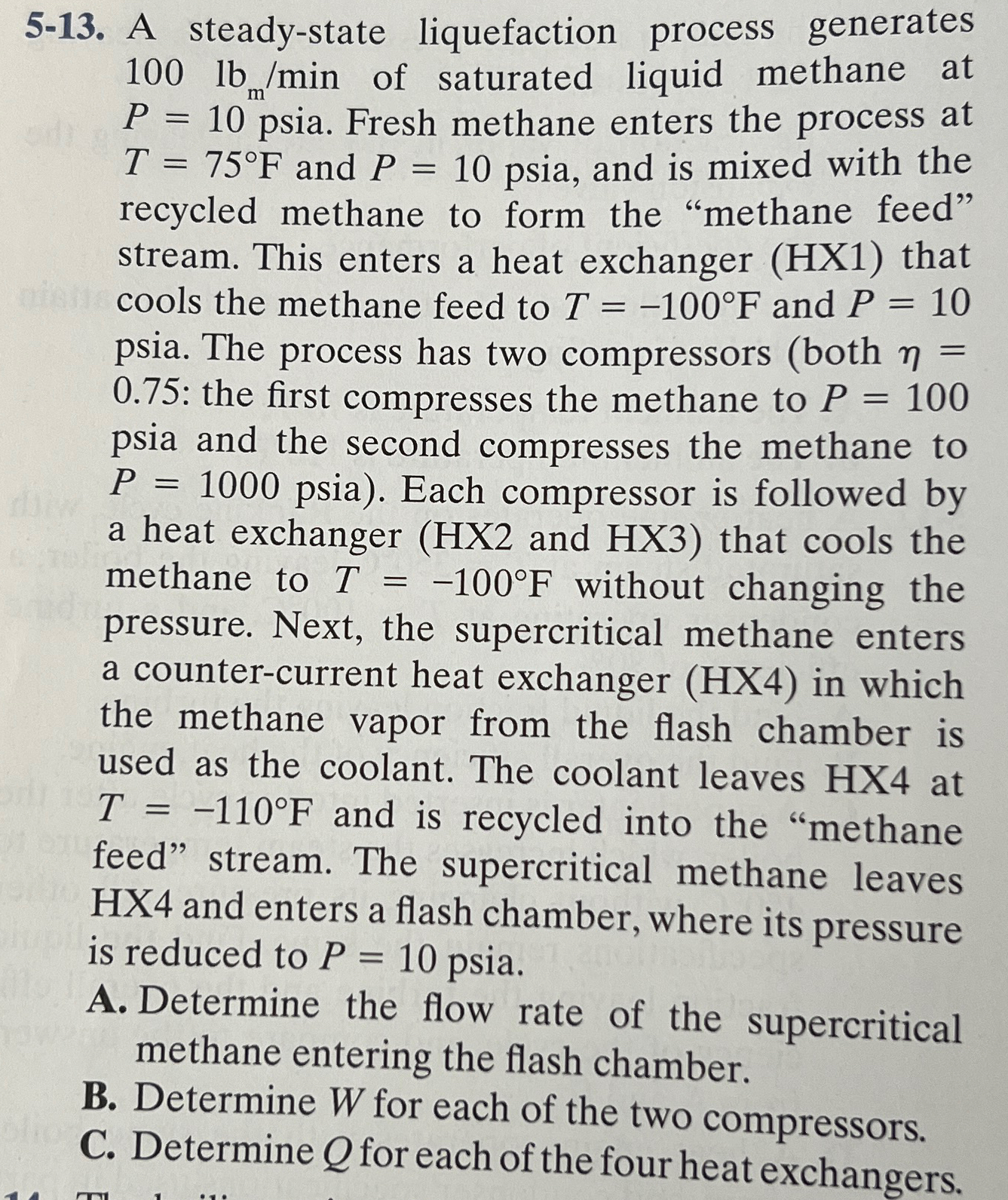
Question: 5 - 1 3 . A steady - state liquefaction process generates 1 0 0 l b m m i n of saturated liquid methane
A steadystate liquefaction process generates of saturated liquid methane at psia. Fresh methane enters the process at and and is mixed with the recycled methane to form the "methane feed" stream. This enters a heat exchanger HX that cools the methane feed to and psia. The process has two compressors both : the first compresses the methane to psia and the second compresses the methane to psia Each compressor is followed by a heat exchanger HX and HX that cools the methane to without changing the pressure. Next, the supercritical methane enters a countercurrent heat exchanger HX in which the methane vapor from the flash chamber is used as the coolant. The coolant leaves HX at and is recycled into the "methane feed" stream. The supercritical methane leaves HX and enters a flash chamber, where its pressure is reduced to psia.
A Determine the flow rate of the supercritical methane entering the flash chamber.
B Determine for each of the two compressors.
C Determine for each of the four heat exchangers.
Step by Step Solution
There are 3 Steps involved in it
1 Expert Approved Answer
Step: 1 Unlock

Question Has Been Solved by an Expert!
Get step-by-step solutions from verified subject matter experts
Step: 2 Unlock
Step: 3 Unlock
 Study Help