







Question: Problem 1. Consider a neoclassical growth model with full depreciation {Ca ke+1. i.h}g';o max if {log (0;) Ah} 0 0 i=0 s.t. c.+a = k'hi'
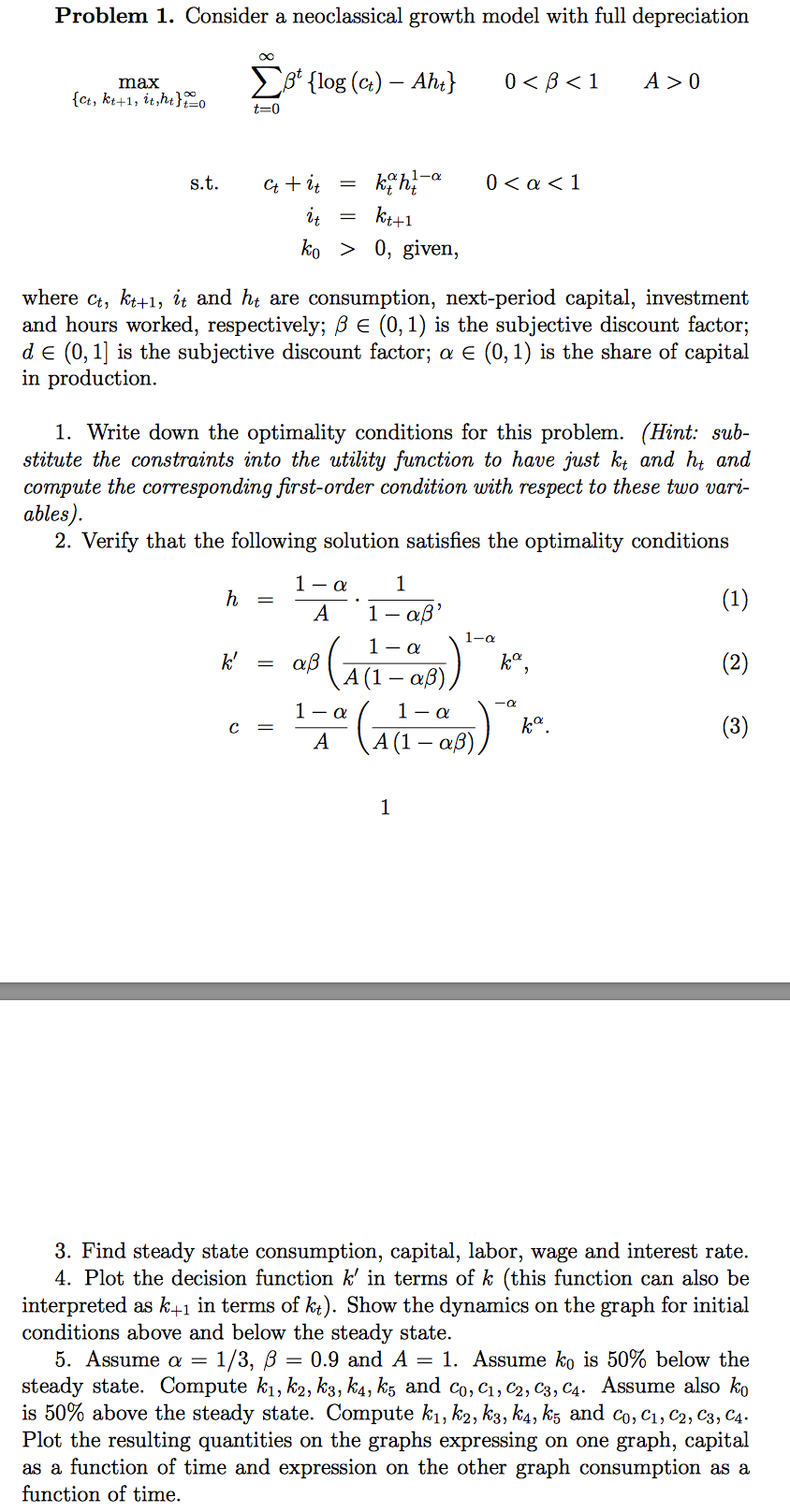
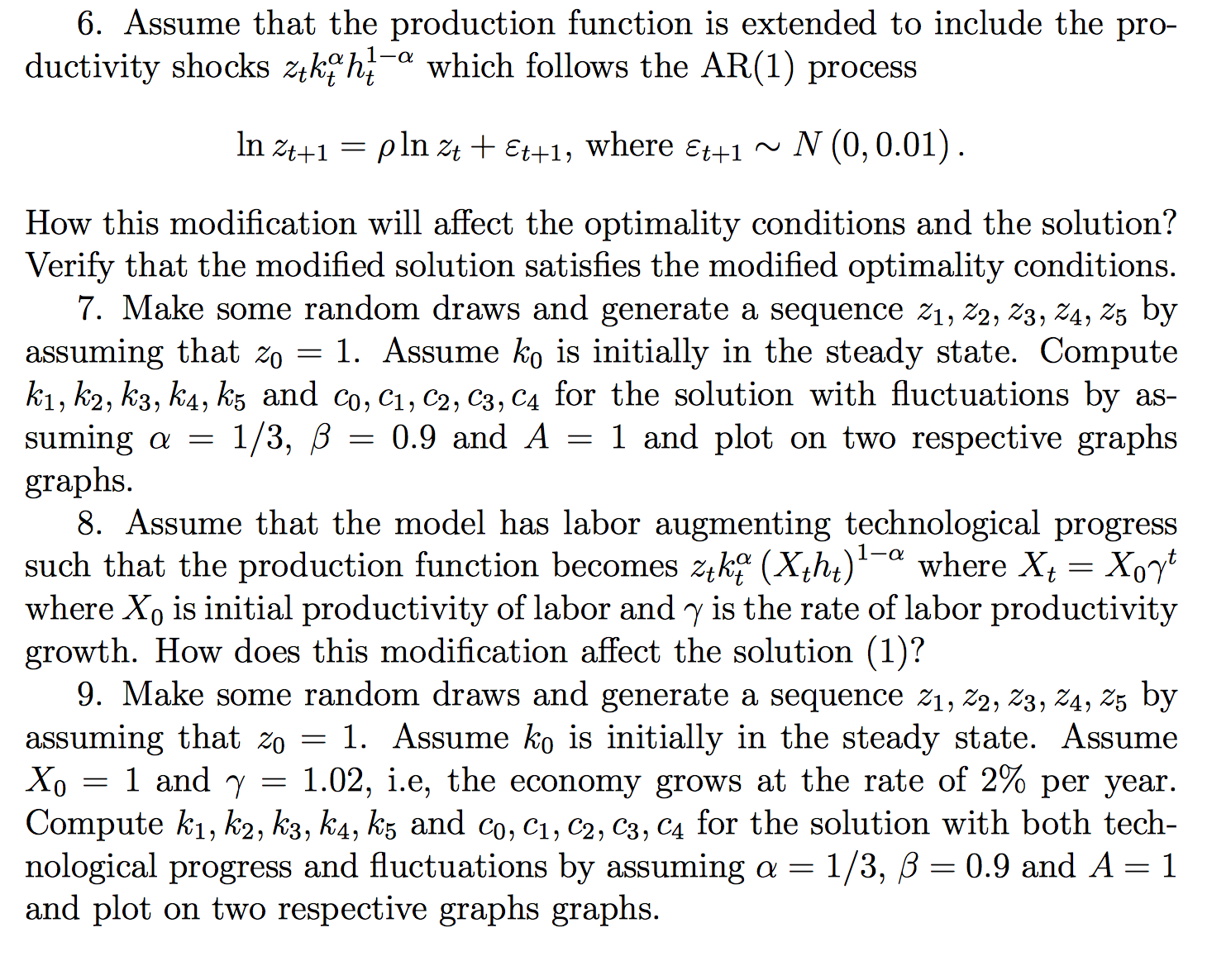
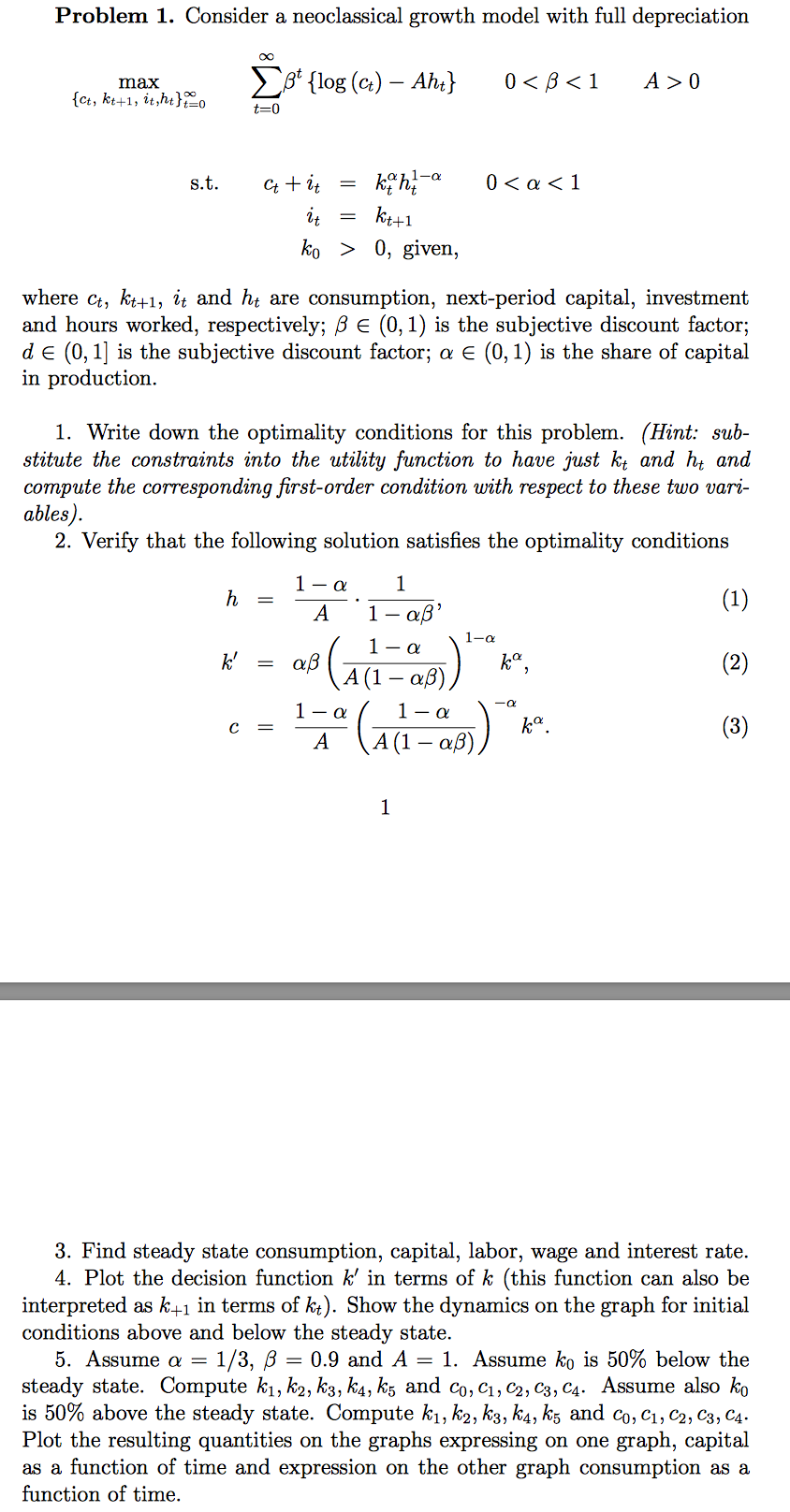
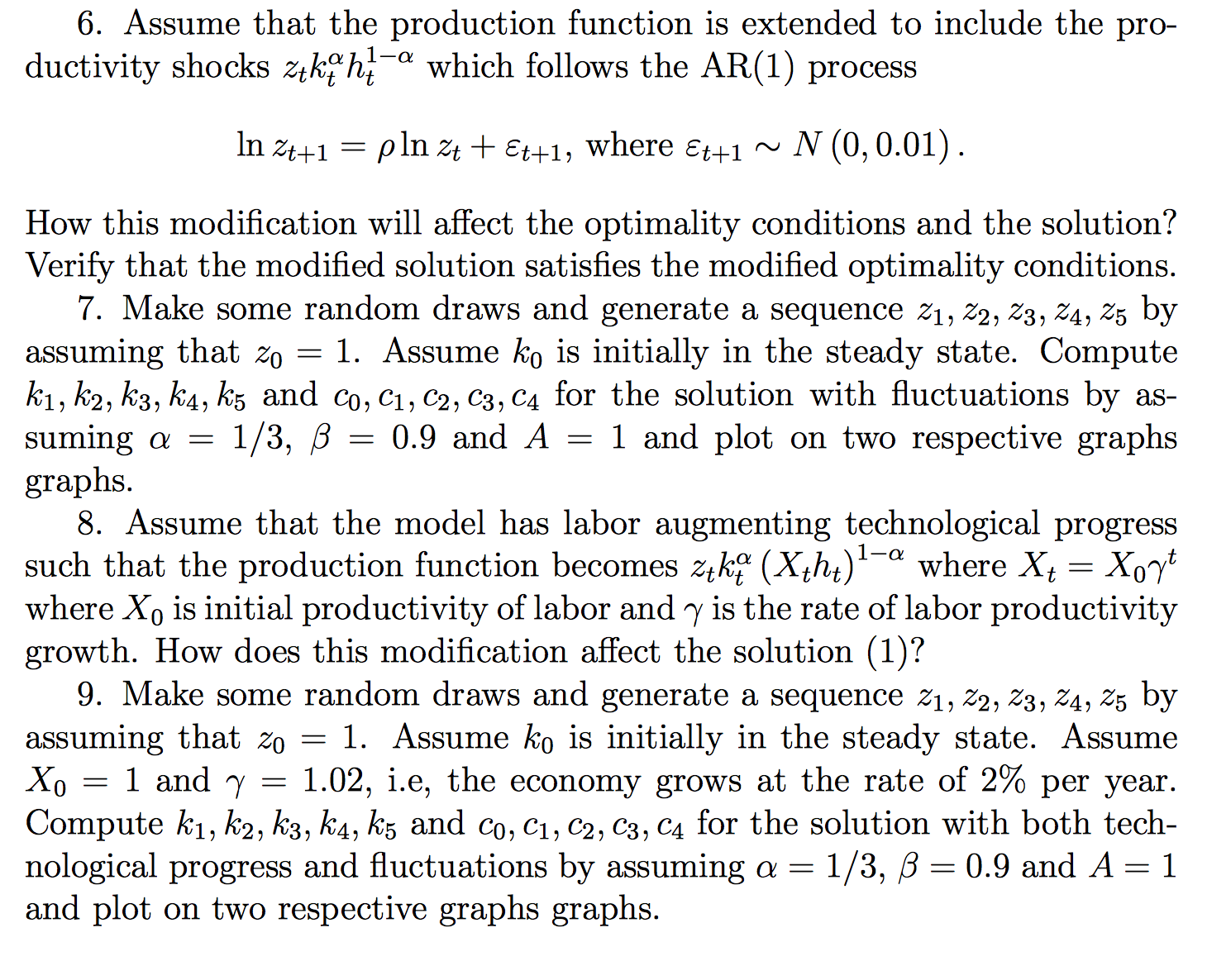
Problem 1. Consider a neoclassical growth model with full depreciation {Ca ke+1. i.h}g';o max if {log (0;) Ah} 0 0 i=0 s.t. c.+a = k'hi'\" 0 0, given, 3: where 05, kt+1, it and h; are consumption, nextperiod capital, investment and hours worked, respectively; )3 E (0, 1) is the subjective discount factor; d E (0, 1] is the subjective discount factor; a: E (0, 1) is the share of capital in production. 1. Write down the optimality conditions for this problem. (Hint: sub stitute the constraints into the utility function to have just is; and it: and compute the corresponding rstorder condition with respect to these two pairi ables). 2. Verify that the following solution satises the optimality conditions h = aw1&6, (1) k' = as (yaka, (2) 1 3. Find steady state consumption, capital, labor, wage and interest rate. 4. Plot the decision flmction k' in terms of Is (this function can also be interpreted as ml in terms of in). Show the dynamics on the graph for initial conditions above and below the steady state. 5. Assume a: = 1/3, 6 = 0.9 and A = 1. Assume kg is 50% below the steady state. Compute in, kg, k3,k4,k5 and co,c1,oz,c3,c4. Assume also k0 is 50% above the steady state. Compute 1701, kg, k3, M, (5 and c0, c1, c2, c3, c4. Plot the resulting quantities on the graphs expressing on one graph, capital as a flmction of time and expression on the other graph consumption as a function of time. 6. Assume that the production function is extended to include the pro- ductivity shocks zekoh, which follows the AR(1) process In zt+1 = pln zt + Et+1, where Et+1 ~ N (0, 0.01) . How this modification will affect the optimality conditions and the solution? Verify that the modified solution satisfies the modified optimality conditions. 7. Make some random draws and generate a sequence z1, Z2, 23, 24, 25 by assuming that zo = 1. Assume ko is initially in the steady state. Compute K1, k2, k3, k4, k5 and Co, C1, C2, C3, C4 for the solution with fluctuations by as- suming a = 1/3, B = 0.9 and A = 1 and plot on two respective graphs graphs. 8. Assume that the model has labor augmenting technological progress such that the production function becomes zeke (Xtht) where Xt = Xort where Xo is initial productivity of labor and y is the rate of labor productivity growth. How does this modification affect the solution (1)? 9. Make some random draws and generate a sequence z1, Z2, 23, 24, 25 by assuming that zo = 1. Assume ko is initially in the steady state. Assume Xo = 1 and y = 1.02, i.e, the economy grows at the rate of 2% per year. Compute K1, K2, k3, k4, k5 and co, C1, C2, C3, C4 for the solution with both tech- nological progress and fluctuations by assuming a = 1/3, B = 0.9 and A = 1 and plot on two respective graphs graphs
Step by Step Solution
There are 3 Steps involved in it

Get step-by-step solutions from verified subject matter experts
 Study Help