







Question: 5 #1. Problem #39 (a) only (30 points) Cloth usage (sq yds) Cloth per shirts Cloth per pants 7 Unit costs Regular time Overtime Holding
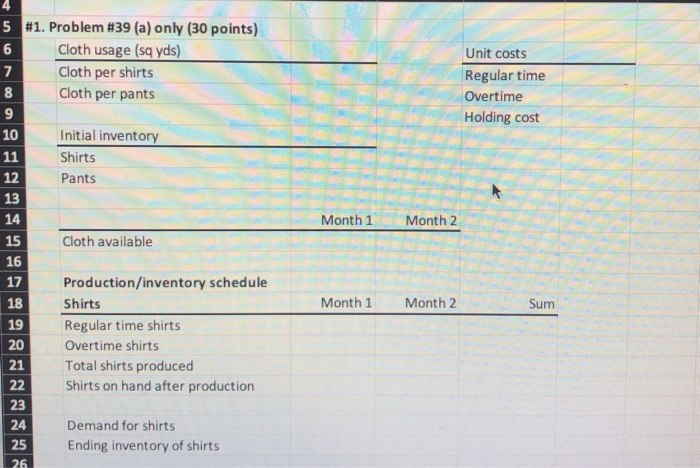
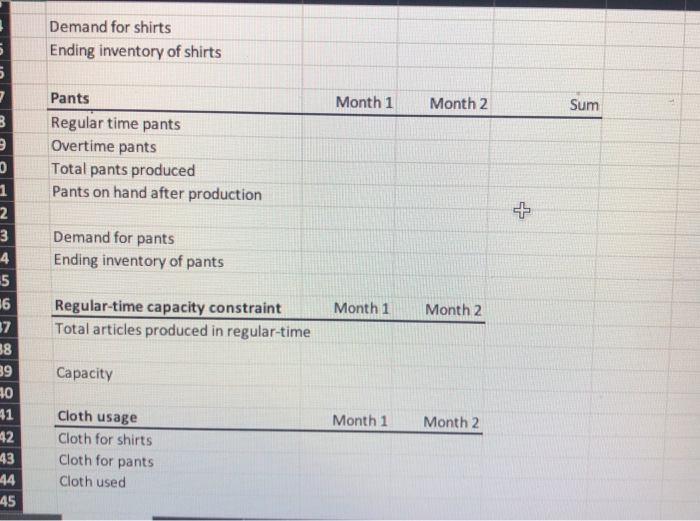
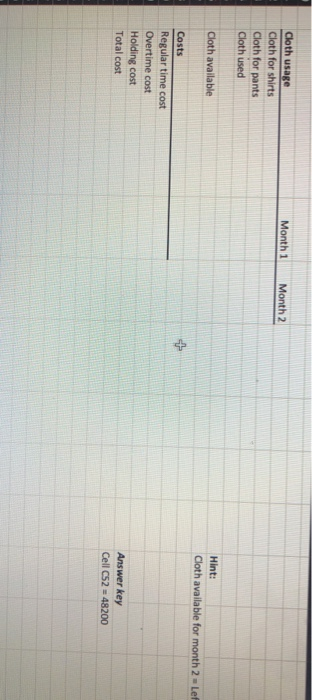
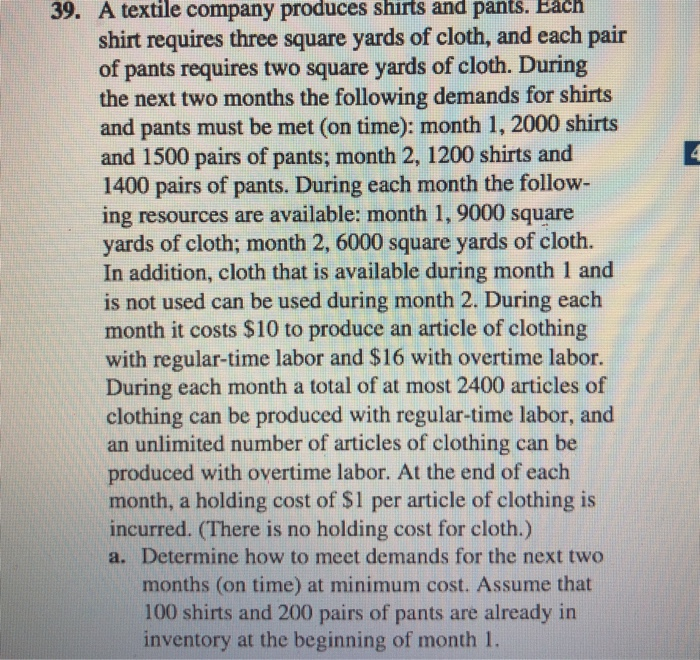
5 #1. Problem #39 (a) only (30 points) Cloth usage (sq yds) Cloth per shirts Cloth per pants 7 Unit costs Regular time Overtime Holding cost Initial inventory Shirts Pants Month 1 Month 2 Cloth available Month 1 Month 2 Production/inventory schedule Shirts Regular time shirts Overtime shirts Total shirts produced Shirts on hand after production Demand for shirts Ending inventory of shirts Demand for shirts Ending inventory of shirts Month 1 Month 2 Sum Pants Regular time pants Overtime pants Total pants produced Pants on hand after production Demand for pants Ending inventory of pants Month 1 Month 2 Regular-time capacity constraint Total articles produced in regular-time Capacity Month 1 Month 2 Cloth usage Cloth for shirts Cloth for pants Cloth used Month 1 Month 2 Cloth usage Cloth for shirts Cloth for pants Cloth used Cloth available Hint: Cloth available for month 2 - Lel Costs Regular time cost Overtime cost Holding cost Total cost Answer key Cell CS2 = 48200 39. A textile company produces shirts and pants. Each shirt requires three square yards of cloth, and each pair of pants requires two square yards of cloth. During the next two months the following demands for shirts and pants must be met (on time): month 1, 2000 shirts and 1500 pairs of pants; month 2, 1200 shirts and 1400 pairs of pants. During each month the follow- ing resources are available: month 1, 9000 square yards of cloth; month 2, 6000 square yards of cloth. In addition, cloth that is available during month 1 and is not used can be used during month 2. During each month it costs $10 to produce an article of clothing with regular-time labor and $16 with overtime labor. During each month a total of at most 2400 articles of clothing can be produced with regular-time labor, and an unlimited number of articles of clothing can be produced with overtime labor. At the end of each month, a holding cost of $1 per article of clothing is incurred. (There is no holding cost for cloth.) a. Determine how to meet demands for the next two months (on time) at minimum cost. Assume that 100 shirts and 200 pairs of pants are already in inventory at the beginning of month 1
Step by Step Solution
There are 3 Steps involved in it

Get step-by-step solutions from verified subject matter experts
 Study Help