







Question: 5. (12 points total) Let A = Rmxn be a full rank matrix with m n. Such matrices were the object of focus at
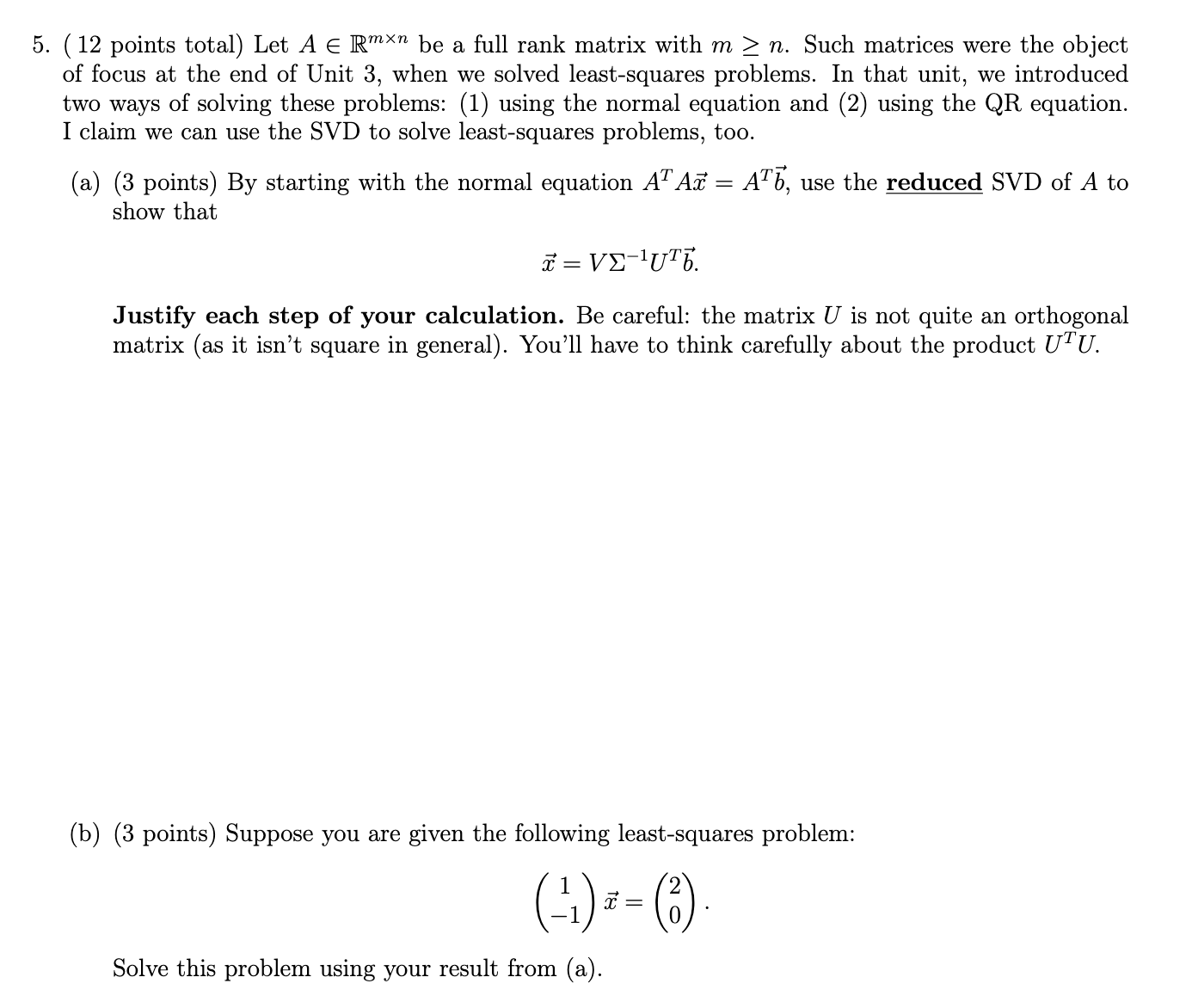
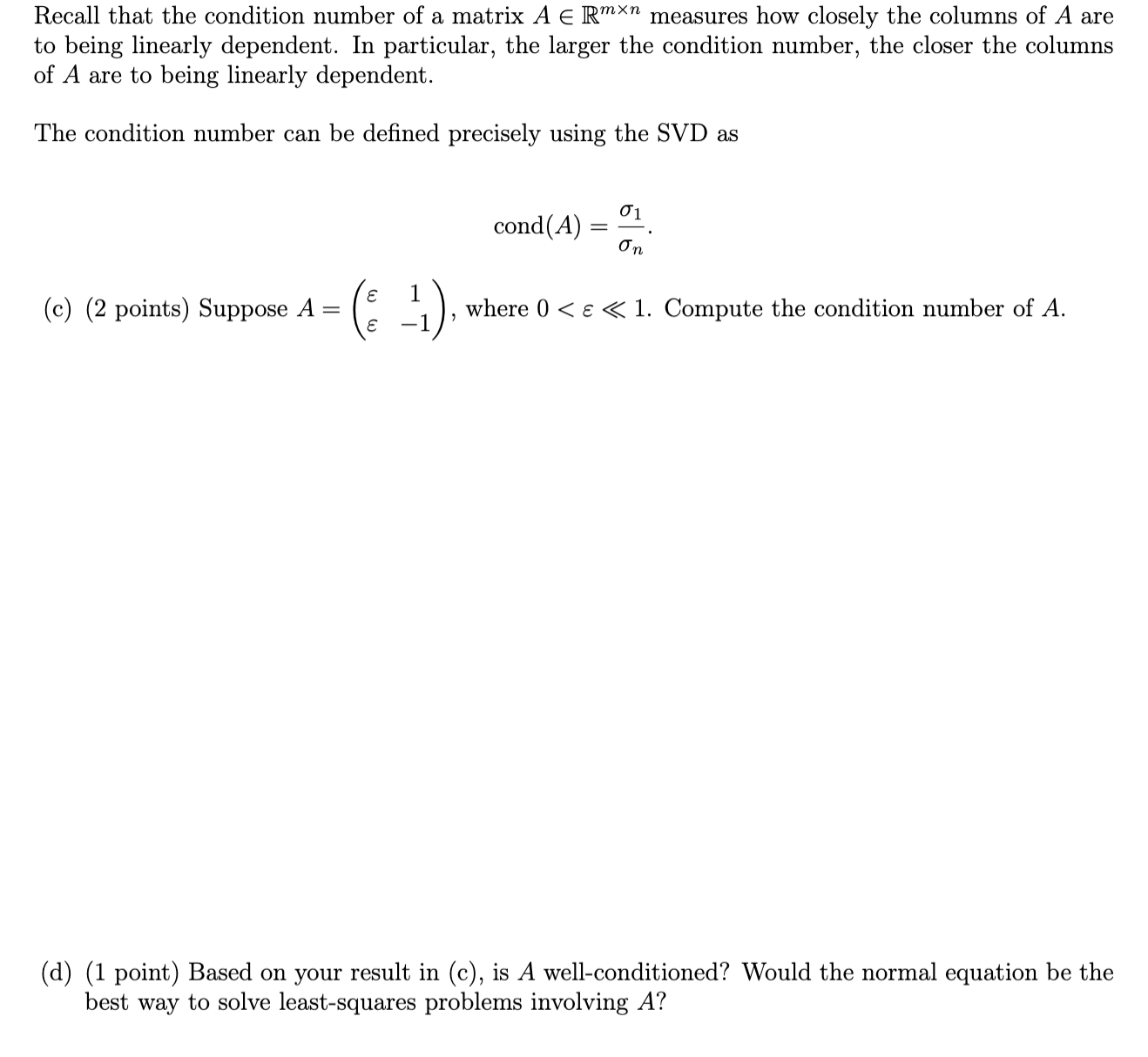
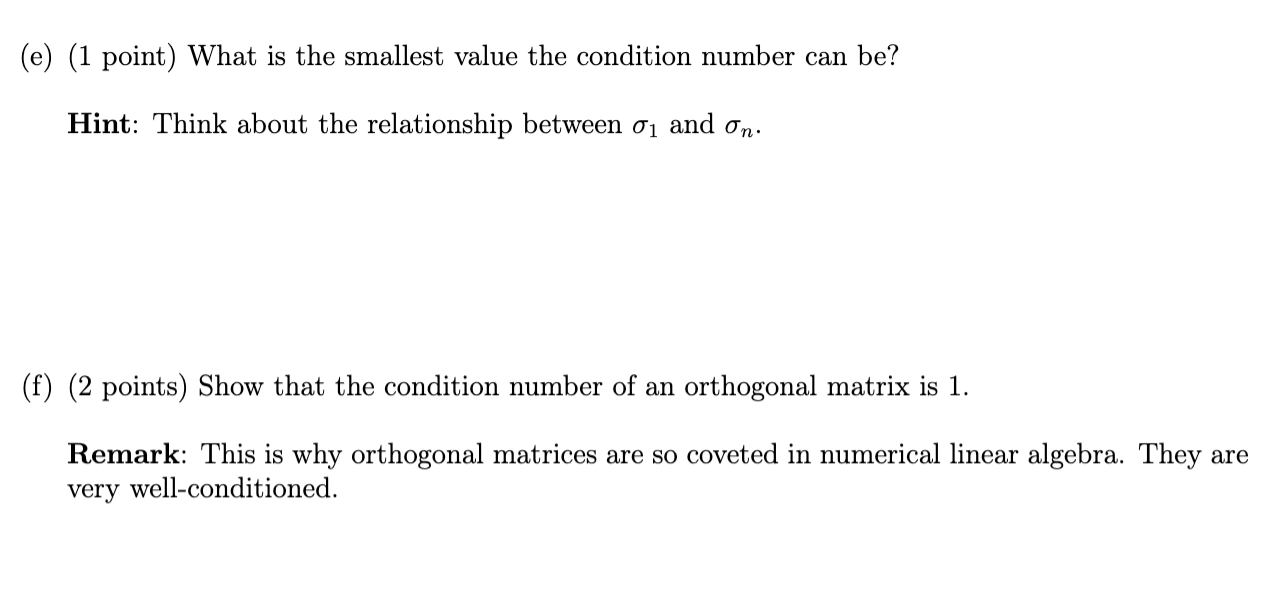
5. (12 points total) Let A = Rmxn be a full rank matrix with m n. Such matrices were the object of focus at the end of Unit 3, when we solved least-squares problems. In that unit, we introduced two ways of solving these problems: (1) using the normal equation and (2) using the QR equation. I claim we can use the SVD to solve least-squares problems, too. = (a) (3 points) By starting with the normal equation AT Ax = show that x = V-UT. , use the reduced SVD of A to Justify each step of your calculation. Be careful: the matrix U is not quite an orthogonal matrix (as it isn't square in general). You'll have to think carefully about the product UTU. (b) (3 points) Suppose you are given the following least-squares problem: (4)-(6) Solve this problem using your result from (a). Recall that the condition number of a matrix A = Rmxn measures how closely the columns of A are to being linearly dependent. In particular, the larger the condition number, the closer the columns of A are to being linearly dependent. The condition number can be defined precisely using the SVD as cond (A): (c) (2 points) Suppose A = ( 11), where 0 < < < 1. Compute the condition number of A. (d) (1 point) Based on your result in (c), is A well-conditioned? Would the normal equation be the best way to solve least-squares problems involving A? (e) (1 point) What is the smallest value the condition number can be? Hint: Think about the relationship between and n. (f) (2 points) Show that the condition number of an orthogonal matrix is 1. Remark: This is why orthogonal matrices are so coveted in numerical linear algebra. They are very well-conditioned.
Step by Step Solution
There are 3 Steps involved in it

Get step-by-step solutions from verified subject matter experts
 Study Help