







Question: 5. (20 MARKS) Fix an alphabet . For k > 0. define the k-interleave operation, as follows : * x + 32 That is, I
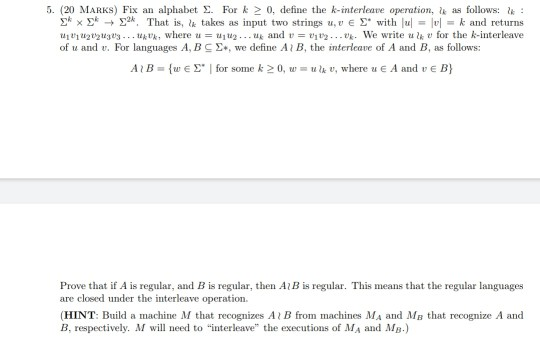
5. (20 MARKS) Fix an alphabet . For k > 0. define the k-interleave operation, as follows : * x + 32 That is, I takes as input two strings , EE with = v=k and returns .. . where = t ... and = tu... We write for the f-interleave of u and u. For languages ABCS, we define AB, the interlove of A and B as follows: AB-{WEE" for some k > 0, W=, where u E A and ve B) Prove that if A is regular, and B is regular, then A B is regular. This means that the regular languages are closed under the interleave operation. (HINT: Build a machine M that recognizes A B from machines MA and Ms that recognize A and B, respectively. Mwill need to "interleave the executions of MA and Ms.)
Step by Step Solution
There are 3 Steps involved in it

Get step-by-step solutions from verified subject matter experts
 Study Help