







Question: 5. [-/22 Points] DETAILS BBUNDERSTAT12 9.R.008. MY NOTES ASK YOUR TEACHER Dorothy Kelly sells life insurance for the Prudence Insurance Company. She sells insurance by
![5. [-/22 Points] DETAILS BBUNDERSTAT12 9.R.008. MY NOTES ASK YOUR TEACHER](https://s3.amazonaws.com/si.experts.images/answers/2024/06/6671fb9674cf5_0066671fb96466ed.jpg)
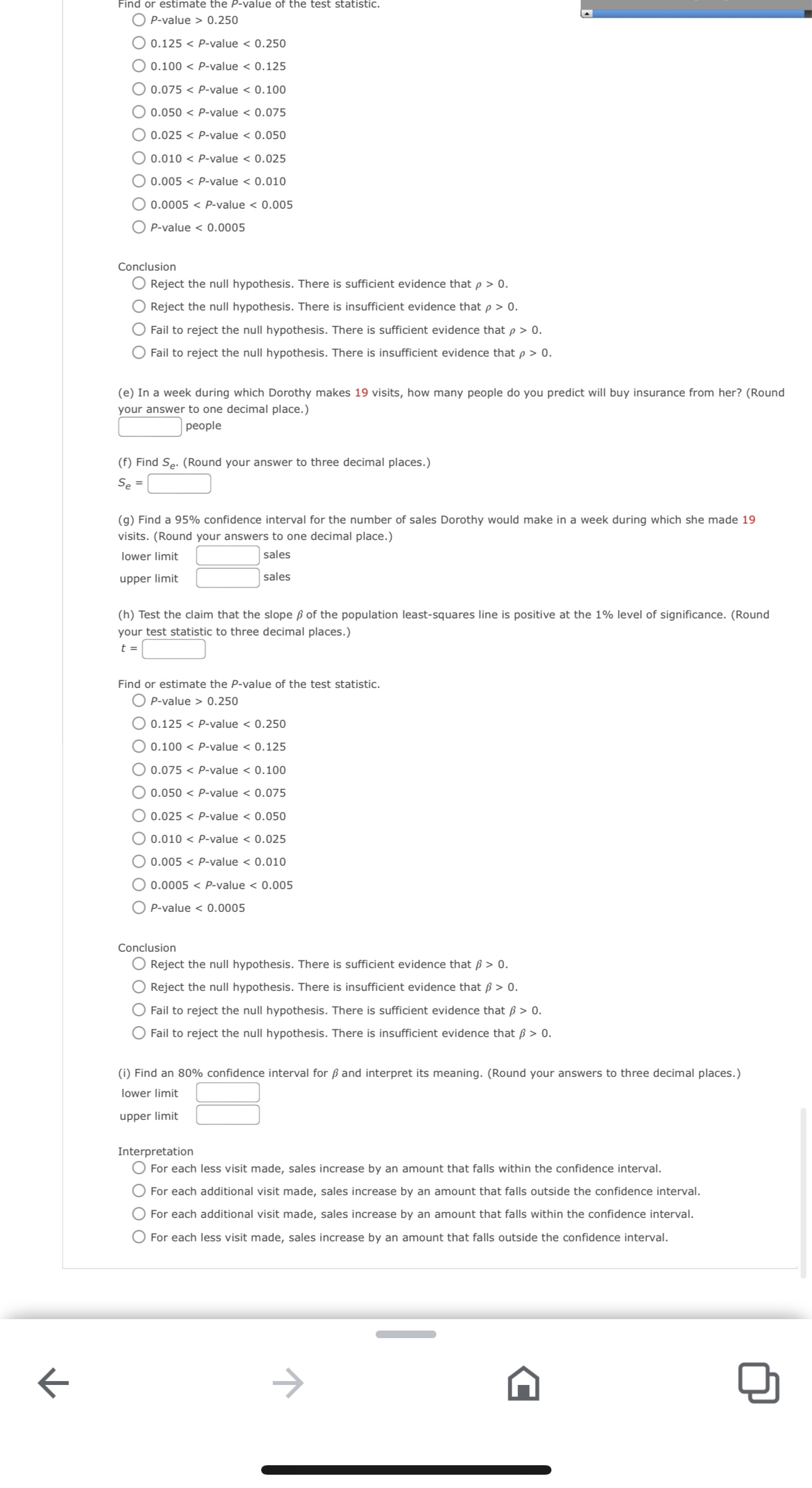
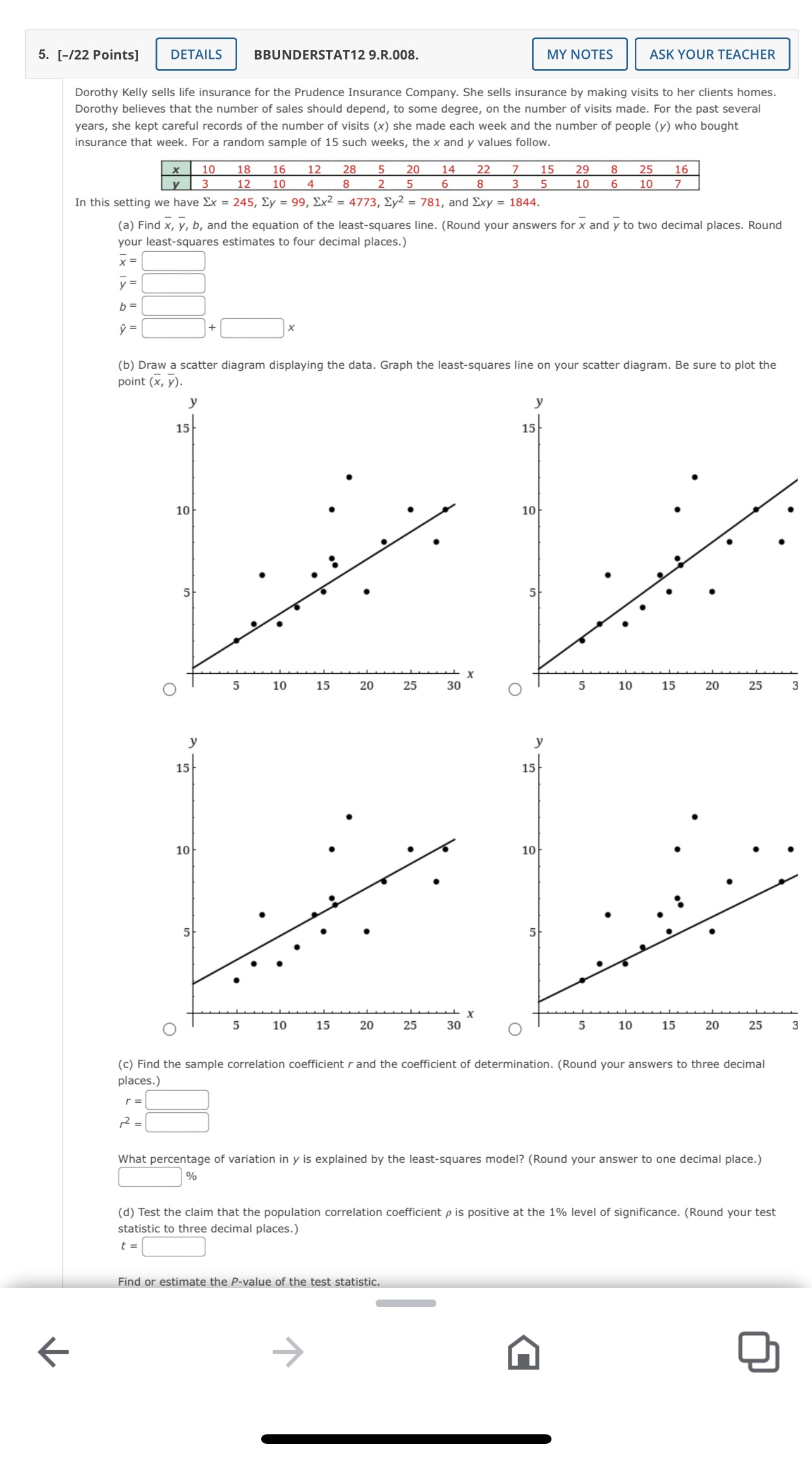
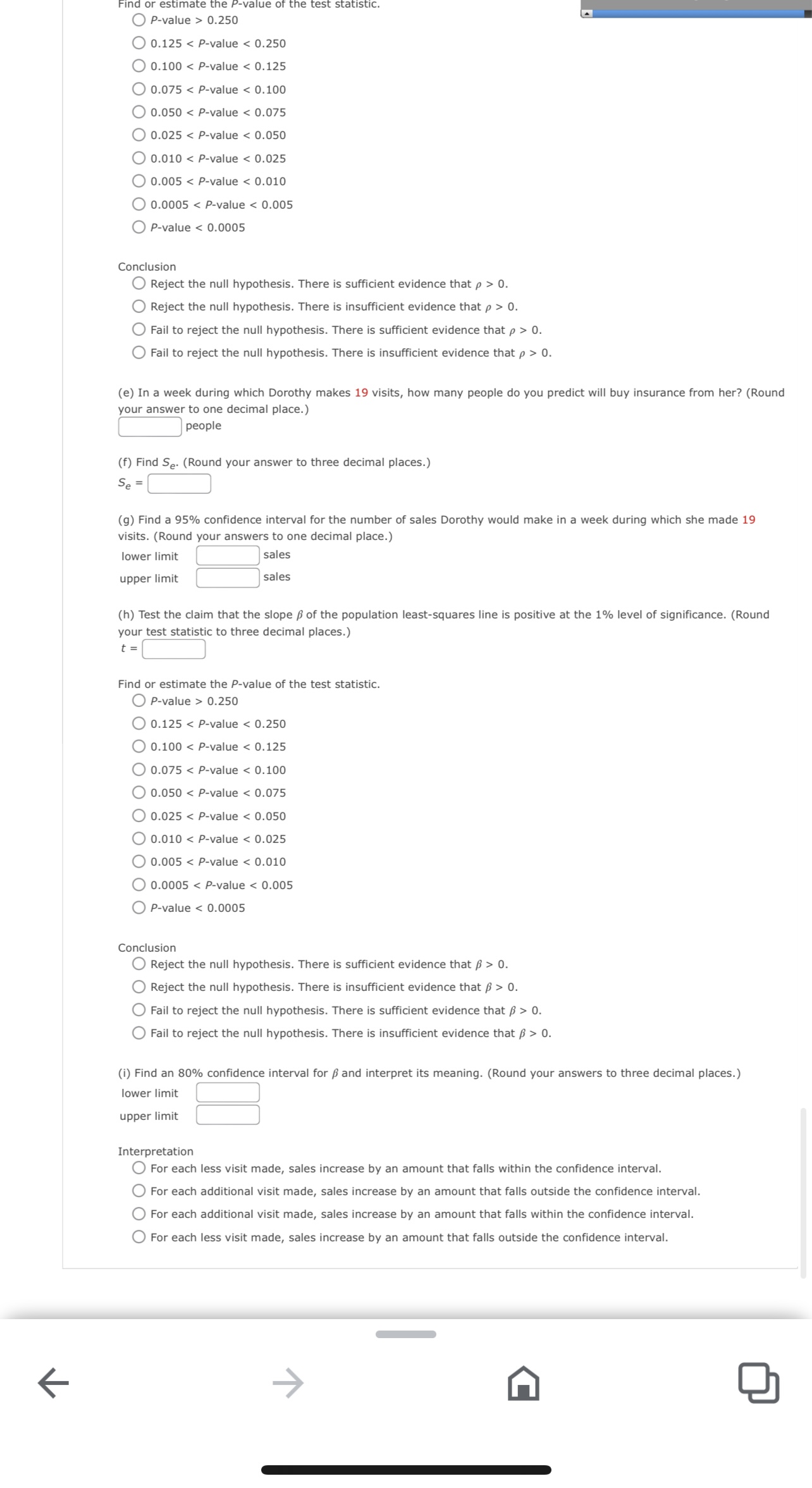
5. [-/22 Points] DETAILS BBUNDERSTAT12 9.R.008. MY NOTES ASK YOUR TEACHER Dorothy Kelly sells life insurance for the Prudence Insurance Company. She sells insurance by making visits to her clients homes. Dorothy believes that the number of sales should depend, to some degree, on the number of visits made. For the past several years, she kept careful records of the number of visits (x) she made each week and the number of people (y) who bought insurance that week. For a random sample of 15 such weeks, the x and y values follow. 10 18 16 12 12 10 4 28 8 2 20 6 8 3 5 25 10 6 10 7 In this setting we have Ex = 245, Zy = 99, Ex2 = 4773, Zy2 = 781, and Exy = 1844. (a) Find x, y, b, and the equation of the least-squares line. (Round your answers for x and y to two decimal places. Round your least-squares estimates to four decimal places.) X = y = b = V = (b) Draw a scatter diagram displaying the data. Graph the least-squares line on your scatter diagram. Be sure to plot the point (x, y). 15 15 10 10 5 5 O 5 10 15 20 25 30 O 5 10 15 20 25 3 15 15 10 10 5 5 O 5 10 15 20 25 30 10 15 20 25 (c) Find the sample correlation coefficient r and the coefficient of determination. (Round your answers to three decimal places.) r = 2 = What percentage of variation in y is explained by the least-squares model? (Round your answer to one decimal place.) % (d) Test the claim that the population correlation coefficient p is positive at the 1% level of significance. (Round your test statistic to three decimal places.) t = Find or estimate the P-value of the test statistic. -Find or estimate the P-value of O P-value > 0.250 O 0.125 0. O Reject the null hypothesis. There is insufficient evidence that p > 0. O Fail to reject the null hypothesis. There is sufficient evidence that p > 0. O Fail to reject the null hypothesis. There is insufficient evidence that p > 0. (e) In a week during which Dorothy makes 19 visits, how many people do you predict will buy insurance from her? (Round your answer to one decimal place.) people (f) Find Se. (Round your answer to three decimal places.) Se =[ (g) Find a 95% confidence interval for the number of sales Dorothy would make in a week during which she made 19 visits. (Round your answers to one decimal place.) lower limit sales upper limit sales (h) Test the claim that the slope f of the population least-squares line is positive at the 1% level of significance. (Round your test statistic to three decimal places.) t = Find or estimate the P-value of the test statistic. O P-value > 0.250 O 0.125 0. O Reject the null hypothesis. There is insufficient evidence that B > 0. O Fail to reject the null hypothesis. There is sufficient evidence that B > 0. O Fail to reject the null hypothesis. There is insufficient evidence that B > 0. (i) Find an 80% confidence interval for $ and interpret its meaning. (Round your answers to three decimal places.) lower limit upper limit Interpretation O For each less visit made, sales increase by an amount that falls within the confidence interval. For each additional visit made, sales increase by an amount that falls outside the confidence interval. For each additional visit made, sales increase by an amount that falls within the confidence interval. O For each less visit made, sales increase by an amount that falls outside the confidence interval
Step by Step Solution
There are 3 Steps involved in it

Get step-by-step solutions from verified subject matter experts
 Study Help