







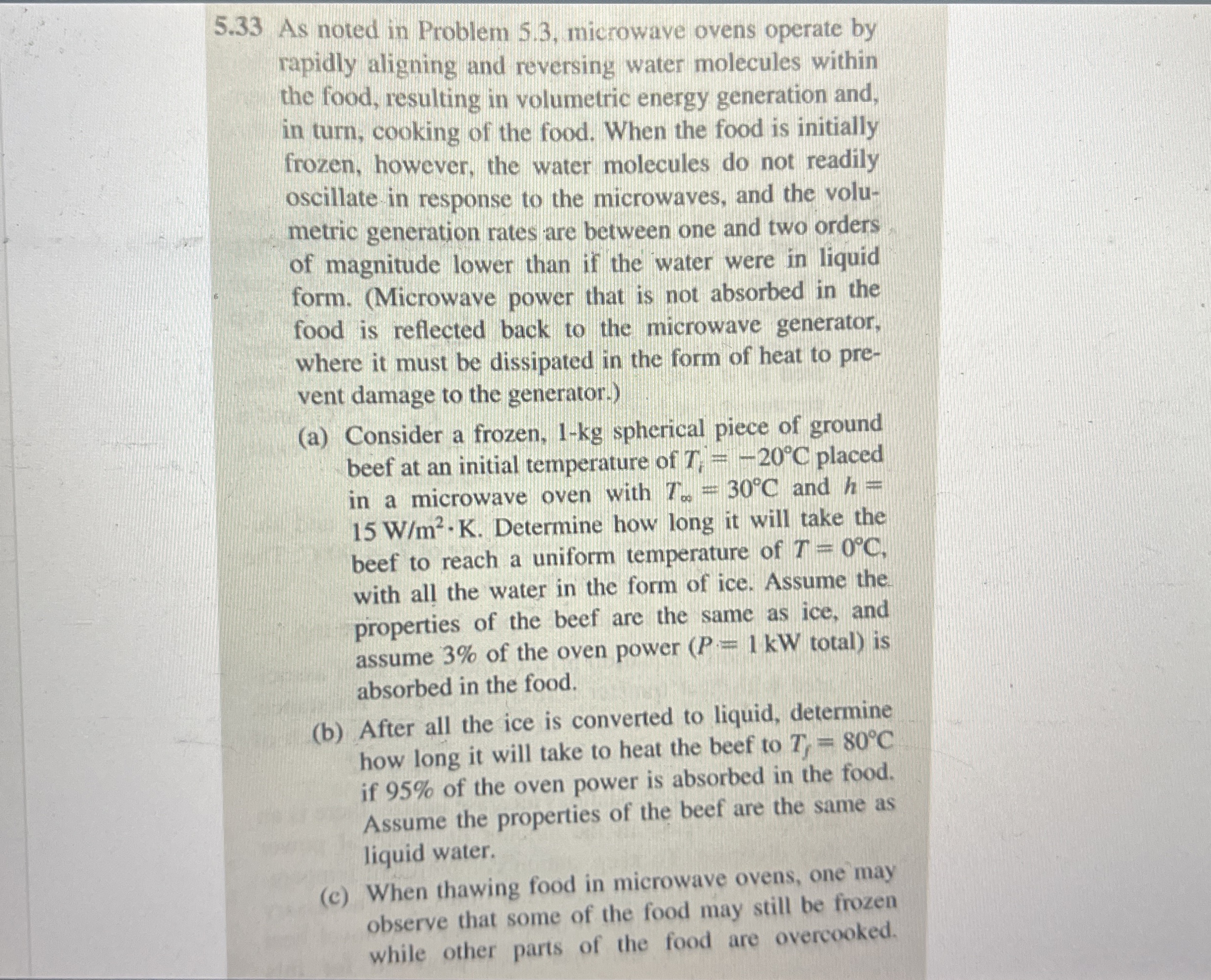
Question: 5 . 3 3 As noted in Problem 5 . 3 , microwave ovens operate by rapidly aligning and reversing water molecules within the food,
As noted in Problem microwave ovens operate by
rapidly aligning and reversing water molecules within
the food, resulting in volumetric energy generation and,
in turn, cooking of the food. When the food is initially
frozen, however, the water molecules do not readily
oscillate in response to the microwaves, and the volu
metric generation rates are between one and two orders
of magnitude lower than if the water were in liquid
form. Microwave power that is not absorbed in the
food is reflected back to the microwave generator,
where it must be dissipated in the form of heat to pre
vent damage to the generator.
a Consider a frozen, spherical piece of ground
beef at an initial temperature of placed
in a microwave oven with and
Determine how long it will take the
beef to reach a uniform temperature of
with all the water in the form of ice. Assume the
properties of the beef are the same as ice, and
assume of the oven power total is
absorbed in the food.
b After all the ice is converted to liquid, determine
how long it will take to heat the beef to
if of the oven power is absorbed in the food.
Assume the properties of the beef are the same as
liquid water.
c When thawing food in microwave ovens, one may
observe that some of the food may still be frozen
while other parts of the food are overcooked.
Step by Step Solution
There are 3 Steps involved in it
1 Expert Approved Answer
Step: 1 Unlock

Question Has Been Solved by an Expert!
Get step-by-step solutions from verified subject matter experts
Step: 2 Unlock
Step: 3 Unlock
 Study Help