Question: 5 a) As discussed in the class, explain segmentation and targeting. Explain, with examples, demographic, geodemographic, behavioral segmentation. What are the criteria for successful segmentation?
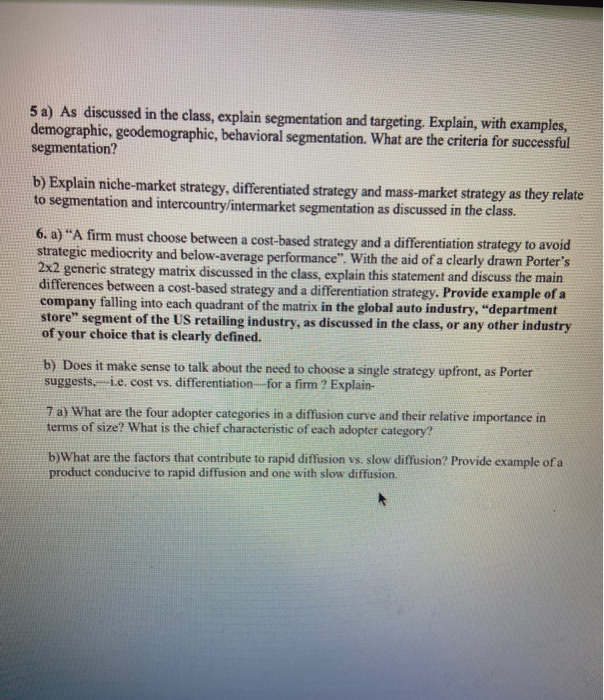
5 a) As discussed in the class, explain segmentation and targeting. Explain, with examples, demographic, geodemographic, behavioral segmentation. What are the criteria for successful segmentation? b) Explain niche-market strategy, differentiated strategy and mass-market strategy as they relate to segmentation and intercountry/intermarket segmentation as discussed in the class. 6. a) "A firm must choose between a cost-based strategy and a differentiation strategy to avoid strategic mediocrity and below-average performance". With the aid of a clearly drawn Porter's 2x2 generic strategy matrix discussed in the class, explain this statement and discuss the main differences between a cost-based strategy and a differentiation strategy. Provide example of a company falling into each quadrant of the matrix in the global auto industry, "department store" segment of the US retailing industry, as discussed in the class, or any other industry of your choice that is clearly defined. b) Does it make sense to talk about the need to choose a single strategy upfront, as Porter suggests. i.e. cost vs. differentiation for a firm ? Explain- 7 a) What are the four adopter categories in a diffusion curve and their relative importance in terms of size? What is the chief characteristic of each adopter category? b)What are the factors that contribute to rapid diffusion vs. slow diffusion? Provide example of a product conducive to rapid diffusion and one with slow diffusion. 5 a) As discussed in the class, explain segmentation and targeting. Explain, with examples, demographic, geodemographic, behavioral segmentation. What are the criteria for successful segmentation? b) Explain niche-market strategy, differentiated strategy and mass-market strategy as they relate to segmentation and intercountry/intermarket segmentation as discussed in the class. 6. a) "A firm must choose between a cost-based strategy and a differentiation strategy to avoid strategic mediocrity and below-average performance". With the aid of a clearly drawn Porter's 2x2 generic strategy matrix discussed in the class, explain this statement and discuss the main differences between a cost-based strategy and a differentiation strategy. Provide example of a company falling into each quadrant of the matrix in the global auto industry, "department store" segment of the US retailing industry, as discussed in the class, or any other industry of your choice that is clearly defined. b) Does it make sense to talk about the need to choose a single strategy upfront, as Porter suggests. i.e. cost vs. differentiation for a firm ? Explain- 7 a) What are the four adopter categories in a diffusion curve and their relative importance in terms of size? What is the chief characteristic of each adopter category? b)What are the factors that contribute to rapid diffusion vs. slow diffusion? Provide example of a product conducive to rapid diffusion and one with slow diffusion









 Study Help