







Question: 5. A large nonstructural cutout was made in panel #6. Refer to the panel shear flows and stringer axial loads shown in Figure 10-5. (a)
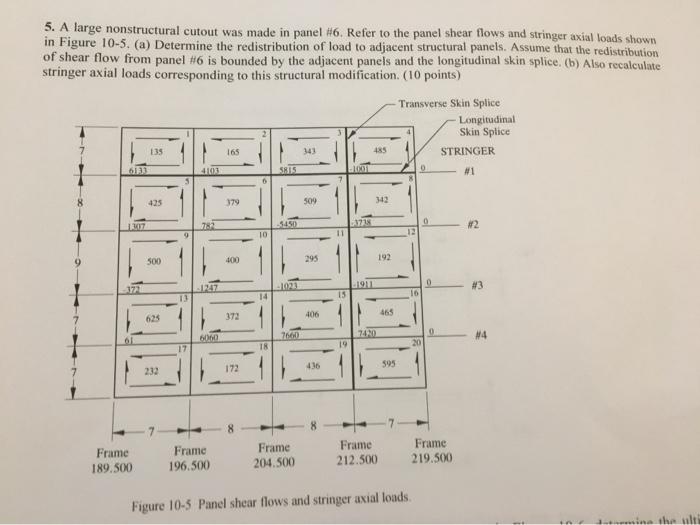
5. A large nonstructural cutout was made in panel #6. Refer to the panel shear flows and stringer axial loads shown in Figure 10-5. (a) Determine the redistribution of load to adjacent structural panels. Assume that the redistribution of shear flow from panel #6 is bounded by the adjacent panels and the longitudinal skin splice. (b) Also recalculate stringer axial loads corresponding to this structural modification. (10 points) Transverse Skin Splice Longitudinal Skin Splice STRINGER #1 135 165 485 425 379 509 342 782 12 0 #2 10 11 12 500 400 295 192 L1911 3771 1023 #3 R47 14 15 406 165 625 372 7600 7420 0 6000 4 6 18 19 20 232 172 595 Frame 189.500 Frame 196.500 Frame 204.500 Frame 212.500 Frame 219.500 Figure 10-5 Panel shear flows and stringer axial loads. 5. A large nonstructural cutout was made in panel #6. Refer to the panel shear flows and stringer axial loads shown in Figure 10-5. (a) Determine the redistribution of load to adjacent structural panels. Assume that the redistribution of shear flow from panel #6 is bounded by the adjacent panels and the longitudinal skin splice. (b) Also recalculate stringer axial loads corresponding to this structural modification. (10 points) Transverse Skin Splice Longitudinal Skin Splice STRINGER #1 135 165 485 425 379 509 342 782 12 0 #2 10 11 12 500 400 295 192 L1911 3771 1023 #3 R47 14 15 406 165 625 372 7600 7420 0 6000 4 6 18 19 20 232 172 595 Frame 189.500 Frame 196.500 Frame 204.500 Frame 212.500 Frame 219.500 Figure 10-5 Panel shear flows and stringer axial loads
Step by Step Solution
There are 3 Steps involved in it

Get step-by-step solutions from verified subject matter experts
 Study Help