







Question: 5. a. Using the information provided in the case and the exhibits, calculate the number of tickets Ann Arbor Railroad must sell to breakeven in
5. a. Using the information provided in the case and the exhibits, calculate the number of tickets Ann Arbor Railroad must sell to breakeven in each service line. (7 points) b. Assuming the sales mix to remain unchanged, what is the volume of sales Ann Arbor Railroad must generate to breakeven overall? (7 points)
PLEASE SHOW WORKINGS OF HOW TO REACH FINAL ANSWER. THANK YOU.
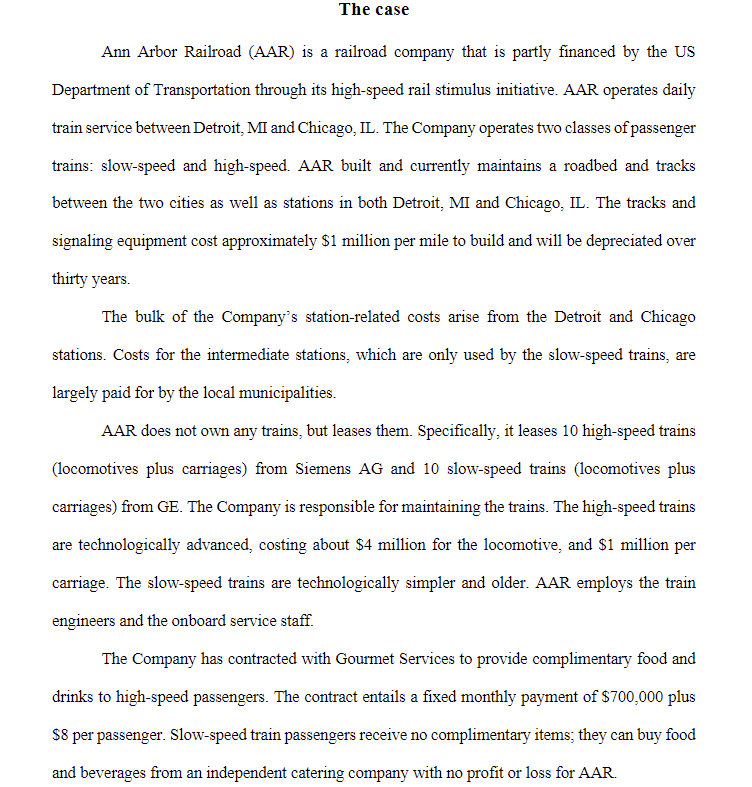
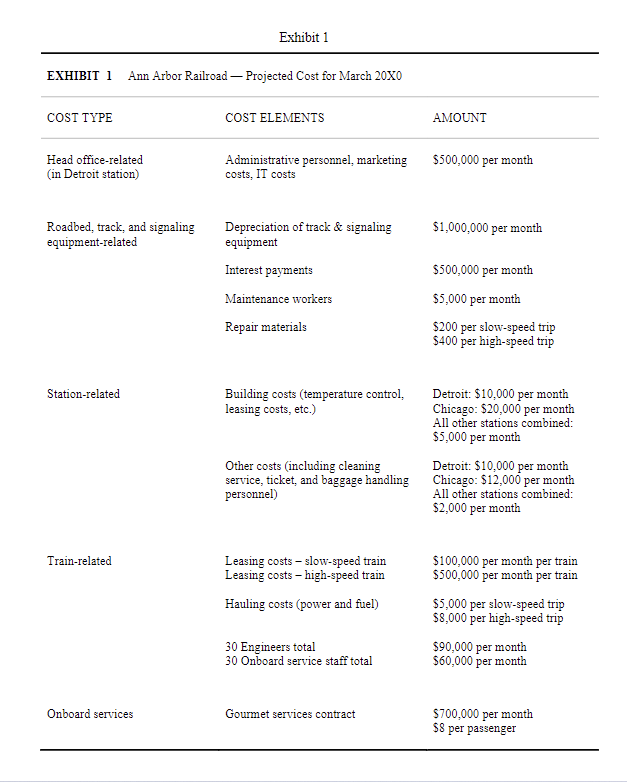
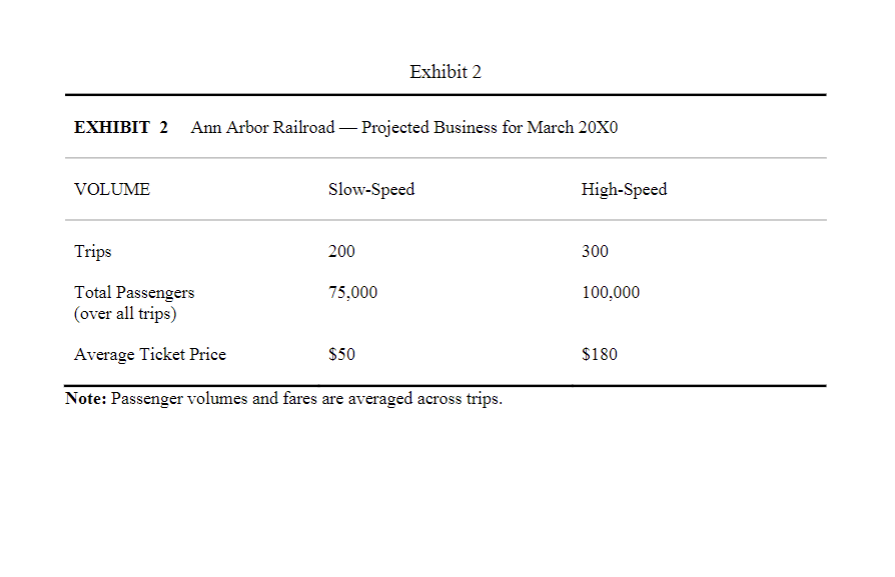
The case Ann Arbor Railroad (AAR) is a railroad company that is partly financed by the US Department of Transportation through its high-speed rail stimulus initiative. AAR operates daily train service between Detroit, MI and Chicago, IL. The Company operates two classes of passenger trains: slow-speed and high-speed. AAR built and currently maintains a roadbed and tracks between the two cities as well as stations in both Detroit, MI and Chicago, IL. The tracks and signaling equipment cost approximately $1 million per mile to build and will be depreciated over thirty years. The bulk of the Company's station-related costs arise from the Detroit and Chicago stations. Costs for the intermediate stations, which are only used by the slow-speed trains, are largely paid for by the local municipalities. AAR does not own any trains, but leases them. Specifically, it leases 10 high-speed trains (locomotives plus carriages) from Siemens AG and 10 slow-speed trains (locomotives plus carriages) from GE. The Company is responsible for maintaining the trains. The high-speed trains are technologically advanced, costing about $4 million for the locomotive, and $1 million per carriage. The slow-speed trains are technologically simpler and older. AAR employs the train engineers and the onboard service staff. The Company has contracted with Gourmet Services to provide complimentary food and drinks to high-speed passengers. The contract entails a fixed monthly payment of $700,000 plus $8 per passenger. Slow-speed train passengers receive no complimentary items; they can buy food and beverages from an independent catering company with no profit or loss for AAR. Exhibit 1 EXHIBIT 1 Ann Arbor Railroad - Projected Cost for March 20X0 COST TYPE COST ELEMENTS AMOUNT Head office-related (in Detroit station) Administrative personnel, marketing costs, IT costs $500,000 per month Roadbed, track, and signaling equipment-related $1,000,000 per month Depreciation of track & signaling equipment Interest payments Maintenance workers Repair materials $500.000 per month $5,000 per month $200 per slow-speed trip $400 per high-speed trip Station-related Building costs (temperature control, leasing costs, etc.) Detroit: $10,000 per month Chicago: $20,000 per month All other stations combined: $5,000 per month Detroit: $10,000 per month Chicago: $12,000 per month All other stations combined: $2,000 per month Other costs (including cleaning service, ticket, and baggage handling personnel) Train-related Leasing costs slow-speed train Leasing costs high-speed train Hauling costs (power and fuel) $100,000 per month per train $500,000 per month per train $5,000 per slow-speed trip $8,000 per high-speed trip $90,000 per month $60,000 per month 30 Engineers total 30 Onboard service staff total Onboard services Gourmet services contract $700.000 per month $8 per passenger Exhibit 2 EXHIBIT 2 Ann Arbor Railroad Projected Business for March 20X0 VOLUME Slow-Speed High-Speed Trips 200 300 75.000 100,000 Total Passengers (over all trips) Average Ticket Price $50 $180 Note: Passenger volumes and fares are averaged across trips
Step by Step Solution
There are 3 Steps involved in it

Get step-by-step solutions from verified subject matter experts
 Study Help