Question: 5. (Adopted from Meredith, Chapter 7, exercises 7&8) Conduct a discounted cash flow calculation to determine the NPV of the following project: The project will
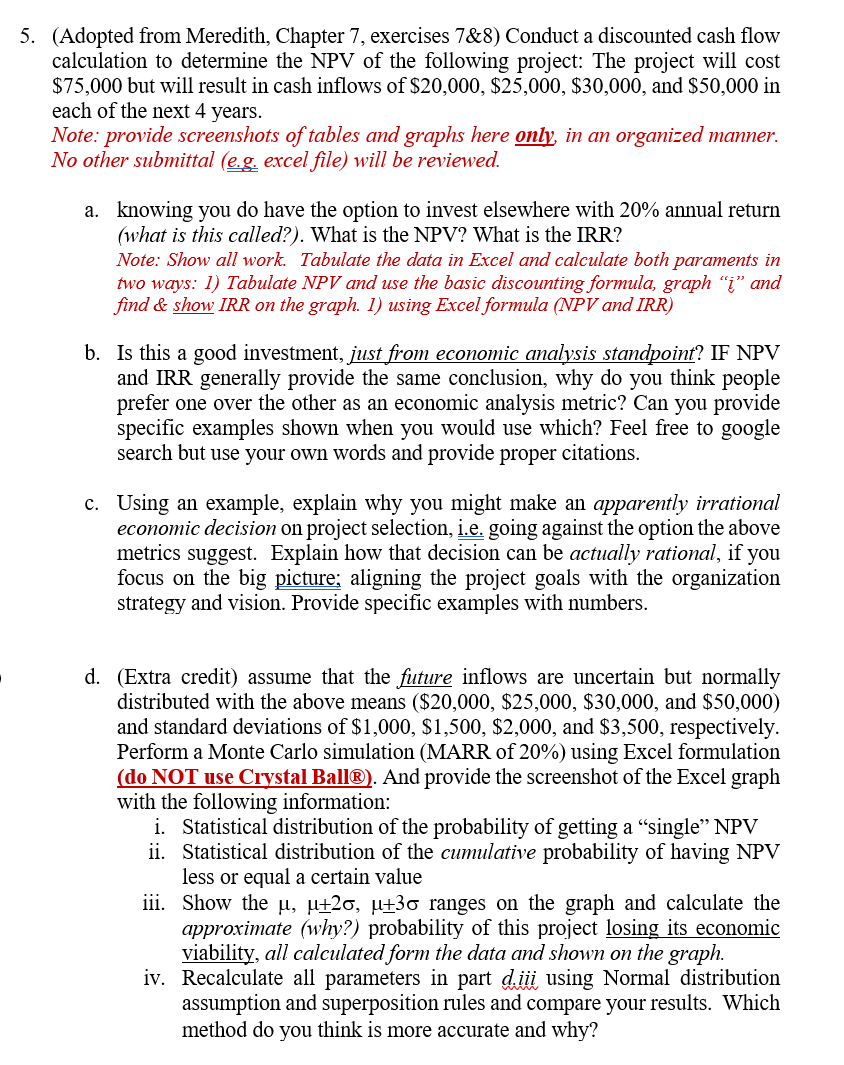
5. (Adopted from Meredith, Chapter 7, exercises 7&8) Conduct a discounted cash flow calculation to determine the NPV of the following project: The project will cost $75,000 but will result in cash inflows of $20,000, $25,000, $30,000, and $50,000 in each of the next 4 years. Note: provide screenshots of tables and graphs here only, in an organized manner. No other submittal (eg. excel file) will be reviewed. a. knowing you do have the option to invest elsewhere with 20% annual return (what is this called?). What is the NPV? What is the IRR? Note: Show all work. Tabulate the data in Excel and calculate both paraments in two ways: 1) Tabulate NPV and use the basic discounting formula, graph "" and find & show IRR on the graph. 1) using Excel formula (NPV and IRR) b. Is this a good investment, just from economic analysis standpoint? IF NPV and IRR generally provide the same conclusion, why do you think people prefer one over the other as an economic analysis metric? Can you provide specific examples shown when you would use which? Feel free to google search but use your own words and provide proper citations. c. Using an example, explain why you might make an apparently irrational economic decision on project selection, i.e. going against the option the above metrics suggest. Explain how that decision can be actually rational, if you focus on the big picture; aligning the project goals with the organization strategy and vision. Provide specific examples with numbers. d. (Extra credit) assume that the future inflows are uncertain but normally distributed with the above means ($20,000, $25,000, $30,000, and $50,000) and standard deviations of $1,000, $1,500, $2,000, and $3,500, respectively. Perform a Monte Carlo simulation (MARR of 20%) using Excel formulation (do NOT use Crystal Ball). And provide the screenshot of the Excel graph with the following information: i. Statistical distribution of the probability of getting a single NPV ii. Statistical distribution of the cumulative probability of having NPV less or equal a certain value iii. Show the u, u+20, u+30 ranges on the graph and calculate the approximate (why?) probability of this project losing its economic viability, all calculated form the data and shown on the graph. iv. Recalculate all parameters in part diii using Normal distribution assumption and superposition rules and compare your results. Which method do you think is more accurate and why




