Question: 5. Assume that we are working with the basic human capital model with popu- lation growth and no technological growth. There is no physical capital,
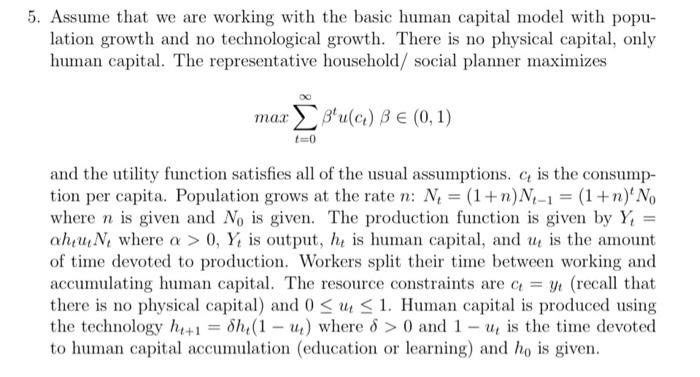
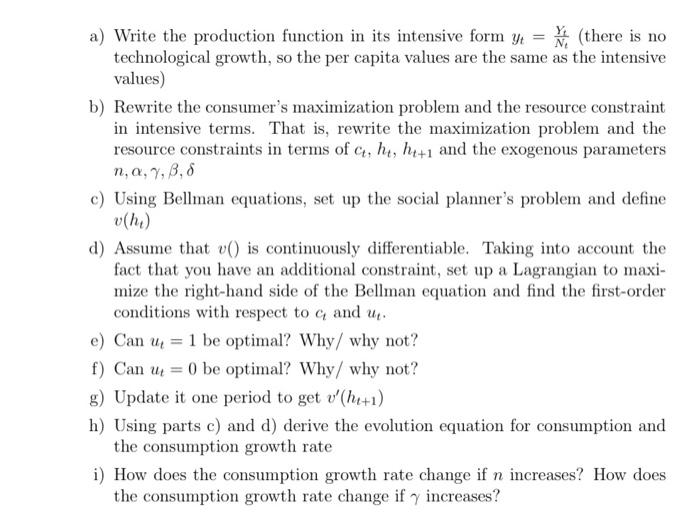
5. Assume that we are working with the basic human capital model with popu- lation growth and no technological growth. There is no physical capital, only human capital. The representative household/ social planner maximizes max (c ( Bu(a) B (0,1) IM and the utility function satisfies all of the usual assumptions. C is the consump- tion per capita. Population grows at the rate n: N = (1+n)N-1 = (1+n)' No where n is given and No is given. The production function is given by Y, ahuN, where a > 0, Y is output, he is human capital, and w is the amount of time devoted to production. Workers split their time between working and accumulating human capital. The resource constraints are a = y (recall that there is no physical capital) and 0 0 and 1 - 4 is the time devoted to human capital accumulation (education or learning) and ho is given. a) Write the production function in its intensive form y: = (there is no technological growth, so the per capita values are the same as the intensive values) b) Rewrite the consumer's maximization problem and the resource constraint in intensive terms. That is, rewrite the maximization problem and the resource constraints in terms of a, hu, ht+1 and the exogenous parameters n,a,7,8,8 c) Using Bellman equations, set up the social planner's problem and define v(h) d) Assume that v() is continuously differentiable. Taking into account the fact that you have an additional constraint, set up a Lagrangian to maxi- mize the right-hand side of the Bellman equation and find the first-order conditions with respect to q and u. e) Can u = 1 be optimal? Why/ why not? f) Can u = 0 be optimal? Why/ why not? g) Update it one period to get v'(he+1) h) Using parts c) and d) derive the evolution equation for consumption and the consumption growth rate i) How does the consumption growth rate change if n increases? How does the consumption growth rate change if , increases? 5. Assume that we are working with the basic human capital model with popu- lation growth and no technological growth. There is no physical capital, only human capital. The representative household/ social planner maximizes max (c ( Bu(a) B (0,1) IM and the utility function satisfies all of the usual assumptions. C is the consump- tion per capita. Population grows at the rate n: N = (1+n)N-1 = (1+n)' No where n is given and No is given. The production function is given by Y, ahuN, where a > 0, Y is output, he is human capital, and w is the amount of time devoted to production. Workers split their time between working and accumulating human capital. The resource constraints are a = y (recall that there is no physical capital) and 0 0 and 1 - 4 is the time devoted to human capital accumulation (education or learning) and ho is given. a) Write the production function in its intensive form y: = (there is no technological growth, so the per capita values are the same as the intensive values) b) Rewrite the consumer's maximization problem and the resource constraint in intensive terms. That is, rewrite the maximization problem and the resource constraints in terms of a, hu, ht+1 and the exogenous parameters n,a,7,8,8 c) Using Bellman equations, set up the social planner's problem and define v(h) d) Assume that v() is continuously differentiable. Taking into account the fact that you have an additional constraint, set up a Lagrangian to maxi- mize the right-hand side of the Bellman equation and find the first-order conditions with respect to q and u. e) Can u = 1 be optimal? Why/ why not? f) Can u = 0 be optimal? Why/ why not? g) Update it one period to get v'(he+1) h) Using parts c) and d) derive the evolution equation for consumption and the consumption growth rate i) How does the consumption growth rate change if n increases? How does the consumption growth rate change if , increases









 Study Help