







Question: 5. Consider the function f(t) : 62 5 + 27m/2t on the real interval 13 6 [0,1). Let 2 be a vector in C10 such
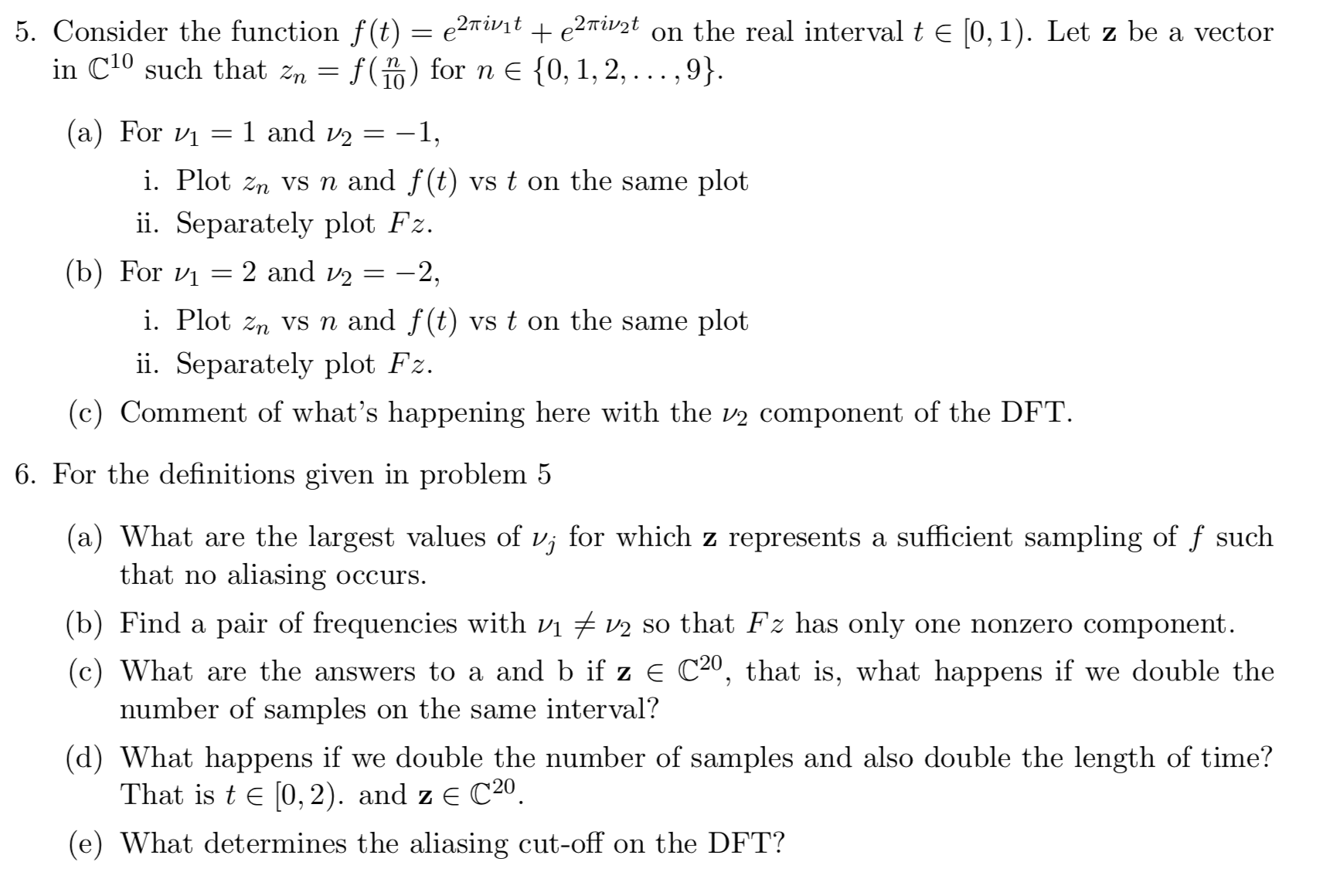
5. Consider the function f(t) : 62\"" \"5 + 27m/2t on the real interval 13 6 [0,1). Let 2 be a vector in C10 such that Zn 2 f(%) for n E {0, 1, 2, . . . ,9}. (a) For 1/1 = 1 and V2 2 1, i. Plot 2,, vs n and f (t) vs t on the same plot ii. Separately plot F 2. (b) F01' 1/1 = 2 and 1/2 = 2, i. Plot 2,, vs n and f(t) vs 15 on the same plot ii. Separately plot F 2. (0) Comment of what's happening here with the V2 component of the DFT. 6. For the denitions given in problem 5 (a) What are the largest values of yj for which z represents a suicient sampling of f such that no aliasing occurs. (b) Find a pair of frequencies with 1/1 75 1/2 so that Fz has only one nonzero component. (c) What are the answers to a and b if z 6 C20, that is, what happens if we double the number of samples on the same interval? ((1) What happens if we double the number of samples and also double the length of time? That is t 6 [0,2). and z 6 C20. (e) What determines the aliasing cut-off on the DFT
Step by Step Solution
There are 3 Steps involved in it

Get step-by-step solutions from verified subject matter experts
 Study Help