







Question: 5. Continuing with the diffusion model from Chapter 19, recall that the threshold q was derived from a coordination game that each node plays with
5. Continuing with the diffusion model from Chapter 19, recall that the threshold q was derived from a coordination game that each node plays with each of its neighbors. Specifically, if nodes v and w are each trying to decide whether to choose behaviors A and B, then
if v and w both adopt behavior A, they each get a payoff of a > 0;
if they both adopt B, they each get a payoff of b > 0; and
if they adopt opposite behaviors, they each get a payoff of 0.
The total payoff for any one node is determined by adding up the payoffs it gets from the coordination game with each neighbor. Lets now consider a slightly more general version of the model, in which the payoff for choosing opposite behaviors is not 0, but some small positive number x. Specifically, suppose we replace the third point above with:
if they adopt opposite behaviors, they each get a payoff of x, where x is a positive number that is less than both a and b.
Heres the question: in this variant of the model with these more general payoffs, is each nodes decision still based on a threshold rule? Specifically, is it possible to write down a formula for a threshold q, in terms of the three quantities a, b, and x, so that each node v will adopt behavior A if at least a q fraction of its neighbors are adopting A, and it will adopt B otherwise?
In your answer, either provide a formula for a threshold q in terms of a, b, and x; or else explain why in this more general model, a nodes decision cant be expressed as a threshold in this way.
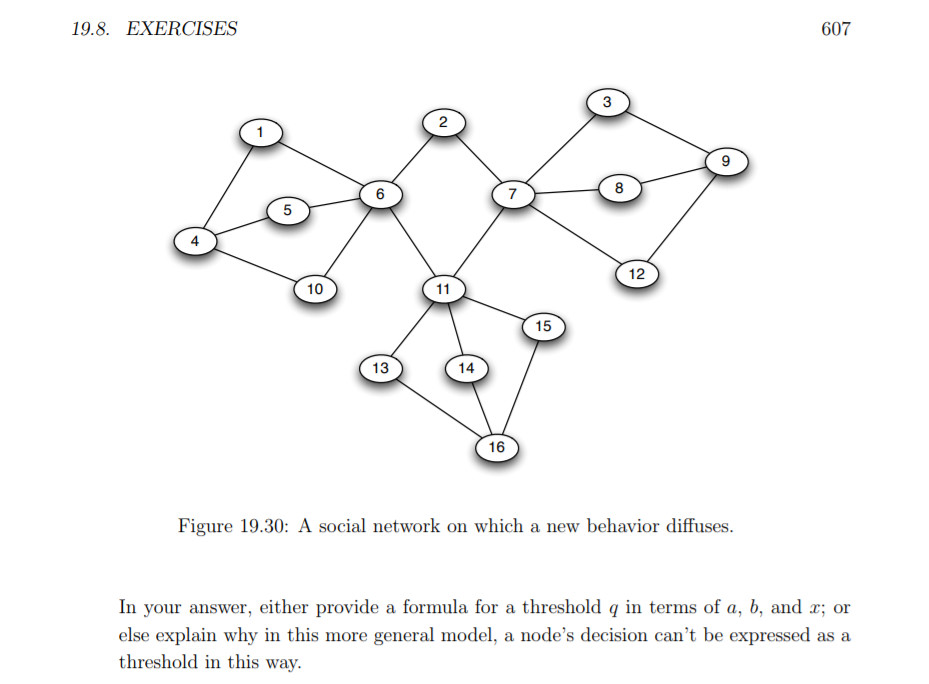
19.8. EXERCISES 607 2 9 8 6 7 4 12 10 15 13 14 16 Figure 19.30: A social network on which a new behavior diffuses. In your answer, either provide a formula for a threshold q in terms of a, b, and ; or else explain why in this more general model, a node's decision can't be expressed as a threshold in this way
Step by Step Solution
There are 3 Steps involved in it

Get step-by-step solutions from verified subject matter experts
 Study Help