







Question: 5. For a converging lens, a virtual occurs when the image is behind the object, and to construct the image, you have to extrapolate the
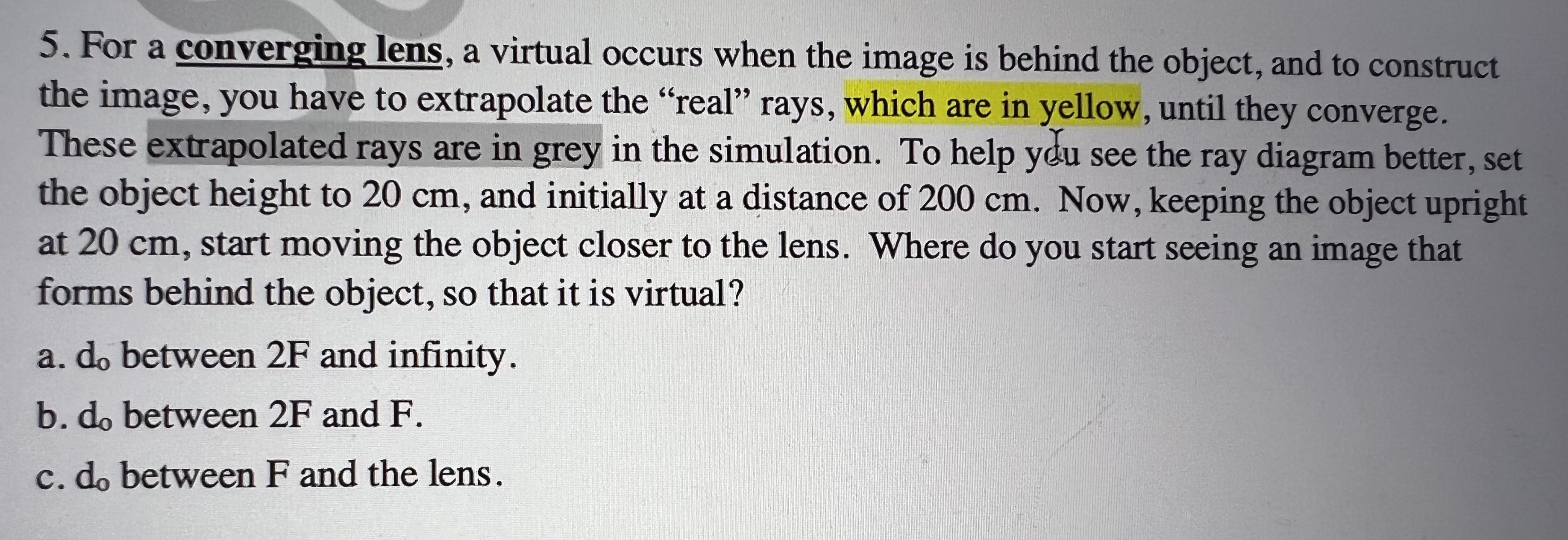
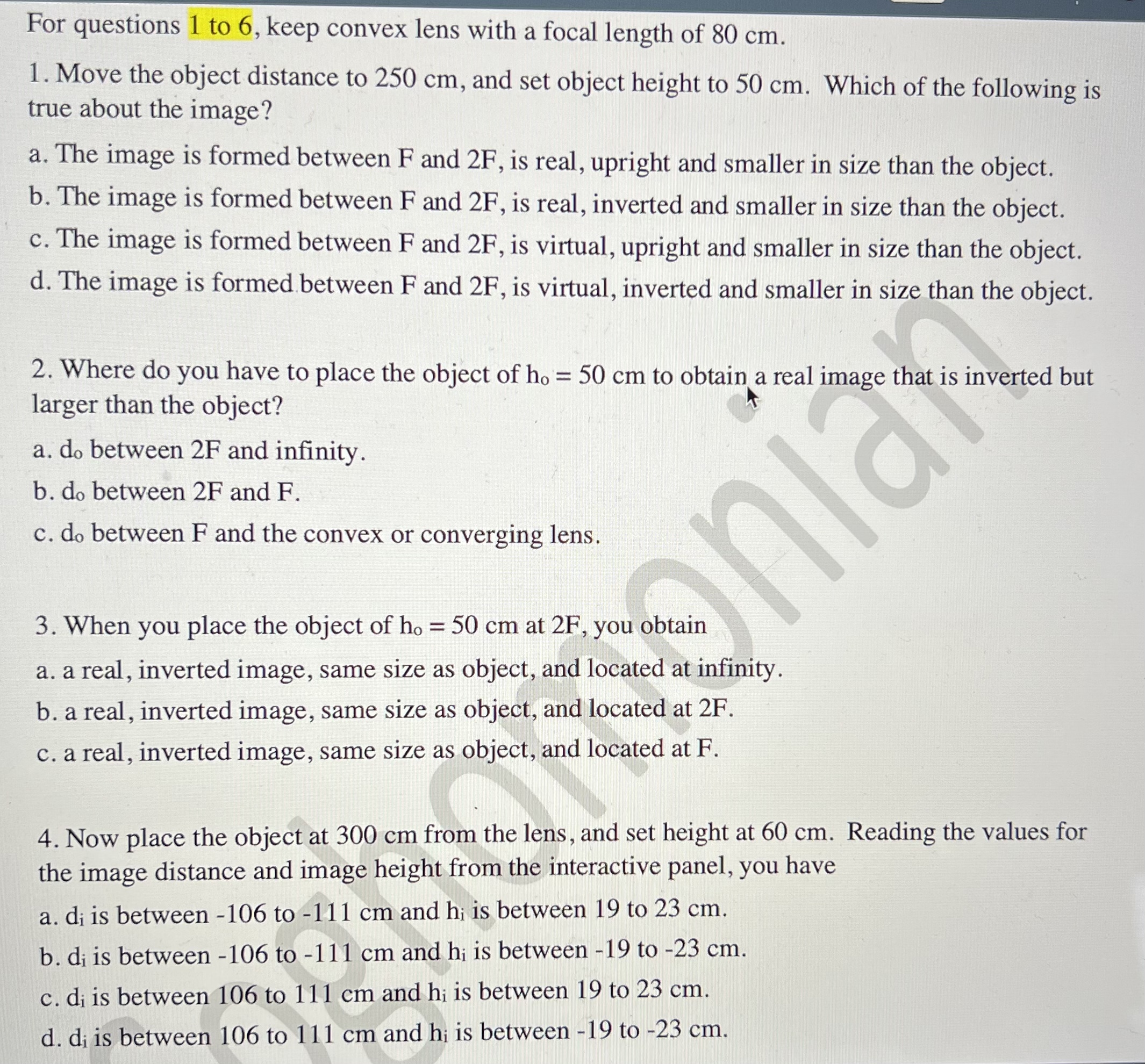
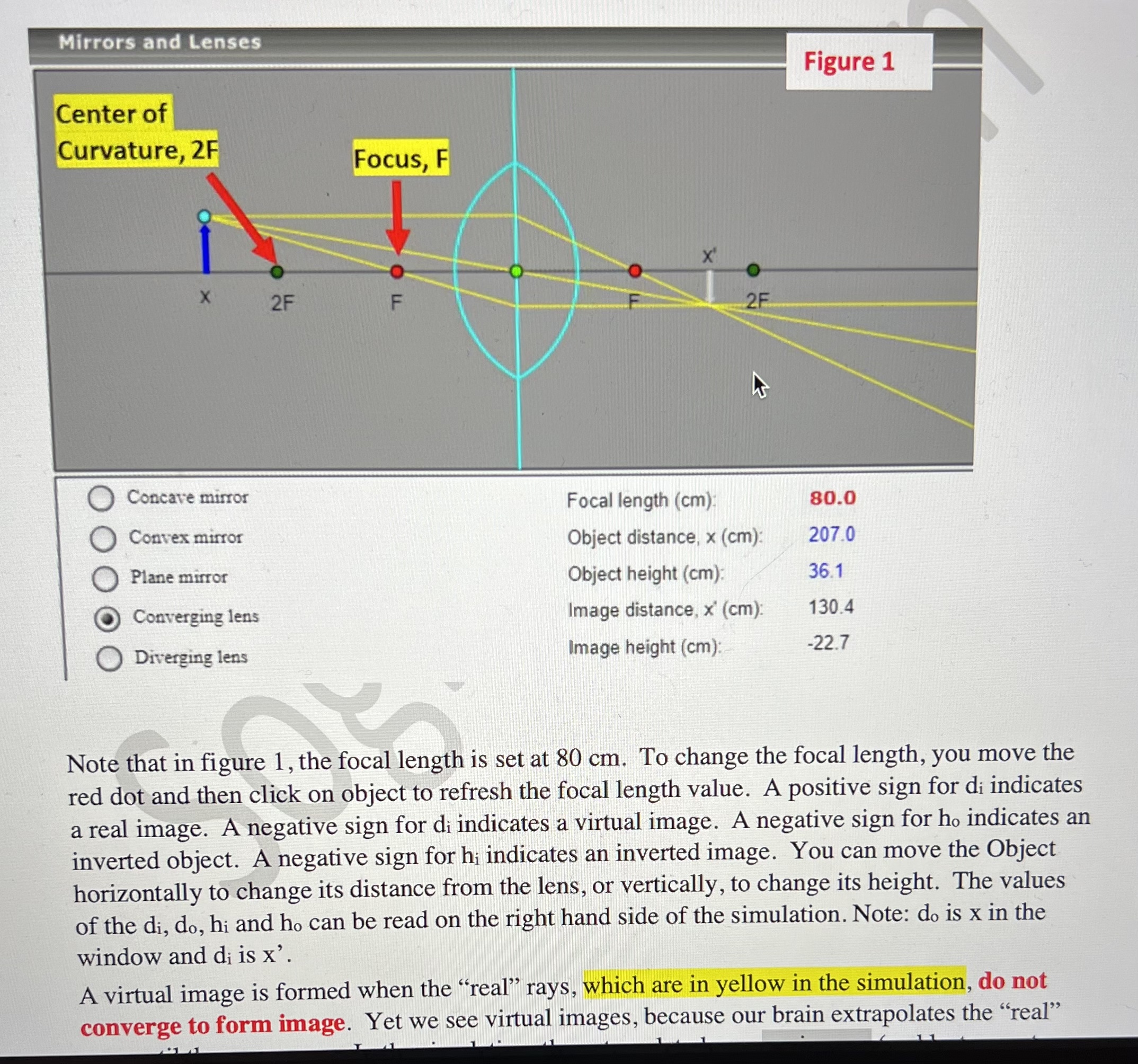
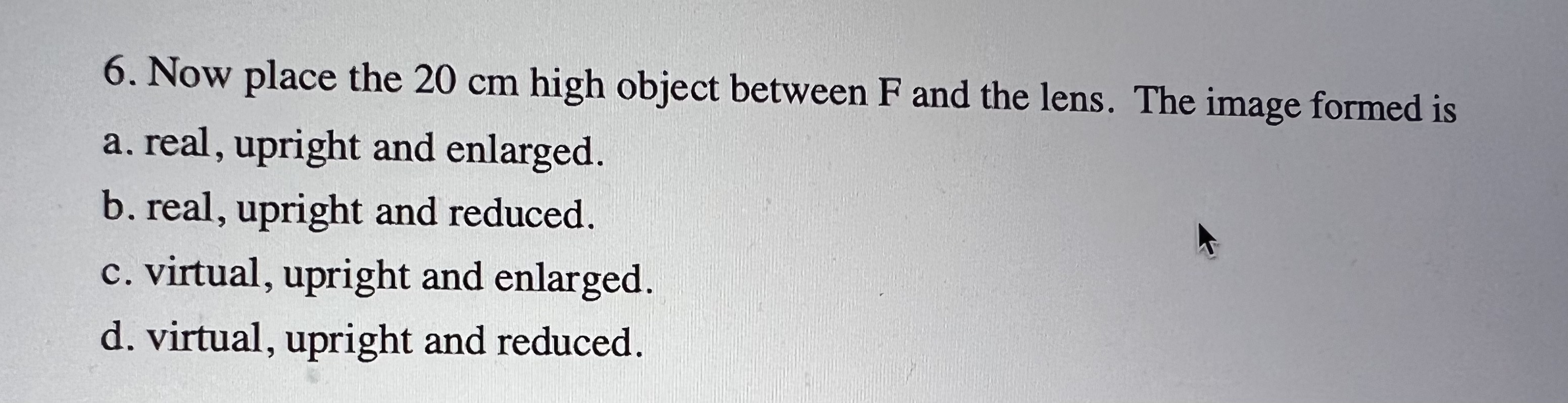
5. For a converging lens, a virtual occurs when the image is behind the object, and to construct the image, you have to extrapolate the "real" rays, which are in yellow, until they converge. These extrapolated rays are in grey in the simulation. To help you see the ray diagram better, set the object height to 20 cm, and initially at a distance of 200 cm. Now, keeping the object upright at 20 cm, start moving the object closer to the lens. Where do you start seeing an image that forms behind the object, so that it is virtual? a. do between 2F and infinity. b. do between 2F and F. c. do between F and the lens.For questions 1 to 6, keep convex lens with a focal length of 80 cm. 1. Move the object distance to 250 cm, and set object height to 50 cm. Which of the following is true about the image? a. The image is formed between F and 2F, is real, upright and smaller in size than the object. b. The image is formed between F and 2F, is real, inverted and smaller in size than the object. c. The image is formed between F and 2F, is virtual, upright and smaller in size than the object. d. The image is formed between F and 2F, is virtual, inverted and smaller in size than the object. 2. Where do you have to place the object of ho = 50 cm to obtain a real image that is inverted but larger than the object? a. do between 2F and infinity. b. do between 2F and F. c. do between F and the convex or converging lens. 3. When you place the object of ho = 50 cm at 2F, you obtain a. a real, inverted image, same size as object, and located at infinity. b. a real, inverted image, same size as object, and located at 2F. c. a real, inverted image, same size as object, and located at F. 4. Now place the object at 300 cm from the lens, and set height at 60 cm. Reading the values for the image distance and image height from the interactive panel, you have a. di is between -106 to -111 cm and hi is between 19 to 23 cm. b. di is between -106 to -111 cm and hi is between -19 to -23 cm. c. di is between 106 to 11 1 cm and hi is between 19 to 23 cm. d. di is between 106 to 111 cm and hi is between -19 to -23 cm.Mirrors and Lenses Figure 1 Center of Curvature, 2F Focus, F X X 2F 2F O Concave mirror Focal length (cm) 80.0 O Convex mirror Object distance, x (cm): 207.0 O Plane mirror Object height (cm): 36.1 O Converging lens Image distance, x (cm): 130.4 O Diverging lens Image height (cm): -22.7 Note that in figure 1, the focal length is set at 80 cm. To change the focal length, you move the red dot and then click on object to refresh the focal length value. A positive sign for di indicates a real image. A negative sign for di indicates a virtual image. A negative sign for ho indicates an inverted object. A negative sign for hi indicates an inverted image. You can move the Object horizontally to change its distance from the lens, or vertically, to change its height. The values of the di, do, hi and ho can be read on the right hand side of the simulation. Note: do is x in the window and di is x' . A virtual image is formed when the "real" rays, which are in yellow in the simulation, do not converge to form image. Yet we see virtual images, because our brain extrapolates the "real"6. Now place the 20 cm high object between F and the lens. The image formed is a. real, upright and enlarged. b. real, upright and reduced. c. virtual, upright and enlarged. d. virtual, upright and reduced
Step by Step Solution
There are 3 Steps involved in it

Get step-by-step solutions from verified subject matter experts
 Study Help