







Question: 5. For the following reaction which reactant is getting oxidized and which is getting reduced: (5 points) MnO(aq) + H.(g) Mn(s) + HO(l) 6. An
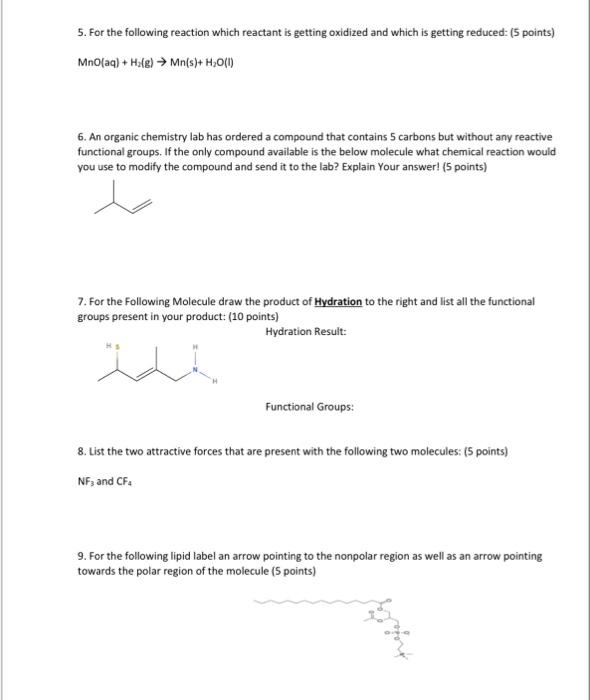
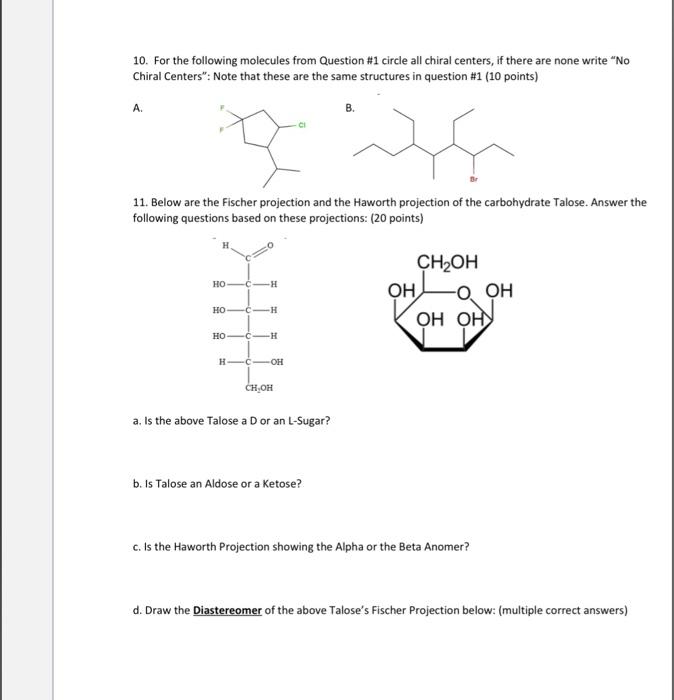
5. For the following reaction which reactant is getting oxidized and which is getting reduced: (5 points) MnO(aq) + H.(g) Mn(s) + HO(l) 6. An organic chemistry lab has ordered a compound that contains 5 carbons but without any reactive functional groups. If the only compound available is the below molecule what chemical reaction would you use to modify the compound and send it to the lab? Explain Your answer! (5 points) 7. For the following Molecule draw the product of Hydration to the right and list all the functional groups present in your product: (10 points) Hydration Result: Functional Groups: 8. List the two attractive forces that are present with the following two molecules: (5 points) NF, and CF 9. For the following lipid label an arrow pointing to the nonpolar region as well as an arrow pointing towards the polar region of the molecule (5 points) 10. For the following molecules from Question #1 circle all chiral centers, if there are none write "No Chiral Centers": Note that these are the same structures in question #1 (10 points) A. q 11. Below are the Fischer projection and the Haworth projection of the carbohydrate Talose. Answer the following questions based on these projections: (20 points) HO-C H CHOH -H HO CIH H-C CHOH a. Is the above Talose a D or an L-Sugar? b. Is Talose an Aldose or a Ketose? c. Is the Haworth Projection showing the Alpha or the Beta Anomer? d. Draw the Diastereomer of the above Talose's Fischer Projection below: (multiple correct answers) -OH
Step by Step Solution
There are 3 Steps involved in it

Get step-by-step solutions from verified subject matter experts
 Study Help