







Question: 5) Jacqueline is tryijg to solve two problems: Avouding conflicts with clients and learning about potential problems early on when they can be solved. What
5) Jacqueline is tryijg to solve two problems: Avouding conflicts with clients and learning about potential problems early on when they can be solved. What would you suggest for each one from what she has learned? 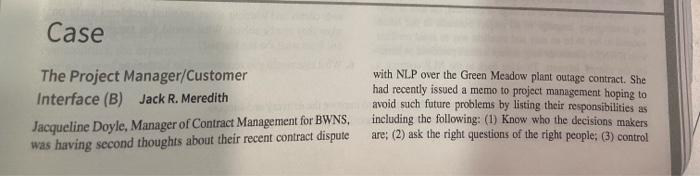
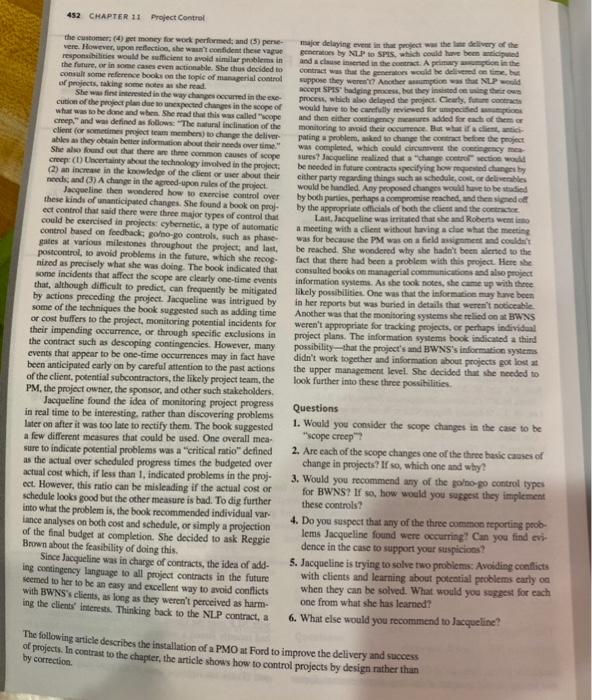
Case The Project Manager/Customer Interface (B) Jack R. Meredith Jacqueline Doyle, Manager of Contract Management for BWNS, was having second thoughts about their recent contract dispute with NLP over the Green Meadow plant outage contract. She had recently issued a memo to project management hoping to avoid such future problems by listing their responsibilities as including the following: (1) know who the decisions makers are: (2) ask the right questions of the right people (3) control 452 CHAPTER 11 Project Control the customer(4money for work performed and (5) pense vere. However, upon reflection, she wasn't confident these vague responsibilities would be sufficient to avoid similar problems in the future or in some cases even actionable. She thus decided to consult some reference books on the topic of managerial control of projects, taking some notes as she read She was first interested in the way changes in the se cution of the project plan de expected changes in the scope of what was to be done and when she read that this was called "scope creep" and was defined as follow "The natural inclination of the client for sometimes project team members) to change the deliver ables as they obtain better information about their needs over time." She also found out that there are the common causes of scope creep (t) theertainty shoot the technology involved in the project: (2) an increase in the knowledge of the client or wer about their needs, and (3) A change in the agreed upon rules of the project Jacqueline then wondered how to exercise control over these kinds of anticipated changes. She found a book on proj est control that said there were three major types of control that could be exercised in projects: cybernetic, a type of automatic control bused on feedback, goo-go controls, such as phase gates at various milestones throughout the project, and last postcontrol to avoid problems in the future, which she recog. nized as precisely what she was doing. The book indicated that some incidents that affect the scope are clearly one-time events that, although difficult to predict, can frequently be mitigated by actions preceding the project. Jacqueline was intrigued by some of the techniques the book suggested such as adding time or cost buffers to the project, monitoring potential incidents for their impending occurrence, or through specific exclusions in the contract such as descoping contingencies. However, many events that appear to be one-time occurrences may in fact have been anticipated early on by careful attention to the past actions of the client, potential subcontractors, the likely project team, the PM, the project owner, the sponsor, and other such stakeholders Jacqueline found the idea of monitoring project progress in real time to be interesting, rather than discovering problems later on after it was too late to rectify them. The book suggested a few different measures that could be used. One overall mea sure to indicate potential problems was a critical ratio" defined as the actual over scheduled progress times the budgeted over actual cost which, if less than 1, indicated problems in the proj- oct. However, this ratio can be misleading if the actual cost or schedule looks good but the other measure is bad. To dig further into what the problem is the book recommended individual var lance analyses on both cost and schedule, or simply a projection of the final budget at completion. She decided to ask Reggie Brown about the feasibility of doing this Since Jacqueline was in charge of contracts, the idea of add- ing contingency language to all project contracts in the future seemed to her to be an easy and excellent way to avoid conflicts with BWNS's clients, as long as they weren't perceived as harm ing the clients' interests. Thinking back to the NLP contract, a maior delaying event in the project was the delivery of the generates by NLP SPIS, which could have been die and scheinend in the contract. A pardon in the Contract was that the generations cold be delicadami but suppose they weren'? Another sumpion that NLP cold Recept SPIS hadging process, but they into this process, which also delayed the project. Clearly, funt contract would have to be carefully reviewed for specified and then either contingency measures added for each of them monitoring to avoid their currence Bat what a matic pating problem, asked to change the contract before the project W completed, which could circumvent the contingency me sures? Jacqueline realized that a change colection wou be needed in future contract specifying how requested changes by either party regarding things such a schedule, costo delete would be handled. Any proposed changes would have to be studied by both parties, perhaps a compromise reached and then signed by the appropriate officials of both the client and the cocho. Last Jacqueline was irritated that she and Roberts went a meeting with a client without having a co what the meeting was for because the PM was on a field assignment and couldn't be reached. She wondered why she hadn't been sented to the fact that there had been a problem with this project Here she consulted books on managerial communications and also project information system. As she took notes, she came up with three likely possibilities. One was that the informations may have been in her reports but was buried in details that weren't noticeable Another was that the monitoring systems she relied on at BWNS weren't appropriate for tracking projects, or perhaps individual project plans. The information systems book indicated a third possibility that the projects and EWNS's information systems didn't work together and information about projects got lost the upper management level. She decided that she needed to look further into these three possibilities Questions 1. Would you consider the scope changes in the case to be "scope creep"? 2. Are each of the scope changes one of the three basic cases of change in projects? If so, which one and why? 3. Would you recommend any of the goo-po control types for BWNS? If so, how would you suggest they implement these controls? 4. Do you suspect that any of the three common reporting poob lems Jacqueline found were occurring? Can you find evi dence in the case to support your suspicions? 5. Jacqueline is trying to solve two problems: Avoiding conflicts with clients and learning about potential problems carly on when they can be solved. What would you suggest for each one from what she has learned? 6. What else would you recommend to Jacqueline The following article describes the installation of a PMO at Ford to improve the delivery and success of projects. In contrast to the chapter, the article shows how to control projects by design rather than by correction
Please refer to the attached case story.
Step by Step Solution
There are 3 Steps involved in it
1 Expert Approved Answer
Step: 1 Unlock

Question Has Been Solved by an Expert!
Get step-by-step solutions from verified subject matter experts
Step: 2 Unlock
Step: 3 Unlock
 Study Help