







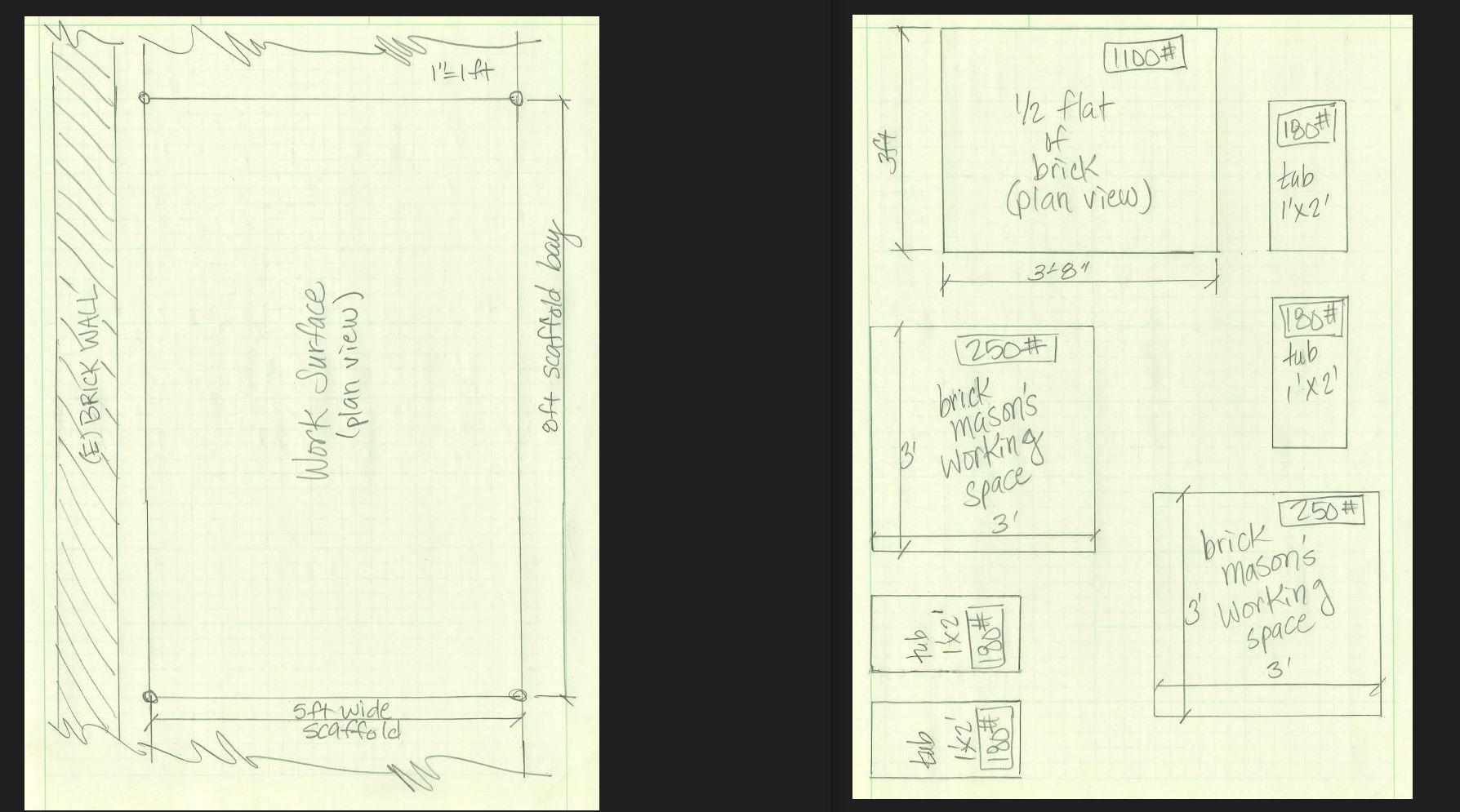
Question: 5 . Load tracing at scaffold posts: ( 1 4 points total ) The scaffolding has bays that are 8 ft long x 5 ft
Load tracing at scaffold posts: points total
The scaffolding has bays that are ft long x ft wide.
There are working levels.
For the sake of this assignment the scaffolding system weight adds an additional # to an interior post load.
You have a nearly level ground surface, but it is not hardscape such as concrete or pavement
You must place your scaffolding in an area of grass that can only support a load of not more than psf
A mudsill is normally made up of multiple layers that can be easily constructed and reused. A scaled down example is shown in the photo to the right.
What is the total maximum load capacity tributary to one interior scaffold post? Hint: Determine the load tributary at one level to an interior post. The end posts will have less tributary area. Then multiply the load by the number of levels required and the minimum live load rating for the scaffolding not the actual loads in each bay points for correct answer plus points for showing your work Provide answer in a complete sentence. point
How much area measured in ft does that load need to be spread out over to prevent the scaffold post from sinking into
the grass? point for correct answer plus point for showing your work Provide answer in a complete sentence. point
If the mudsill is square in shape what is the minimum edge distance show your units of the square required? For example, if the calculation produced an area of ft then the square root of ft is a square with edge distance of ft a mudsill that measures inched along all edges point for correct answer plus point for showing your work Provide answer in a complete sentence. point
Step by Step Solution
There are 3 Steps involved in it
1 Expert Approved Answer
Step: 1 Unlock

Question Has Been Solved by an Expert!
Get step-by-step solutions from verified subject matter experts
Step: 2 Unlock
Step: 3 Unlock
 Study Help