



Question: Suppose we generate n = 100 independent and identically distributed uniformly random numbers N1,..., Nn on the interval [0, 100]. Let N1,..., n be
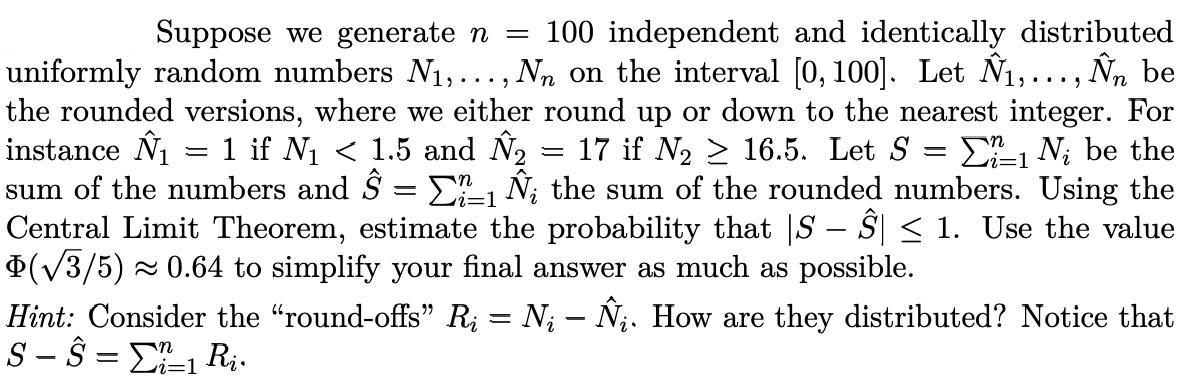
Suppose we generate n = 100 independent and identically distributed uniformly random numbers N1,..., Nn on the interval [0, 100]. Let N1,..., n be the rounded versions, where we either round up or down to the nearest integer. For instance N1 = 1 if N1 < 1.5 and N2 sum of the numbers and S = EL ; the sum of the rounded numbers. Using the Central Limit Theorem, estimate the probability that |S - | < 1. Use the value (V3/5) - 0.64 to simplify your final answer as much as possible. 17 if N2 > 16.5. Let S = D Ni be the :1 Hint: Consider the "round-offs" R; = N; - ;. How are they distributed? Notice that S- = E Ri-
Step by Step Solution
3.46 Rating (153 Votes )
There are 3 Steps involved in it
To solve this problem well use the Central Limit Theorem CLT to find the probability that the absolu... View full answer

Get step-by-step solutions from verified subject matter experts