







Question: 5. Measuring stand-alone risk When projects involve certain, or constant, cash flows, the capital budgeting analysis that can be conducted is very simple and straightforward.
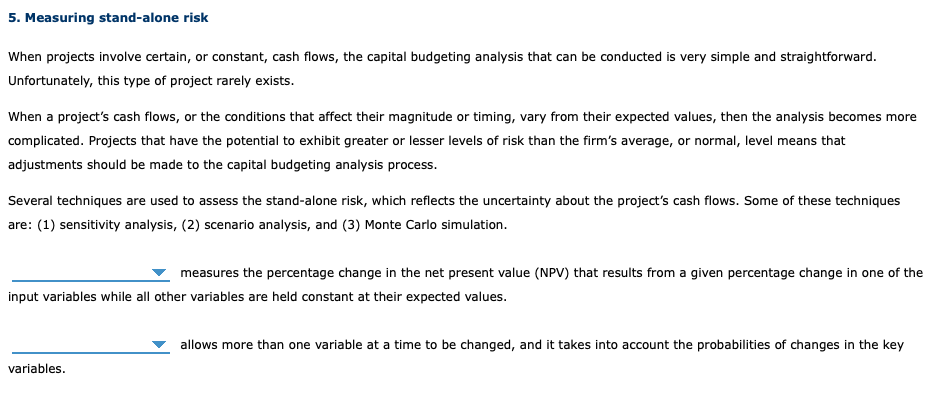
5. Measuring stand-alone risk When projects involve certain, or constant, cash flows, the capital budgeting analysis that can be conducted is very simple and straightforward. Unfortunately, this type of project rarely exists. When a project's cash flows, or the conditions that affect their magnitude or timing, vary from their expected values, then the analysis becomes more complicated. Projects that have the potential to exhibit greater or lesser levels of risk than the firm's average, or normal, level means that adjustments should be made to the capital budgeting analysis process. Several techniques are used to assess the stand-alone risk, which reflects the uncertainty about the project's cash flows. Some of these techniques are: (1) sensitivity analysis, (2) scenario analysis, and (3) Monte Carlo simulation. measures the percentage change in the net present value (NPV) that results from a given percentage change in one of the input variables while all other variables are held constant at their expected values. allows more than one variable at a time to be changed, and it takes into account the probabilities of changes in the key variables
Step by Step Solution
There are 3 Steps involved in it

Get step-by-step solutions from verified subject matter experts
 Study Help