







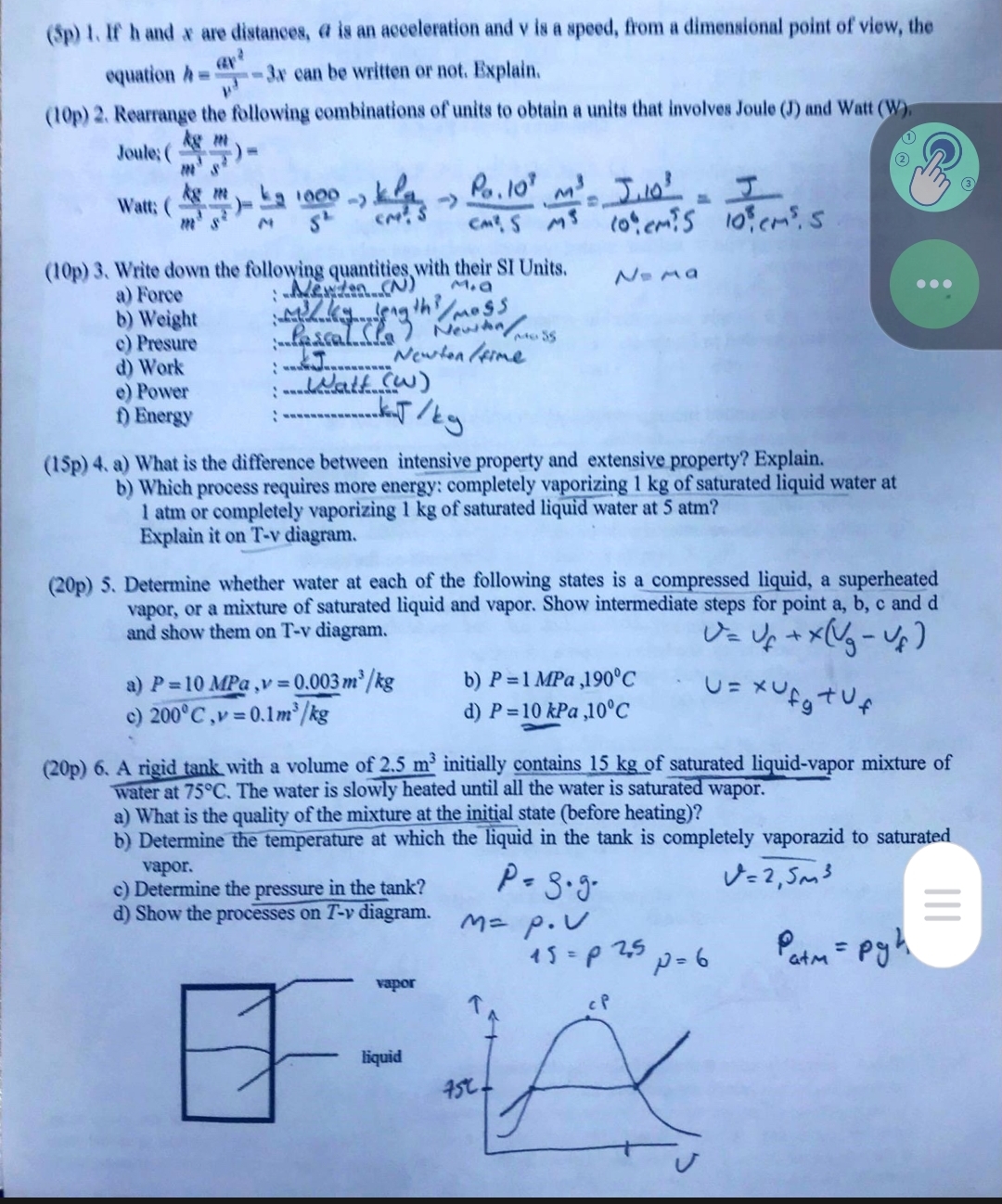
Question: ( 5 p ) 1 . If h and x are distances, a is an aceeleration and v is a speed, from a dimensional point
p If h and are distances, is an aceeleration and is a speed, from a dimensional point of view, the equation ean be written or not. Explain.
p Rearrange the following combinations of units to obtain a units that involves Joule J and Watt W Joules
Watt
p Write down the following quantities, with their SI Units.
a Force
b Weight
c Presure
d Work
e Power
f Energy
p a What is the difference between intensive property and extensive property? Explain.
b Which process requires more energy: completely vaporizing kg of saturated liquid water at atm or completely vaporizing kg of saturated liquid water at atm
Explain it on Tv diagram.
p Determine whether water at each of the following states is a compressed liquid, a superheated vapor, or a mixture of saturated liquid and vapor. Show intermediate steps for point a b c and d and show them on Tv diagram.
aMPa,
c
bMPa,
dkPa,
p A rigid tank with a volume of initially contains kg of saturated liquidvapor mixture of water at The water is slowly heated until all the water is saturated wapor.
a What is the quality of the mixture at the initial state before heating
b Determine the temperature at which the liquid in the tank is completely vaporazid to saturated vapor.
c Determine the pressure in the tank?
d Show the processes on diagram.
Step by Step Solution
There are 3 Steps involved in it
1 Expert Approved Answer
Step: 1 Unlock

Question Has Been Solved by an Expert!
Get step-by-step solutions from verified subject matter experts
Step: 2 Unlock
Step: 3 Unlock
 Study Help