







Question: (5 points) Consider a 2 attribute dataset with 2 classes such that attribute 21, 22 are taken from the set V E 10, 20, 30,
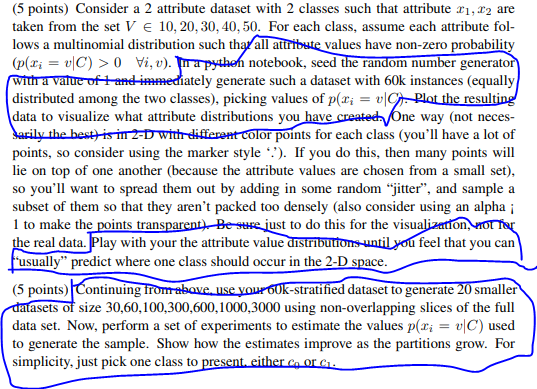
(5 points) Consider a 2 attribute dataset with 2 classes such that attribute 21, 22 are taken from the set V E 10, 20, 30, 40,50. For each class, assume each attribute fol- lows a multinomial distribution such that all attribute values have non-zero probability (pli = vC) >0 Vi, v). In a pythen notebook, seed the random number generator With a value oft and immediately generate such a dataset with 60k instances (equally distributed among the two classes), picking values of px = v ). Plot the resulting data to visualize what attribute distributions you have created. One way (not neces- Sarily the best) is in 2-D with different color points for each class (you'll have a lot of points, so consider using the marker style :"). If you do this, then many points will lie on top of one another because the attribute values are chosen from a small set), so you'll want to spread them out by adding in some random jitter, and sample a subset of them so that they aren't packed too densely (also consider using an alpha i 1 to make the points transparent). Bestire just to do this for the visualization, or for the real data. Play with your the attribute value distributions until you feel that you can fusually" predict where one class should occur in the 2-D space. (5 points) Continuing from above, use your ook-stratified dataset to generate 20 smaller datasets of size 30,60,100,300,600,1000,3000 using non-overlapping slices of the full data set. Now, perform a set of experiments to estimate the values p(= vC) used to generate the sample. Show how the estimates improve as the partitions grow. For simplicity, just pick one class to present, either C. org. (5 points) Consider a 2 attribute dataset with 2 classes such that attribute 21, 22 are taken from the set V E 10, 20, 30, 40,50. For each class, assume each attribute fol- lows a multinomial distribution such that all attribute values have non-zero probability (pli = vC) >0 Vi, v). In a pythen notebook, seed the random number generator With a value oft and immediately generate such a dataset with 60k instances (equally distributed among the two classes), picking values of px = v ). Plot the resulting data to visualize what attribute distributions you have created. One way (not neces- Sarily the best) is in 2-D with different color points for each class (you'll have a lot of points, so consider using the marker style :"). If you do this, then many points will lie on top of one another because the attribute values are chosen from a small set), so you'll want to spread them out by adding in some random jitter, and sample a subset of them so that they aren't packed too densely (also consider using an alpha i 1 to make the points transparent). Bestire just to do this for the visualization, or for the real data. Play with your the attribute value distributions until you feel that you can fusually" predict where one class should occur in the 2-D space. (5 points) Continuing from above, use your ook-stratified dataset to generate 20 smaller datasets of size 30,60,100,300,600,1000,3000 using non-overlapping slices of the full data set. Now, perform a set of experiments to estimate the values p(= vC) used to generate the sample. Show how the estimates improve as the partitions grow. For simplicity, just pick one class to present, either C. org
Step by Step Solution
There are 3 Steps involved in it

Get step-by-step solutions from verified subject matter experts
 Study Help