







Question: (5 points) Mark each statement below as true or false by circling T or F . No justification is necessary. T F If c is
(5 points) Mark each statement below as true or false by circling
Tor
F. No justification is necessary.\ T F If
cis critical number of a function
fand also
f^('')(c)=0, then by the Second Derivative Test, it follows that
fachieves neither a local maximum nor a local minimum at
x=c.\ T F The absolute maximum value of a continuous function
f(x)defined on a closed interval
a,bcan only be realized at an endpoint or
x=bor at a point where the graph of
fhas a horizontal tangent.\ T F If
his continuous, decreasing, and concave down for all
x, then
h(x)must be negative for some sufficiently large value of
x.\ T F A recommended initial "guess" when using Newton's method to solve the equation
f(x)=0is an
x_(1)such that
f^(')(x_(1))is very close to zero.
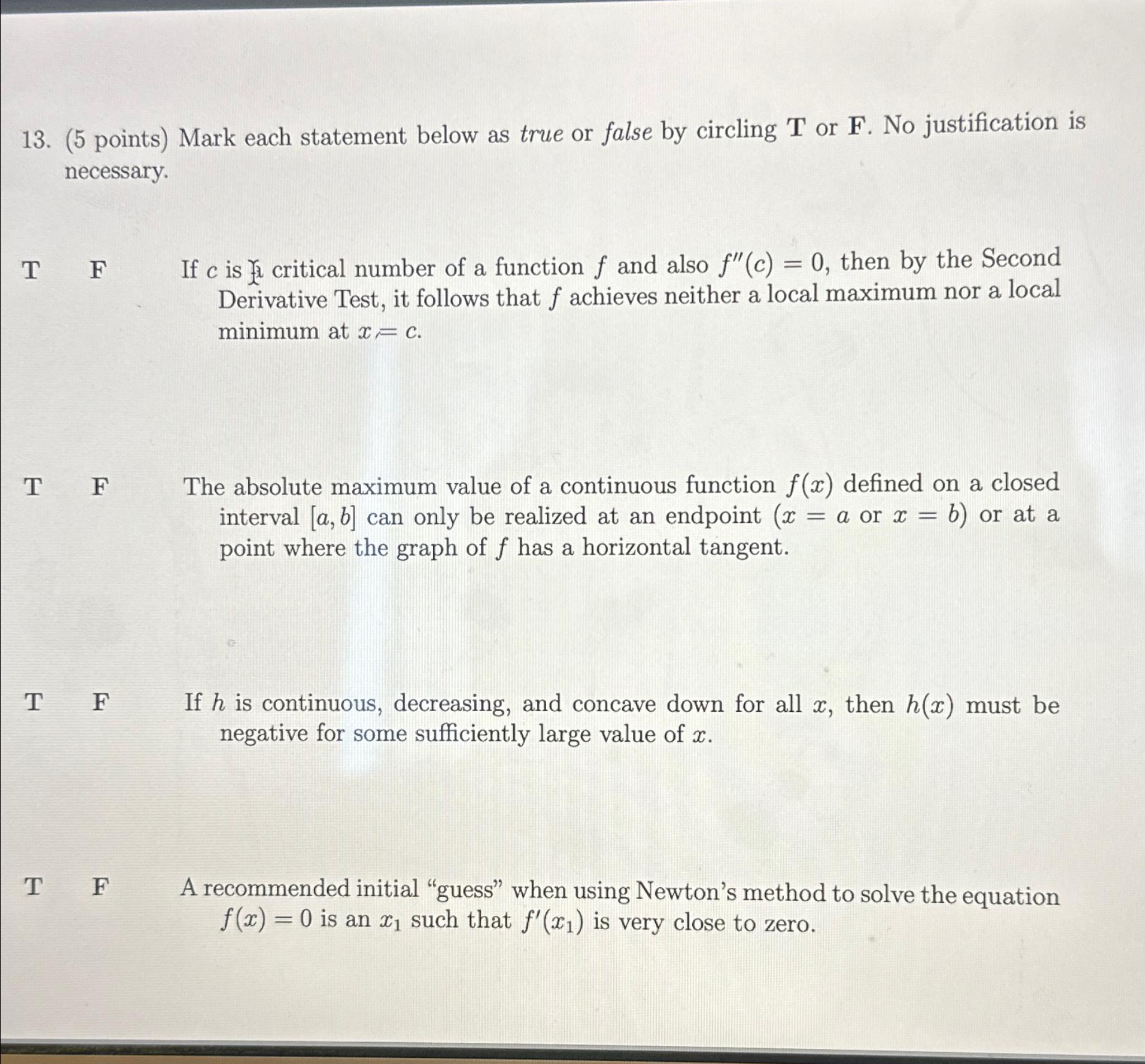
13. (5 points) Mark each statement below as true or false by circling T or F. No justification is necessary. T I c is critical number of a function f and also f(c)=0, then by the Second Derivative Test, it follows that f achieves neither a local maximum nor a local minimum at x=c. T F The absolute maximum value of a continuous function f(x) defined on a closed interval [a,b] can only be realized at an endpoint (x=a or x=b) or at a point where the graph of f has a horizontal tangent. T If h is continuous, decreasing, and concave down for all x, then h(x) must be negative for some sufficiently large value of x. T F A recommended initial "guess" when using Newton's method to solve the equation f(x)=0 is an x1 such that f(x1) is very close to zero
Step by Step Solution
There are 3 Steps involved in it

Get step-by-step solutions from verified subject matter experts
 Study Help