







Question: 5. Problem 3.15 (Income Statement) eBook Problem Walk-Through Edmonds Industries is forecasting the following income statement: Sales Operating costs excluding depreciation & amortization $6,000,000 3,300,000
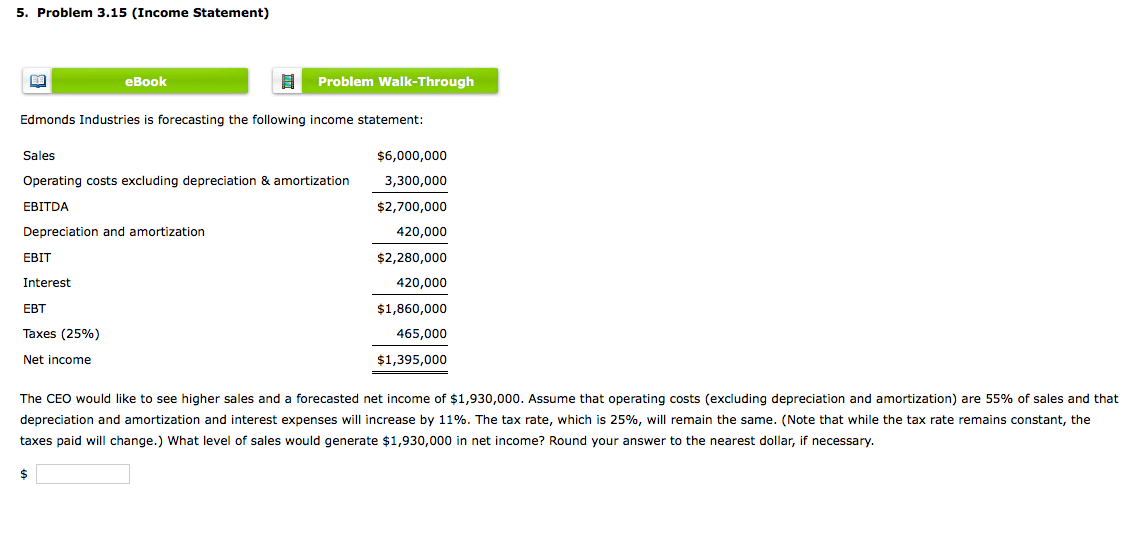
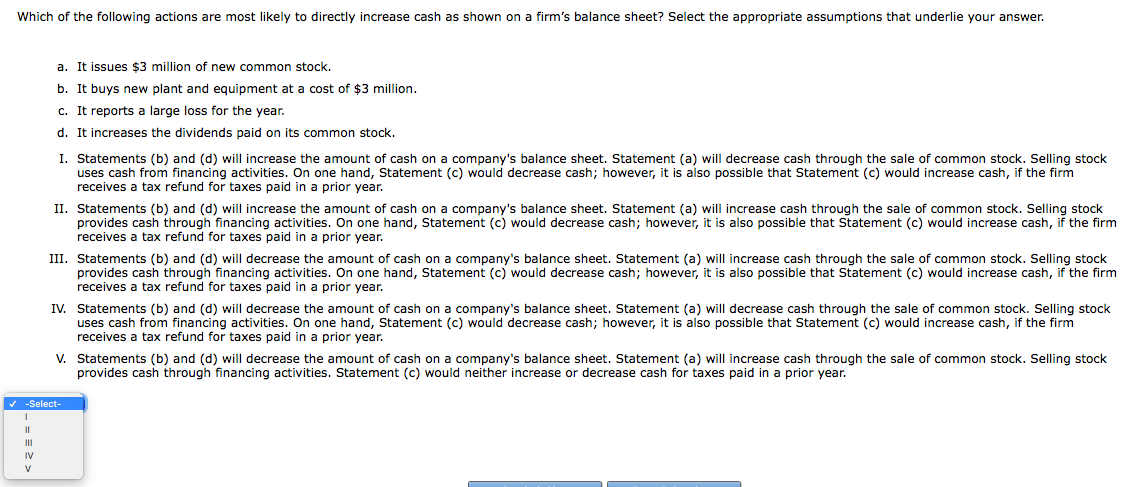
5. Problem 3.15 (Income Statement) eBook Problem Walk-Through Edmonds Industries is forecasting the following income statement: Sales Operating costs excluding depreciation & amortization $6,000,000 3,300,000 $2,700,000 420,000 EBITDA Depreciation and amortization EBIT $2,280,000 Interest 420,000 EBT $1,860,000 465,000 Taxes (25%) Net income $1,395,000 The CEO would like to see higher sales and a forecasted net income of $1,930,000. Assume that operating costs (excluding depreciation and amortization) are 55% of sales and that depreciation and amortization and interest expenses will increase by 11%. The tax rate, which is 25%, will remain the same. (Note that while the tax rate remains constant, the taxes paid will change.) What level of sales would generate $1,930,000 in net income? Round your answer to the nearest dollar, if necessary. Which of the following actions are most likely to directly increase cash as shown on a firm's balance sheet? Select the appropriate assumptions that underlie your answer. a. It issues $3 million of new common stock. b. It buys new plant and equipment at a cost of $3 million. C. It reports a large loss for the year. d. It increases the dividends paid on its common stock. 1. Statements (b) and (d) will increase the amount of cash on a company's balance sheet. Statement (a) will decrease cash through the sale of common stock. Selling stock uses cash from financing activities. On one hand, Statement (c) would decrease cash; however, it is also possible that Statement (c) would increase cash, if the firm receives a tax refund for taxes paid in a prior year. II. Statements (b) and (d) will increase the amount of cash on a company's balance sheet. Statement (a) will increase cash through the sale of common stock. Selling stock provides cash through financing activities. On one hand, Statement (C) would decrease cash; however, it is also possible that Statement (c) would increase cash, if the firm receives a tax refund for taxes paid in a prior year. III. Statements (b) and (d) will decrease the amount of cash on a company's balance sheet. Statement (a) will increase cash through the sale of common stock. Selling stock provides cash through financing activities. On one hand, Statement (c) would decrease cash; however, it is also possible that Statement (c) would increase cash, if the firm receives a tax refund for taxes paid in a prior year. IV. Statements (b) and (d) will decrease the amount of cash on a company's balance sheet. Statement (a) will decrease cash through the sale of common stock. Selling stock uses cash from financing activities. On one hand, Statement (C) would decrease cash; however, it is also possible that Statement (C) would increase cash, if the firm receives a tax refund for taxes paid in a prior year. V. Statements (b) and (d) will decrease the amount of cash on a company's balance sheet. Statement (a) will increase cash through the sale of common stock. Selling stock provides cash through financing activities. Statement (c) would neither increase or decrease cash for taxes paid in a prior year. -Select
Step by Step Solution
There are 3 Steps involved in it

Get step-by-step solutions from verified subject matter experts
 Study Help