







Question: 5) This question is about the two (_ a E dimensional Bravais lattice shown with blue __ _ _ _ o___.__..___.__.__ dots Indicating lattice
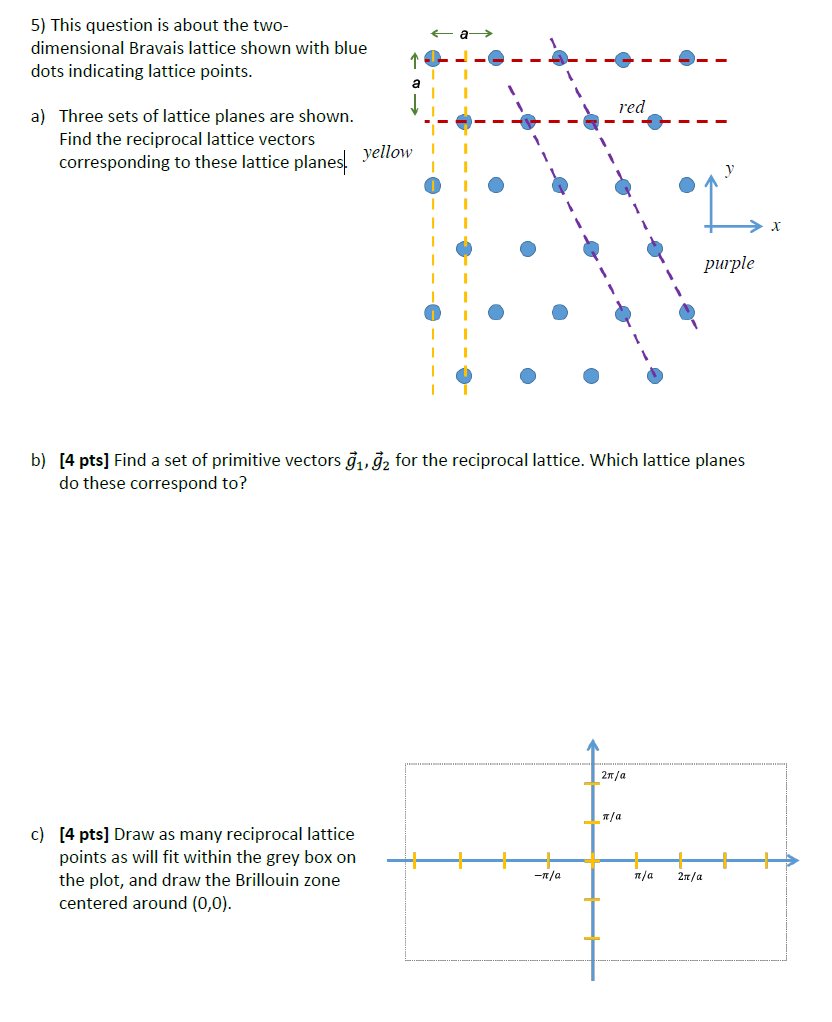
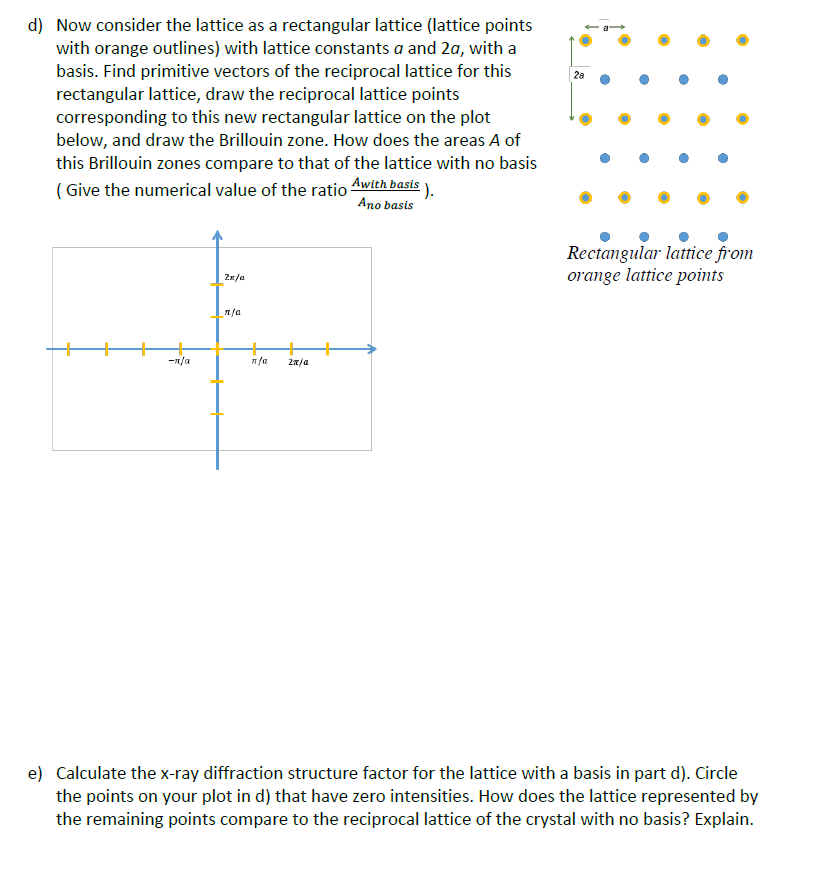
5) This question is about the two (_ a E \\ dimensional Bravais lattice shown with blue __ _ _ _ o___.__..___.__.__ dots Indicating lattice pomts. 1 \\ l ' ' a] Three sets of lattice planes are shown. . _ Q- _ 2.. _ _ i 330:... _ _ _ Find the reciprocal lattice vectors \\ \\ . . yellow corresponding to these lattice planesl o 0 lb it o 'T 0 . \\' \\Q I>x \\ \\ pm'ple b] [4 pts] Find a set of primitive vectors vz for the reciprocal lattice. Which lattice planes do these correspond to? c] [4 pts] Draw as many reciprocal lattice points as will fit within the grey box on _____._____>. the plot, and draw the Brillouin zone m centered around (0,0). ' d) Now consider the lattice as a rectangular lattice (lattice points with orange outlines) with lattice constants a and 2a, with a basis. Find primitive vectors of the reciprocal lattice for this 28 rectangular lattice, draw the reciprocal lattice points corresponding to this new rectangular lattice on the plot below, and draw the Brillouin zone. How does the areas A of this Brillouin zones compare to that of the lattice with no basis ( Give the numerical value of the ratio with basis ) Ano basis Rectangular lattice from 2x/a orange lattice points e) Calculate the x-ray diffraction structure factor for the lattice with a basis in part d). Circle the points on your plot in d) that have zero intensities. How does the lattice represented by the remaining points compare to the reciprocal lattice of the crystal with no basis? Explain
Step by Step Solution
There are 3 Steps involved in it

Get step-by-step solutions from verified subject matter experts
 Study Help