







Question: 5. Two packet streams arrive at a node with rates 1M packets/sec (Stream 1) and 1.55M packets/sec (Stream 2), respectively. They are then sent to
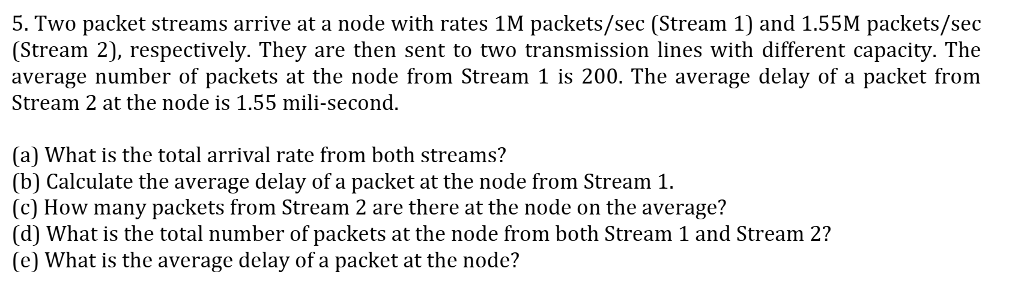
5. Two packet streams arrive at a node with rates 1M packets/sec (Stream 1) and 1.55M packets/sec (Stream 2), respectively. They are then sent to two transmission ines with different capacity. The average number of packets at the node from Stream 1 is 200. The average delay of a packet from Stream 2 at the node is 1.55 mili-second. (a) What is the total arrival rate from both streams? (b) Calculate the average delay of a packet at the node from Stream 1. (c) How many packets from Stream 2 are there at the node on the average? (d) What is the total number of packets at the node from both Stream 1 and Stream 27 (e) What is the average delay of a packet at the node? 5. Two packet streams arrive at a node with rates 1M packets/sec (Stream 1) and 1.55M packets/sec (Stream 2), respectively. They are then sent to two transmission ines with different capacity. The average number of packets at the node from Stream 1 is 200. The average delay of a packet from Stream 2 at the node is 1.55 mili-second. (a) What is the total arrival rate from both streams? (b) Calculate the average delay of a packet at the node from Stream 1. (c) How many packets from Stream 2 are there at the node on the average? (d) What is the total number of packets at the node from both Stream 1 and Stream 27 (e) What is the average delay of a packet at the node
Step by Step Solution
There are 3 Steps involved in it

Get step-by-step solutions from verified subject matter experts
 Study Help