







Question: 5. Use the Independent Samples Test table as well as your findings for the mean and SDs (from questions #1 and #2) and the tnTest
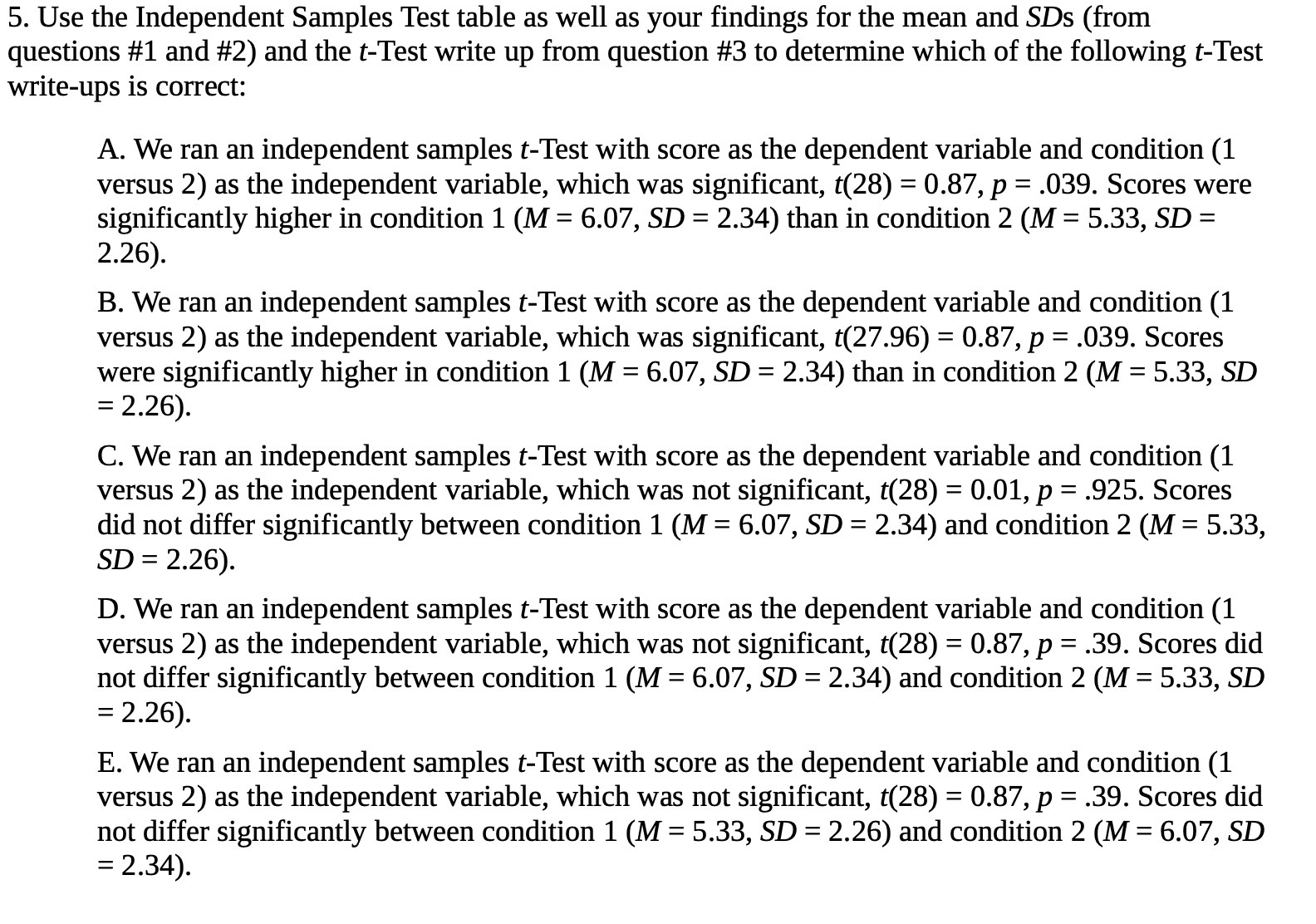
5. Use the Independent Samples Test table as well as your findings for the mean and SDs (from questions #1 and #2) and the tnTest write up from question #3 to determine which of the following t-Test write-ups is correct: A. We ran an independent samples tTest with score as the dependent variable and condition (1 versus 2) as the independent variable, which was significant, t(28) = 0.87, p = .039. Scores were significantly higher in condition 1 (M = 6.07, SD = 2.34) than in condition 2 (M = 5.33, SD = 2.26). B. We ran an independent samples tTest with score as the dependent variable and condition (1 versus 2) as the independent variable, which was significant, t(27.96) = 0.87, p = .039. Scores were significantly higher in condition 1 (M = 6.07, SD = 2.34) than in condition 2 (M = 5.33, SD = 2.26). C. We ran an independent samples t-Test with score as the dependent variable and condition (1 versus 2) as the independent variable, which was not significant, t(28) = 0.01, p = .925. Scores did not differ significantly between condition 1 (M = 6.07, SD = 2.34) and condition 2 (M = 5.33, SD = 2.26). D. We ran an independent samples t-Test with score as the dependent variable and condition (1 versus 2) as the independent variable, which was not significant, t(28) = 0.87, p = .39. Scores did not differ significantly between condition 1 (M = 6.07, SD = 2.34) and condition 2 (M = 5.33, SD = 2.26). E. We ran an independent samples tTest with score as the dependent variable and condition (1 versus 2) as the independent variable, which was not significant, t(28) = 0.87, p = .39. Scores did not differ significantly between condition 1 (M = 5.33, SD = 2.26) and condition 2 (M = 6.07, SD = 2.34)
Step by Step Solution
There are 3 Steps involved in it

Get step-by-step solutions from verified subject matter experts
 Study Help