



Question: 5.24 An additive process model is depicted in the figure below. For G1=s1,G2=2s+14,G3=s+13,U(s)=1 (unit impulse) a. Derive the response Y(s) and describe y(t) quantitatively. b.
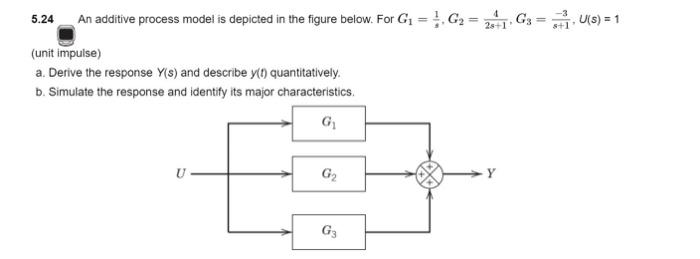
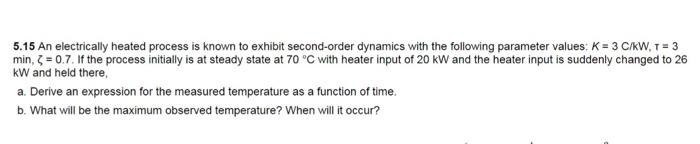
5.24 An additive process model is depicted in the figure below. For G1=s1,G2=2s+14,G3=s+13,U(s)=1 (unit impulse) a. Derive the response Y(s) and describe y(t) quantitatively. b. Simulate the response and identify its major characteristics. 5.15 An electrically heated process is known to exhibit second-order dynamics with the following parameter values: K=3C/kW, T=3 min,=0.7. If the process initially is at steady state at 70C with heater input of 20kW and the heater input is suddenly changed to 26 kW and held there, a. Derive an expression for the measured temperature as a function of time. b. What will be the maximum observed temperature? When will it occur? 5.24 An additive process model is depicted in the figure below. For G1=s1,G2=2s+14,G3=s+13,U(s)=1 (unit impulse) a. Derive the response Y(s) and describe y(t) quantitatively. b. Simulate the response and identify its major characteristics. 5.15 An electrically heated process is known to exhibit second-order dynamics with the following parameter values: K=3C/kW, T=3 min,=0.7. If the process initially is at steady state at 70C with heater input of 20kW and the heater input is suddenly changed to 26 kW and held there, a. Derive an expression for the measured temperature as a function of time. b. What will be the maximum observed temperature? When will it occur
Step by Step Solution
There are 3 Steps involved in it

Get step-by-step solutions from verified subject matter experts