







Question: 5.6. Ambipolar Diffusion in Parallel Plate Geometry A highly collisional rf discharge is ignited between two parallel electrodes located at x=l/2. Assume a constant ion-neutral
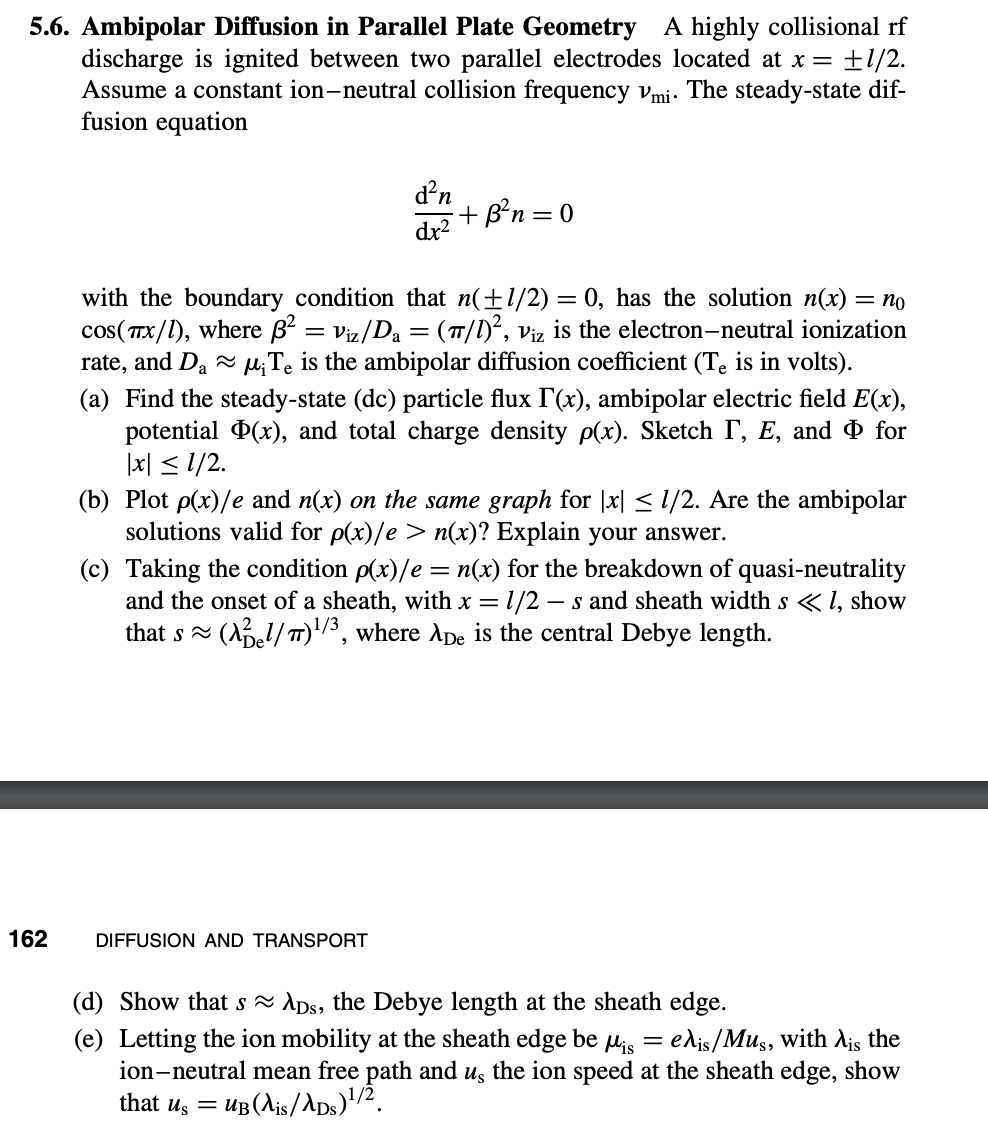
5.6. Ambipolar Diffusion in Parallel Plate Geometry A highly collisional rf discharge is ignited between two parallel electrodes located at x=l/2. Assume a constant ion-neutral collision frequency vmi. The steady-state diffusion equation dx2d2n+2n=0 with the boundary condition that n(l/2)=0, has the solution n(x)=n0 cos(x/l), where 2=viz/Da=(/l)2,iz is the electron-neutral ionization rate, and DaiTe is the ambipolar diffusion coefficient ( Te is in volts). (a) Find the steady-state (dc) particle flux (x), ambipolar electric field E(x), potential (x), and total charge density (x). Sketch ,E, and for xl/2. (b) Plot (x)/e and n(x) on the same graph for xl/2. Are the ambipolar solutions valid for (x)/e>n(x) ? Explain your answer. (c) Taking the condition (x)/e=n(x) for the breakdown of quasi-neutrality and the onset of a sheath, with x=l/2s and sheath width sl, show that s(De2l/)1/3, where De is the central Debye length. DIFFUSION AND TRANSPORT (d) Show that sDs, the Debye length at the sheath edge. (e) Letting the ion mobility at the sheath edge be is=eis/Mus, with is the ion-neutral mean free path and us the ion speed at the sheath edge, show that us=uB(is/Ds)1/2
Step by Step Solution
There are 3 Steps involved in it

Get step-by-step solutions from verified subject matter experts
 Study Help