



Question: 5-7. Transient Diffusion in a Film with a First-Order Reaction Consider transient diffusion in a liquid or solid film with a first-order, irreversible reaction. As
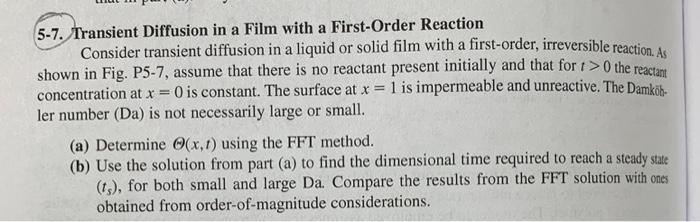
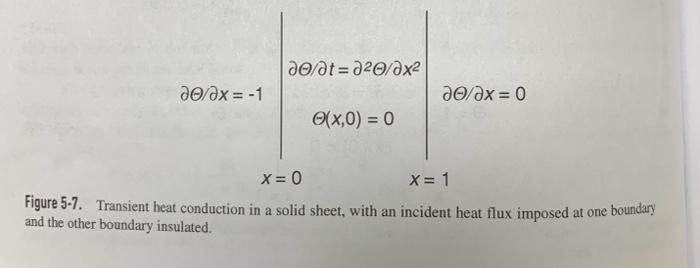
5-7. Transient Diffusion in a Film with a First-Order Reaction Consider transient diffusion in a liquid or solid film with a first-order, irreversible reaction. As shown in Fig. P5-7, assume that there is no reactant present initially and that for t>0 the reactant concentration at x=0 is constant. The surface at x=1 is impermeable and unreactive. The Damkbler number (Da) is not necessarily large or small. (a) Determine (x,t) using the FFT method. (b) Use the solution from part (a) to find the dimensional time required to reach a steady state (ts), for both small and large Da. Compare the results from the FFT solution with ones obtained from order-of-magnitude considerations. Figure 5-7. Transient heat conduction in a solid sheet, with an incident heat flux imposed at one boundary and the other boundary insulated. 5-7. Transient Diffusion in a Film with a First-Order Reaction Consider transient diffusion in a liquid or solid film with a first-order, irreversible reaction. As shown in Fig. P5-7, assume that there is no reactant present initially and that for t>0 the reactant concentration at x=0 is constant. The surface at x=1 is impermeable and unreactive. The Damkbler number (Da) is not necessarily large or small. (a) Determine (x,t) using the FFT method. (b) Use the solution from part (a) to find the dimensional time required to reach a steady state (ts), for both small and large Da. Compare the results from the FFT solution with ones obtained from order-of-magnitude considerations. Figure 5-7. Transient heat conduction in a solid sheet, with an incident heat flux imposed at one boundary and the other boundary insulated
Step by Step Solution
There are 3 Steps involved in it

Get step-by-step solutions from verified subject matter experts