







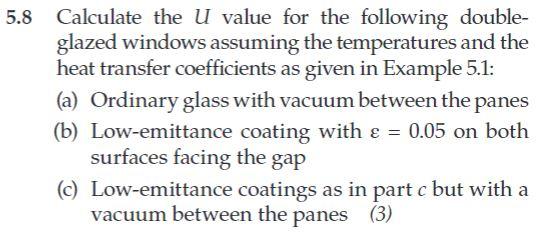
Question: 5.8 Calculate the U value for the following double- glazed windows assuming the temperatures and the heat transfer coefficients as given in Example 5.1:
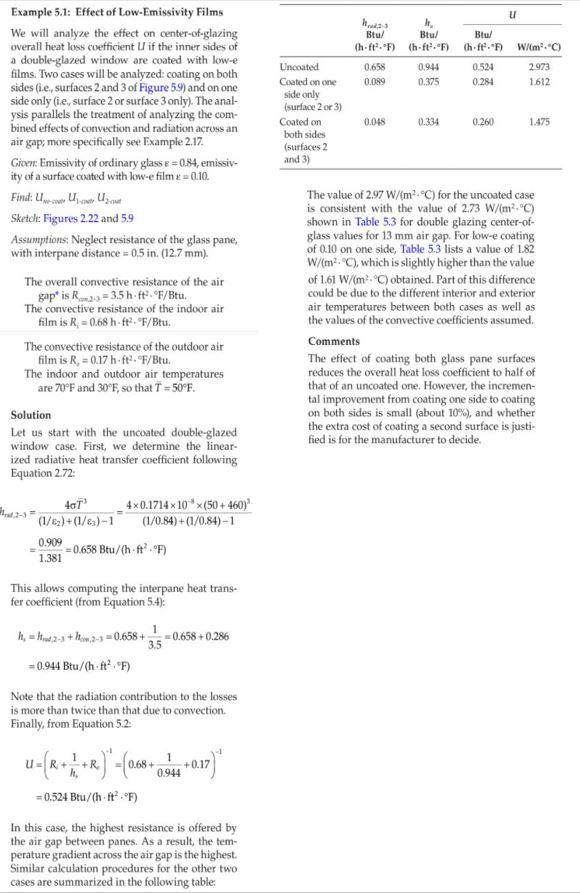
5.8 Calculate the U value for the following double- glazed windows assuming the temperatures and the heat transfer coefficients as given in Example 5.1: (a) Ordinary glass with vacuum between the panes (b) Low-emittance coating with = 0.05 on both surfaces facing the gap (c) Low-emittance coatings as in part c but with a vacuum between the panes (3) Example 5.1: Effect of Low-Emissivity Films We will analyze the effect on center-of-glazing overall heat loss coefficient U if the inner sides of a double-glazed window are coated with low-e films. Two cases will be analyzed: coating on both sides (i.e., surfaces 2 and 3 of Figure 5.9) and on one side only (ie, surface 2 or surface 3 only). The anal- ysis parallels the treatment of analyzing the com- bined effects of convection and radiation across an air gap; more specifically see Example 2.17. Given: Emissivity of ordinary glass e=0.84, emissiv- ity of a surface coated with low-e filme=0.10. Find: U U U e-co Sketch: Figures 2.22 and 5.9 Assumptions: Neglect resistance of the glass pane, with interpane distance = 0.5 in. (12.7 mm). The overall convective resistance of the air gap is R2-3-3.5 h ft F/Btu.. The convective resistance of the indoor air film is R, = 0.68 h-ft- "F/Btu. The convective resistance of the outdoor air film is R, = 0.17 h-ft-F/Btu. The indoor and outdoor air temperatures are 70F and 30F, so that T = 50F. Solution Let us start with the uncoated double-glazed window case. First, we determine the linear- ized radiative heat transfer coefficient following Equation 2.72: 407 (1/6)+(1/3)-1 0.909 1.381 4x0.171410 (50+460) (1/0.84)+(1/0.84)-1 =0.658 Btu/(h-ft F) This allows computing the interpane heat trans- fer coefficient (from Equation 5.4): ht=2-3+2-3-0.658+ = 0.658+0.286 1 3.5 = 0.944 Btu/(h-ft.F) Note that the radiation contribution to the losses is more than twice than that due to convection. Finally, from Equation 5.2: U=(R + 1 + R) - (0.68 +0 = 0.524 Btu/(h-ft F) 1 0.944 +0.17) In this case, the highest resistance is offered by the air gap between panes. As a result, the tem- perature gradient across the air gap is the highest. Similar calculation procedures for the other two cases are summarized in the following table Uncoated Coated on one side only (surface 2 or 3) Coated on both sides (surfaces 2 and 3) -3 Btu/ (h-ft-F) 0.658 0.089 0.048 h, Btu/ (h-ft-F) 0.944 0.375 0.334 Btu/ (h-ft-"F) 0.524 0.284 0.260 u W/(m.C) 2.973 1.612 1.475 The value of 2.97 W/(m C) for the uncoated case is consistent with the value of 2.73 W/(m.C) shown in Table 5.3 for double glazing center-of- glass values for 13 mm air gap. For low-e coating of 0.10 on one side, Table 5.3 lists a value of 1.82 W/(mC), which is slightly higher than the value of 1.61 W/(m. C) obtained. Part of this difference could be due to the different interior and exterior air temperatures between both cases as well as the values of the convective coefficients assumed. Comments The effect of coating both glass pane surfaces reduces the overall heat loss coefficient to half of that of an uncoated one. However, the incremen- tal improvement from coating one side to coating on both sides is small (about 10%), and whether the extra cost of coating a second surface is justi- fied is for the manufacturer to decide.
Step by Step Solution
There are 3 Steps involved in it

Get step-by-step solutions from verified subject matter experts
 Study Help