







Question: 6. (5 points) True/false. Give a brief explanation/counterexample for each part. (i) If f,g: R2 + R are continuous, f(x,z) y(x). { = yo (ii)
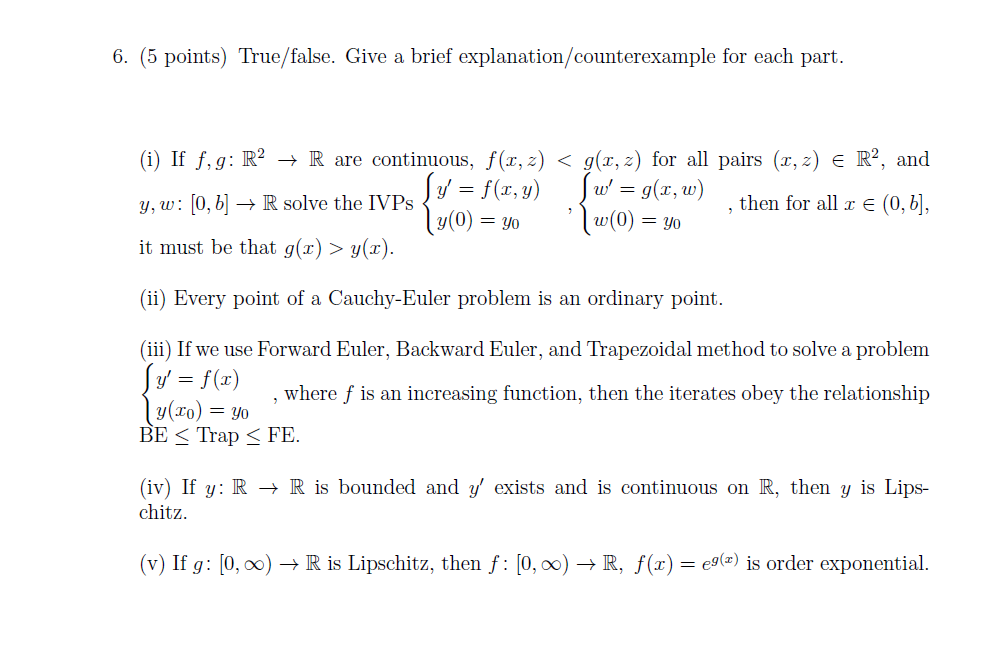
6. (5 points) True/false. Give a brief explanation/counterexample for each part. (i) If f,g: R2 + R are continuous, f(x,z) y(x). { = yo (ii) Every point of a Cauchy-Euler problem is an ordinary point. (iii) If we use Forward Euler, Backward Euler, and Trapezoidal method to solve a problem Sy' = f(x) where f is an increasing function, then the iterates obey the relationship 1 y(x0) = yo BE (iv) If y: R + R is bounded and y exists and is continuous on R, then y is Lips- chitz. (v) If g: [0,00) + R is Lipschitz, then f : [0,00) + R, f(x) = 9(a) is order exponential. 6. (5 points) True/false. Give a brief explanation/counterexample for each part. (i) If f,g: R2 + R are continuous, f(x,z) y(x). { = yo (ii) Every point of a Cauchy-Euler problem is an ordinary point. (iii) If we use Forward Euler, Backward Euler, and Trapezoidal method to solve a problem Sy' = f(x) where f is an increasing function, then the iterates obey the relationship 1 y(x0) = yo BE (iv) If y: R + R is bounded and y exists and is continuous on R, then y is Lips- chitz. (v) If g: [0,00) + R is Lipschitz, then f : [0,00) + R, f(x) = 9(a) is order exponential
Step by Step Solution
There are 3 Steps involved in it

Get step-by-step solutions from verified subject matter experts
 Study Help