Question: (6) A metropolitan area is facing a serious problem with disposing of its waste. Its current landfill is almost full and it is looking for
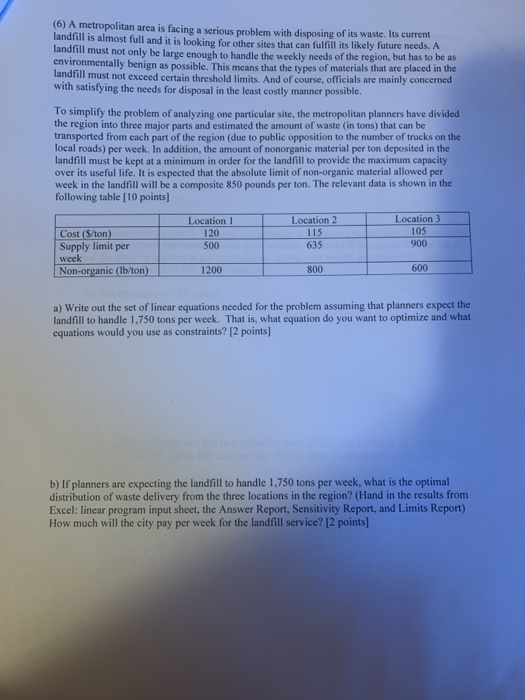
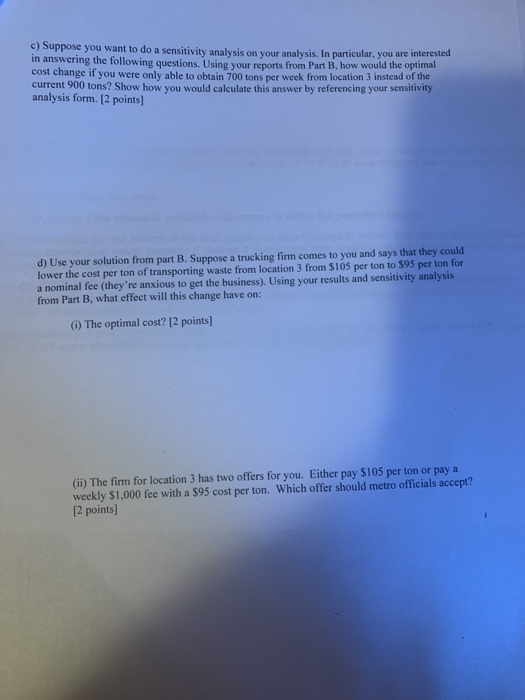
(6) A metropolitan area is facing a serious problem with disposing of its waste. Its current landfill is almost full and it is looking for other sites that can fulfill its likely future needs. A landfill must not only be large enough to handle the weekly needs of the region, but has to be as environmentally benign as possible. This means that the types of materials that are placed in the landfill must not exceed certain threshold limits. And of course, officials are mainly concerned with satisfying the needs for disposal in the least costly manner possible. To simplify the problem of analyzing one particular site, the metropolitan planners have divided the region into three major parts and estimated the amount of waste (in tons) that can be transported from each part of the region (due to public opposition to the number of trucks on the local roads) per week. In addition, the amount of nonorganic material per ton deposited in the landfill must be kept at a minimum in order for the landfill to provide the maximum capacity over its useful life. It is expected that the absolute limit of non-organic material allowed per week in the landfill will be a composite 850 pounds per ton. The relevant data is shown in the following table [10 points] Location 3 Location 2 Location I Cost (S/ton) Supply limit per week 105 900 120 115 635 500 600 Non-organic (Ib/ton) 1200 800 a) Write out the set of linear equations needed for the problem assuming that planners expect the landfill to handle 1,750 tons per week. That is, what equation do you want to optimize and what equations would you use as constraints? [2 points] b) If planners are expecting the landfill to handle 1,750 tons per week, what is the optimal distribution of waste delivery from the three locations in the region? (Hand in the results from Excel: linear program input sheet, the Answer Report, Sensitivity Report, and Limits Report) How much will the city pay per week for the landfill service? [2 points] c) Suppose you want to do a sensitivity analysis on your analysis. In particular, you are interested in answering the following questions. Using your reports from Part B, how would the optimal cost change if you were only able to obtain 700 tons per week from location 3 instead of the current 900 tons? Show how you would calculate this answer by referencing your sensitivity analysis form. [2 points] d) Use your solution from part B. Suppose a trucking firm comes to you and says that they could lower the cost per ton of transporting waste from location 3 from $105 per ton to $95 per ton for a nominal fee (they're anxious to get the business). Using your results and sensitivity analysis from Part B, what effect will this change have on: (1) The optimal cost? [2 points] (ii) The firm for location 3 has two offers for you. Either pay $105 per ton or pay a weekly $1,000 fee with a $95 cost per ton. Which offer should metro officials accept? [2 points] (6) A metropolitan area is facing a serious problem with disposing of its waste. Its current landfill is almost full and it is looking for other sites that can fulfill its likely future needs. A landfill must not only be large enough to handle the weekly needs of the region, but has to be as environmentally benign as possible. This means that the types of materials that are placed in the landfill must not exceed certain threshold limits. And of course, officials are mainly concerned with satisfying the needs for disposal in the least costly manner possible. To simplify the problem of analyzing one particular site, the metropolitan planners have divided the region into three major parts and estimated the amount of waste (in tons) that can be transported from each part of the region (due to public opposition to the number of trucks on the local roads) per week. In addition, the amount of nonorganic material per ton deposited in the landfill must be kept at a minimum in order for the landfill to provide the maximum capacity over its useful life. It is expected that the absolute limit of non-organic material allowed per week in the landfill will be a composite 850 pounds per ton. The relevant data is shown in the following table [10 points] Location 3 Location 2 Location I Cost (S/ton) Supply limit per week 105 900 120 115 635 500 600 Non-organic (Ib/ton) 1200 800 a) Write out the set of linear equations needed for the problem assuming that planners expect the landfill to handle 1,750 tons per week. That is, what equation do you want to optimize and what equations would you use as constraints? [2 points] b) If planners are expecting the landfill to handle 1,750 tons per week, what is the optimal distribution of waste delivery from the three locations in the region? (Hand in the results from Excel: linear program input sheet, the Answer Report, Sensitivity Report, and Limits Report) How much will the city pay per week for the landfill service? [2 points] c) Suppose you want to do a sensitivity analysis on your analysis. In particular, you are interested in answering the following questions. Using your reports from Part B, how would the optimal cost change if you were only able to obtain 700 tons per week from location 3 instead of the current 900 tons? Show how you would calculate this answer by referencing your sensitivity analysis form. [2 points] d) Use your solution from part B. Suppose a trucking firm comes to you and says that they could lower the cost per ton of transporting waste from location 3 from $105 per ton to $95 per ton for a nominal fee (they're anxious to get the business). Using your results and sensitivity analysis from Part B, what effect will this change have on: (1) The optimal cost? [2 points] (ii) The firm for location 3 has two offers for you. Either pay $105 per ton or pay a weekly $1,000 fee with a $95 cost per ton. Which offer should metro officials accept? [2 points]









 Study Help